Red dot sight reviews
SIG SAUER Romeo5 Gen II Review
Quick answer
The SIG SAUER Romeo5 Gen II at $128.98 earns its place through MOTAC motion activation, which SIG publishes as 40,000 hours of runtime by shutting the dot off whenever the rifle sits still and waking it instantly the moment it moves.
A published battery-life number on a red dot sight only tells half the story. The other half is whether that number assumes the sight is left switched on continuously, or whether the sight is smart enough to switch itself off. The SIG SAUER Romeo5 Gen II is built almost entirely around the second answer: SIG's MOTAC system senses motion and powers the dot down automatically when the rifle is stored, which is a different product than a sight you have to remember to turn off.
This review is built from SIG's own published specifications for the Romeo5 Gen II, the exact MOA subtension arithmetic its 2 MOA dot allows, and the consensus of verified owner reviews describing how MOTAC behaves after months in storage. We did not test this sight in person.
On this page
- How big is the 2 MOA dot actually, in inches, at real distances?
- What does MOTAC actually change about the published battery figure?
- What does owner-review consensus say about MOTAC after months in storage?
- The limitation MOTAC does not fix: astigmatism and a proprietary mount
- A cheaper motion-activated option, and a durability step up instead
How big is the 2 MOA dot actually, in inches, at real distances?
The working
dot diameter = MOA x 1.047 x (range in yards / 100)
Exact trigonometry from the published 2 MOA dot size. Exit pupil does not apply to a 1x reflex sight, so dot subtension is the real precision ceiling worth computing here.
The 2 MOA dot covers 2.09 inches at 100 yards and 4.19 inches at 200, which is the hard precision ceiling of this sight regardless of how clean the glass looks.
Sourced figure
| Distance | Dot diameter |
|---|---|
| 100 yd | 2.09 in |
| 200 yd | 4.19 in |
See the full reticle subtension chart for how a 2 MOA dot compares against a 4 MOA dot and a 65 MOA circle at the same distances.
What does MOTAC actually change about the published battery figure?
A red dot's battery rating is only meaningful next to how the sight manages power. Comparing the published figures side by side across four sights on this site shows why MOTAC changes the practical answer more than the raw hour count does.
The Romeo5 Gen II publishes fewer raw hours than the SPARC or the 510C, but MOTAC means those hours are spent almost entirely while the rifle is actually being used rather than sitting in a safe.
Sourced figure
| Sight | Published battery life | Power management |
|---|---|---|
| SIG Romeo5 Gen II | 40,000 hours | MOTAC: shuts off when still, wakes on motion |
| Vortex SPARC Gen II | Up to 50,000 hours (lowest setting) | Manual on and off only |
| Holosun 510C | Up to 50,000 hours | Shake Awake plus solar failsafe |
| Aimpoint PRO | Over 30,000 hours (3+ years) | Left on continuously, no motion sensor needed |
Figures are each manufacturer's own published rating and are not directly comparable brightness-for-brightness, since each brand tests at a different setting. The power management column is the more useful comparison for a sight that lives on a stored rifle.
What does owner-review consensus say about MOTAC after months in storage?
The recurring positive theme matches SIG's own claim closely: owners consistently describe picking up a rifle that has sat untouched for weeks and finding the dot already lit and waiting within a fraction of a second of the first movement, with no dead battery on a sight that was never manually switched off. The parallax-free optical design and the fully multi-coated lens also draw repeated praise for a clear sight picture across a wide range of head positions.
The recurring caution is about the mount: the Romeo5 Gen II ships on SIG's own I-BEAM mount rather than a widely adopted third-party footprint, so owners who want to swap to a different low-profile or absolute co-witness mount have fewer off-the-shelf options than they would with a common open-reflex footprint.
The limitation MOTAC does not fix: astigmatism and a proprietary mount
MOTAC solves battery management. It does not solve the fact that a red dot is a point source of light, and an astigmatic eye smears any point source into a star or a comma shape rather than a clean dot, regardless of brand or price. This is true of every red dot on this site, not a defect specific to the Romeo5, and it is worth knowing before buying one: if a red dot has always looked fuzzy or doubled to you, the sight is not at fault. A prism sight with an etched glass reticle, reviewed on the red dot against prism sight comparison, is the standard fix.
The I-BEAM mount is the other real limitation: it works well and includes co-witness height options, but it is SIG's own design rather than the widely supported footprint some other open-reflex sights use, which narrows the aftermarket mount and riser options if you later want to change mounting height.
A cheaper motion-activated option, and a durability step up instead
If MOTAC is the deciding feature and price matters more than the brand, the Vortex Crossfire Red Dot Gen II at $119.99 is a tube-style sight that seals better against weather, though it runs on a simple timer rather than true motion sensing. If durability and a proven duty record matter more than price, the Trijicon MRO HD at $689.99 steps up instead, reviewed separately.
| Model | Price | Magnification | Dot size | Objective lens |
|---|---|---|---|---|
 SIG SAUER ROMEO5 GEN II 1x20 Red Dot Sight SIG SAUER ROMEO5 GEN II 1x20 Red Dot Sight | $128.98 | 1x | 2 MOA | 20 mm |
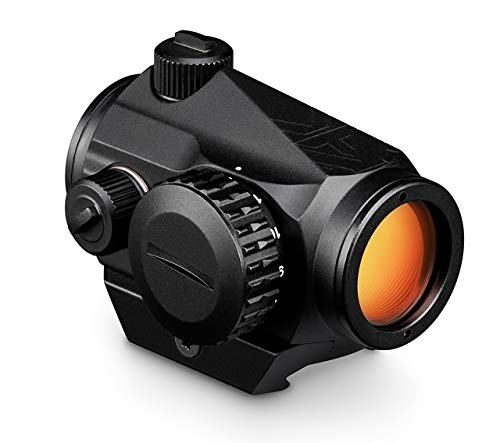 Vortex Crossfire Red Dot Sight Gen II, 2 MOA Red Dot Vortex Crossfire Red Dot Sight Gen II, 2 MOA Red Dot | $119.99 | 1x | 2 MOA | - |
 Trijicon MRO HD 2.0 MOA Red Dot Sight Trijicon MRO HD 2.0 MOA Red Dot Sight | $689.99 | 1x | 2 MOA | 25 mm |
A dash means the manufacturer does not publish that figure. We leave it blank rather than estimating it.
How we chose
We did not test these optics in person and we never claim to. Picks are researched from manufacturer specification sheets, published optical and ballistic formulas, and the recurring themes in verified owner reviews. Every pick is matched to a real objective diameter, a real tube size, a real ring height or a real exit pupil rather than to a price bracket, and it is placed in the tier where its capability actually belongs. Where a figure is shooter convention rather than a sourced number we label it, and where a manufacturer does not publish a figure we leave it out instead of estimating it.
Sources
- SIG SAUER published specifications for the Romeo5 Gen II
- Manufacturer published battery specifications for the comparison sights listed
- Owner-review consensus on MOTAC behaviour after extended storage
Frequently asked questions
What is MOTAC on the SIG Romeo5 Gen II?
SIG's motion-activated illumination system. It powers the dot down automatically after a period without movement and reactivates it instantly when the rifle moves again. SIG publishes an industry-leading 40,000-hour runtime figure for this behaviour under normal use, which assumes the sight spends most of its life switched off in storage rather than continuously lit.
Full spec sheet for the Romeo5 Gen II?
Yes. The published magnification, objective, dot size and MOTAC detail are all listed on the Romeo5 Gen II spec sheet, drawn from the same catalog data used to build this review, so the numbers stay in sync with the current listing.
How big is the 2 MOA dot at 100 and 200 yards?
2.09 inches at 100 yards and 4.19 inches at 200 yards, computed directly from the published 2 MOA dot size. That is the sight's precision ceiling for a deliberate shot, independent of how clean or bright the emitter looks in daylight.
Will an astigmatic eye see the Romeo5's dot cleanly?
Not necessarily. A red dot is a projected point of light, and an astigmatic eye smears any point source into a star shape or a doubled image regardless of brand, price or dot size. This affects every red dot sight, not just this one. A prism sight with an etched glass reticle is the standard alternative for an astigmatic eye.
Does the Romeo5 Gen II use a common mounting footprint?
It ships on SIG's own I-BEAM mount rather than a widely shared third-party open-reflex footprint. The mount includes co-witness height options out of the box, but the aftermarket selection of alternative mounts and risers is narrower than for a sight built on a more common footprint.
Is the Romeo5 Gen II parallax free?
Yes. SIG publishes a parallax-free optical design for this sight, meaning the dot stays on target regardless of where your eye is positioned behind the lens, within the sight's normal field of view. That is standard for a red dot in this class and is separate from the astigmatism issue, which is about the shape of the dot itself rather than its position.
Researched, not professional advice. This page is compiled from published manufacturer specifications, published optical and ballistic formulas, and owner-review consensus, not hands-on testing. Figures described as a rule of thumb are shooter convention rather than sourced numbers, and they are labelled that way wherever they appear. Ballistic figures come from a point mass model using the ballistic coefficient the maker publishes, so treat them as a starting point and confirm them on paper at a measured distance. Confirm your firearm is unloaded with the action open before you mount, level, torque or bore sight anything. Verify a zero only on a supervised range or a safe, legal backstop, know what lies beyond your target, and follow the law where you hunt and shoot, including rules on land access and permitted cartridges.