Reticle focal plane
First Focal Plane or Second Focal Plane?
Quick answer
Buy first focal plane (FFP) if you hold or range at more than one magnification, because its reticle subtension stays correct across the whole zoom range. Buy second focal plane (SFP) if you always shoot at one power, since its reticle is only accurate at that single setting, usually maximum, and costs less.
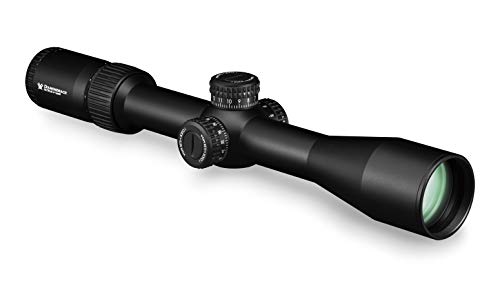
Vortex Diamondback Tactical 4-16x44 First Focal Plane Riflescope, EBR-2C MOA
$399.00 Full specificationsThe EBR-2C reticle grows and shrinks with magnification, so its subtension is correct for holdover or ranging at any power from 4x to 16x, not only at one setting.
Best for: a first precision rifle scope, or a hunting rifle that will be dialled
Check price on Amazon
Vortex Strike Eagle 1-6x24 Second Focal Plane Riflescope, BDC3 MOA
$225.75 Full specificationsThe BDC3 MOA reticle stays a fixed size on the glass at every power, calibrated to be accurate only at 6x, its top magnification.
Best for: a first LPVO on a carbine
Check price on AmazonEvery variable power riflescope puts its reticle in one of two places: in front of the magnifying lens group, where it grows and shrinks with the zoom, or behind it, where it stays a fixed size on the glass no matter what power you dial. The first arrangement is first focal plane, or FFP. The second is second focal plane, or SFP.
This single mechanical difference decides whether a mil dot, a BDC hash mark or a Christmas tree reticle actually measures what it claims to measure at any power you happen to be on, or only at one specific power the manufacturer chose. It is a real functional difference, not a marketing distinction, and the two designs suit genuinely different shooters.
These figures are researched from published manufacturer specifications and standard optical principles, not from a side by side comparison of these particular scopes.
What actually changes between FFP and SFP?
In an FFP scope the reticle sits in the first lens group the image passes through, ahead of the erector and magnifying lenses. As you turn the power ring, the reticle is magnified along with the target, so a mil dot that subtends exactly one mil at 4x still subtends exactly one mil at 16x. It looks noticeably different in size at each end of the zoom, sometimes fine as a hair at the bottom and heavy at the top, but the math behind it never changes.
In an SFP scope the reticle sits behind the magnifying group, in the second focal plane, so it is not touched by the zoom at all. It looks identical at 3x and at 9x. The tradeoff is that its subtension, the actual angular value of each hash mark, is only correct at one power the manufacturer specifies, almost always the top of the zoom range.
What happens to reticle subtension across the zoom range
The working
FFP: reticle subtension is fixed regardless of power, because the reticle scales with the image. SFP: subtension at any power P equals the reticle's stated subtension at its reference power R, multiplied by R / P.
An SFP reticle calibrated at maximum power reads correctly there and reads increasingly wrong as you zoom down from it.
Take a reticle whose hash marks are exactly 1 MOA apart at the reference power. Here is what that same hash mark actually subtends at other magnifications, depending on which focal plane it sits in.
An FFP reticle's 1 MOA hash mark reads 1 MOA at every power. The same reticle in SFP, calibrated at 16x, reads 4 MOA at 4x, four times too coarse to use for a hold.
Sourced figure
| Power | FFP subtension | SFP subtension (calibrated at 16x) |
|---|---|---|
| 4x | 1 MOA | 4 MOA |
| 8x | 1 MOA | 2 MOA |
| 12x | 1 MOA | 1.33 MOA |
| 16x | 1 MOA | 1 MOA |
The SFP column is exact arithmetic: reference power divided by current power, multiplied by the calibrated value. Below the reference power the SFP hash marks read progressively too coarse, and there is no way to compensate except by zooming to the reference power first.
Why FFP scopes cost more
Putting the reticle ahead of the magnifying group means it has to be etched onto glass precisely enough to stay legible and centred through the entire mechanical travel of the zoom, rather than sitting on a fixed lens behind it. That is a harder part to manufacture consistently, and it shows up in price: FFP is the near-universal choice on long range and precision scopes, where the ability to hold or range at any power is worth paying for, but it is rarely the cheapest option in a given lineup.
When SFP is the smarter buy, not just the cheaper one
An SFP reticle that stays one size at every power is genuinely easier to see against a busy or dark background at low magnification, since it does not shrink down to a sliver the way an FFP reticle can. It is also the simpler, more forgiving option for a shooter who sets a magnification once and leaves it there, such as most rifles used at a single known distance or with a duplex-style reticle used mainly for a centre hold rather than precise subtension.
Neither design is a compromise choice. FFP earns its price on a scope you actually zoom while ranging or holding. SFP earns its lower price and its reticle visibility on a scope where the zoom is mostly there to help you see the target, not to change your hold.
Sources
- Vortex Optics published specifications
- First and second focal plane reticle placement, standard riflescope optical design
Frequently asked questions
What is the difference between first focal plane and second focal plane?
In first focal plane (FFP), the reticle sits ahead of the magnifying lenses and grows or shrinks with the zoom, so its subtension stays correct at every power. In second focal plane (SFP), the reticle sits behind the magnifying lenses and stays a constant size, so its subtension is only accurate at one specified power, usually the top of the range.
Is FFP or SFP better for long range shooting?
FFP, in almost every case. Long range shooting frequently means dialling or holding at whatever magnification gives the clearest sight picture for the conditions, and an FFP reticle keeps its subtension correct at any of those powers. An SFP reticle would force you back to one specific magnification every time you needed to use the hash marks for a real hold.
Why is my SFP reticle wrong at low power?
Because it is only calibrated at one magnification, almost always the highest. Below that power, every hash mark subtends more than its stated value, in direct proportion to how far below the reference power you are. At half the reference power, a 1 MOA hash mark actually covers 2 MOA. This is expected behaviour, not a defect.
Does FFP or SFP make the reticle harder to see?
FFP reticles shrink at low magnification, which can make a thin duplex or Christmas tree pattern hard to see against a dark background at the bottom of the zoom. SFP reticles stay one size at every power, so a duplex crosshair remains equally visible whether you are at 3x or 9x. This is a real, common reason to choose SFP.
Do I need FFP if I only shoot at one magnification?
Not for the reticle math. If you genuinely set one power and leave it there, an SFP scope's reticle is already correct at that setting as long as it matches the manufacturer's reference power, and you save money over an FFP scope you would rarely use the full range of.
Is FFP always more expensive than SFP?
Within the same product line, almost always, because an FFP reticle is harder to manufacture consistently across the zoom range. Across different lines, a premium SFP scope can still cost more than a budget FFP one. Compare specific models rather than assuming the focal plane alone tells you the price.
Researched, not professional advice. This page is compiled from published manufacturer specifications, published optical and ballistic formulas, and owner-review consensus, not hands-on testing. Figures described as a rule of thumb are shooter convention rather than sourced numbers, and they are labelled that way wherever they appear. Ballistic figures come from a point mass model using the ballistic coefficient the maker publishes, so treat them as a starting point and confirm them on paper at a measured distance. Confirm your firearm is unloaded with the action open before you mount, level, torque or bore sight anything. Verify a zero only on a supervised range or a safe, legal backstop, know what lies beyond your target, and follow the law where you hunt and shoot, including rules on land access and permitted cartridges.