Red Dot Sights
Best Red Dot Sights
Quick answer
The best red dot sight for most shooters is the Aimpoint PRO Red Dot Reflex Sight with QRP2 Mount and Spacer, 2 MOA at $512.00, because Aimpoint publishes about three years of continuous battery life on one AA cell, and battery life left switched on predicts a good red dot far better than dot size ever does.
Two specifications decide whether a red dot is a serious purchase, and neither of them is dot size. The first is published battery life left switched on continuously, because a red dot that has to be turned off between uses is a red dot that gets found dead exactly when it matters. The second is motion activation, which extends real-world battery life further by putting the dot to sleep automatically and waking it the instant the sight moves.
Dot size in MOA gets outsized attention because it is the easiest number to compare on a shelf. A 2 MOA dot covers about 2 inches of the target at 100 yards; a 4 MOA dot covers about 4 inches. That is a real trade between precision at distance and speed up close, but it is a smaller factor in real-world performance than whether the sight is still on when you pick it up.
This roundup is built from published manufacturer specifications and owner-review consensus, not our own hands-on testing.
On this page
Why does battery life left on matter more than dot size?
A red dot with poor battery life trains its owner into a habit that defeats the entire purpose of the sight: turning it off to save the battery. A sight that is off when you pick up the rifle is a sight you have to remember to turn on, which is exactly the delay a red dot exists to remove.
The sights that separate themselves here publish battery life in years on a single common battery, left running continuously at a middle brightness setting, rather than in hours. That is a genuinely different design target, usually achieved with a simple LED reflex design and an efficient circuit rather than more advanced optics, and it is worth more in practice than a smaller dot or a wider field of view.
What does dot size actually cover on the target?
The arithmetic is exact and worth knowing cold: dot size in MOA times 1.047 gives inches covered at 100 yards, and that figure scales linearly with distance.
A 2 MOA dot covers about 2.1 inches at 100 yards, and a 6 MOA dot covers about 6.3 inches at the same distance, so dot size is a real precision trade rather than a marketing number.
Sourced figure
| Dot size (MOA) | At 25 yd (in) | At 50 yd (in) | At 100 yd (in) |
|---|---|---|---|
| 1 MOA | 0.26 | 0.52 | 1.05 |
| 2 MOA | 0.52 | 1.05 | 2.09 |
| 3 MOA | 0.79 | 1.57 | 3.14 |
| 4 MOA | 1.05 | 2.09 | 4.19 |
| 6 MOA | 1.57 | 3.14 | 6.28 |
Calculated directly from 1 MOA equals 1.047 inches at 100 yards, an exact figure from the trigonometry of a minute of angle, scaled linearly to shorter distances.
Tube red dot against open reflex: the weather trade
A tube-style red dot, built like a small scope with a lens at each end, protects both the front and rear glass inside a metal housing. It handles rain, mud, and a knock against gear better than an open design, at the cost of a smaller field of view and a heavier package.
An open reflex sight, with a single exposed lens and no housing around the emitter side, gives a wider field of view and a lighter, lower-profile footprint. The trade is that the single lens is more exposed to rain, fogging, and debris, and a shooter operating in genuinely poor weather feels that difference. Neither design is universally correct; it is a real weather and use-case trade, not a quality difference.
Beginner: a durable first red dot
At this tier the priority is a tube design from an established maker with a real warranty, because a first red dot is frequently mounted, dismounted, and knocked around more than any optic it replaces.
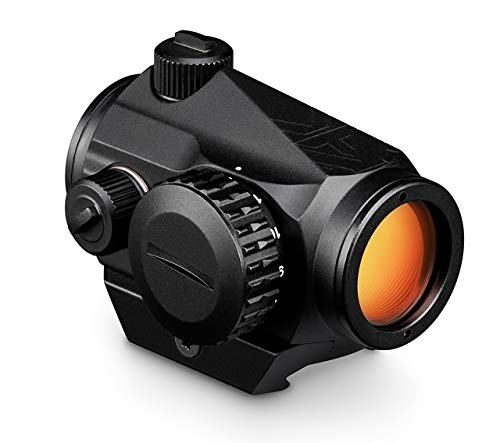
Vortex Crossfire Red Dot Sight Gen II, 2 MOA Red Dot
$119.99A tube-style sight with a transferable lifetime warranty and motion activation, at a price that leaves room in the budget for a proper mount.
Best for: A first AR-pattern build or a home-defense rifle that will be mounted once and left alone.
Check price on AmazonIntermediate: the buy-once pick
Longer published battery life, a wider field of view through an open reflex design, and motion activation that meaningfully extends real-world runtime.

Holosun ARO-CORE Red Dot Sight with Shake Awake, 22mm Window
$119.99Shake-awake motion activation on a wide 22mm window, published battery life measured in years rather than months of continuous use.
Best for: A shooter who wants an open reflex field of view without giving up years of published runtime.
Check price on Amazon
SIG SAUER ROMEO5 GEN II 1x20 Red Dot Sight
$128.98 Full specificationsA tube design at a similar price point, for a shooter who prioritizes weather protection over the wider field of view an open reflex offers.
Best for: Hunting or field use where mud and rain are a real concern.
Check price on AmazonExpert: the performance ceiling
At this tier the housing is machined to a durability standard built for hard duty use, the glass and coatings improve dot clarity, and the electronics add features like multiple reticle patterns without sacrificing published battery life.

Trijicon MRO HD 2.0 MOA Red Dot Sight
$689.99A rugged, forged aluminum housing and a crisp 2 MOA dot with clarity built for a precision co-witnessed use case at a durability standard above most tube designs.
Best for: A duty rifle or a precision-focused build where housing durability and dot clarity outweigh price.
Check price on AmazonWho should not buy this tier: Not for a shooter mounting a red dot on a rimfire plinker or a lightly used range gun. The durability this tier buys is for hard use and real abuse, and a lighter, cheaper sight serves a casual range rifle just as well.
How we chose
We did not test these optics in person and we never claim to. Picks are researched from manufacturer specification sheets, published optical and ballistic formulas, and the recurring themes in verified owner reviews. Every pick is matched to a real objective diameter, a real tube size, a real ring height or a real exit pupil rather than to a price bracket, and it is placed in the tier where its capability actually belongs. Where a figure is shooter convention rather than a sourced number we label it, and where a manufacturer does not publish a figure we leave it out instead of estimating it.
Sources
- Aimpoint published specifications
- Trijicon published specifications
- Holosun published specifications
- Owner-review consensus from defensive and competition shooting forums
Frequently asked questions
What dot size in MOA should I buy?
A 2 MOA dot covers about 2 inches at 100 yards and suits precise shots at distance. A 4 to 6 MOA dot covers 4 to 6 inches at the same range and is faster to find and put on target up close. Neither is universally correct: match the dot size to whether your shooting is mostly close and fast or occasionally at real distance.
How much does battery life actually matter on a red dot?
More than almost any other specification. A sight with poor battery life trains its owner to turn it off between uses, which defeats the purpose entirely: a red dot that is off when you pick up the rifle costs you the exact half-second it exists to save. Look for published battery life measured in years on a common battery, not hours.
What is motion activation and do I need it?
Motion activation, sometimes marketed as shake-awake, puts the sight to sleep after a period of stillness and wakes it instantly when the rifle moves. It extends real battery life dramatically without asking the shooter to remember to turn the sight on, and it is close to a requirement rather than a luxury on a modern red dot.
Should I buy a tube red dot or an open reflex sight?
Choose a tube design if you expect rain, mud, or rough handling, since the enclosed housing protects both lenses. Choose an open reflex design for a wider field of view and a lighter, lower-profile sight, accepting more exposure to weather on the single lens. It is a genuine trade rather than one design being universally better.
Do I need 1 MOA or 2 MOA precision from a red dot?
Most red dots sold as precision options top out around 2 MOA, which is a reasonable ceiling for a non-magnified reflex sight. Chasing a smaller dot than that mostly costs you speed finding the dot in the window without a meaningful precision gain, since your own hold and the target's size are usually the larger sources of group size at that point.
Is a more expensive red dot actually more durable?
Generally yes, and it shows up in the housing material and machining rather than in the optics. A forged aluminum housing built to a hard-use military or duty standard survives drops and impacts that a lighter polymer or thin aluminum housing will not. If the sight lives on a range gun handled gently, that durability margin is rarely worth its price.
Researched, not professional advice. This page is compiled from published manufacturer specifications, published optical and ballistic formulas, and owner-review consensus, not hands-on testing. Figures described as a rule of thumb are shooter convention rather than sourced numbers, and they are labelled that way wherever they appear. Ballistic figures come from a point mass model using the ballistic coefficient the maker publishes, so treat them as a starting point and confirm them on paper at a measured distance. Confirm your firearm is unloaded with the action open before you mount, level, torque or bore sight anything. Verify a zero only on a supervised range or a safe, legal backstop, know what lies beyond your target, and follow the law where you hunt and shoot, including rules on land access and permitted cartridges.