Optic Types
Red Dot Against a Prism Sight
Quick answer
Choose the Swampfox Blade prism if your eye has astigmatism, and the Vortex Crossfire red dot if it does not. A red dot is a point source of light, which an astigmatic eye sees as a smear or a starburst, while a prism's etched glass reticle stays sharp no matter how the eye focuses light, and still works with a dead battery.
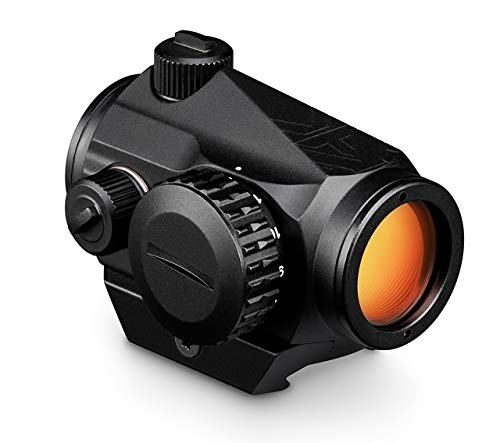
Vortex Crossfire Red Dot Sight Gen II, 2 MOA Red Dot
$119.99A point-source LED dot that is fast and light, but genuinely unusable as a clean dot for a shooter with meaningful astigmatism.
Best for: a red dot used in genuinely bad weather
Check price on Amazon
Swampfox Blade 1x25 Prism Scope, Amber BRC Reticle
$205.00 Full specificationsAn etched glass reticle that stays sharp regardless of how the eye focuses light, and keeps working with a dead battery.
Best for: close range shooting with an astigmatic eye
Check price on AmazonMost comparisons between a red dot and a prism sight start with price or field of view. The comparison that should actually decide it is astigmatism, and it is a real optical fact rather than a matter of taste.
A red dot's illuminated point comes from an LED reflected back to your eye as a single point source of light. If your cornea is not perfectly spherical, which is what astigmatism means in plain terms, that point does not focus to a clean dot on your retina. It smears into a star shape, a blur, or several overlapping images, and no adjustment on the sight fixes it, because the flaw is in the eye, not the optic. This page is built from published manufacturer specifications and owner-review consensus, not our own hands-on testing.
Why does astigmatism ruin a red dot's picture?
A normal cornea focuses light evenly in every direction, so a single point of light entering the eye lands as a single, sharp point on the retina. An astigmatic cornea is shaped more like the side of a football than a sphere, focusing light differently along different axes. A point source of light, which is exactly what a red dot's illuminated dot is, gets smeared across that mismatch and arrives at the retina as a star pattern, a comet-like blur, or several faint copies of the dot rather than one crisp point.
This is not a defect in any particular red dot. Every reflex sight on the market generates its reticle the same way, as a point or a shape of light reflected off a lens, so the problem follows the shooter from one red dot to the next regardless of price or brand. Eyeglasses correct it for normal vision but frequently do not fully correct it for a small, bright point of light viewed through an optic at close range, which is why many astigmatic shooters report the smear persists even with their glasses on.
Why does an etched glass reticle solve it?
A prism sight builds its reticle differently. Rather than projecting a point of light into the optical path, the reticle pattern is etched directly into a piece of glass inside the sight and illuminated from behind or beside it, similar in principle to text printed on a page. An astigmatic eye reads printed text on a page just as clearly as anyone else does, because the light forming that image is not a single point source that depends on the cornea's shape to focus correctly. The same logic applies to an etched reticle: the crosshair, dot, or chevron pattern stays sharp and correctly shaped regardless of how the eye's cornea bends incoming light.
This is the entire argument for a prism sight over a red dot for a shooter who already knows they have astigmatism. It is not about magnification, field of view, or price. It is a specific optical fix for a specific optical problem that a red dot structurally cannot solve.
Red dot against prism sight, by the numbers
Beyond the astigmatism question, the two designs differ in ways worth knowing before buying either one.
A prism sight's etched reticle stays sharp for an astigmatic eye and keeps working with a dead battery, while a red dot is lighter and has no fixed eye relief to manage.
Sourced figure
| Specification | Red dot | Prism sight |
|---|---|---|
| Reticle for an astigmatic eye | Smears into a starburst or blur | Stays sharp regardless of eye focus |
| If the battery dies | No aiming point at all | Etched reticle remains fully usable |
| Eye relief | Unlimited, no eye box | Fixed, a real eye box exists |
| Typical magnification | 1x only | Fixed magnification, commonly 1x to 3x |
| Typical weight | Lighter | Heavier, more glass and housing |
Fixed eye relief on a prism sight means head position matters more than it does on a red dot, which is the real cost of the astigmatism fix.
What does the fixed eye relief on a prism sight actually cost you?
A red dot has no eye box because it has no fixed eye relief distance to maintain. A prism sight is a true magnifying optic, even at a modest 1x to 3x, and every magnifying optic has a specific eye relief distance and a real, if generous, eye box around it. Mount a prism sight too far forward or too far back and the picture vignettes or blacks out at the edges, the same failure mode as a riflescope mounted with the wrong eye relief.
In practice this means a prism sight demands more care at mounting time than a red dot does, and it rewards a consistent cheek weld more than a red dot ever needs to. For a shooter without astigmatism, that is a real cost with no corresponding benefit. For a shooter who has actually confirmed the smear a red dot gives them, it is a small price for a reticle that finally looks the way it is supposed to.
Sources
- Swampfox published specifications
- Vortex published specifications
- Owner-review consensus from optics forums discussing astigmatism and reflex sights
Frequently asked questions
How do I know if I have astigmatism?
Look at a bright point of light, such as a distant streetlight, at night with one eye at a time. A normal eye sees a clean point. An astigmatic eye sees a star pattern, a streak, or a comet-like tail off the light. If a red dot's illuminated dot looks smeared or starburst-shaped through your optic, the same test explains why, and a prism sight is worth trying instead.
Does a prism sight fix astigmatism completely?
It fixes the specific problem of a point-source dot smearing, because the reticle is etched into glass rather than projected as a point of light. It does not correct your overall vision the way glasses or contacts do, and some shooters with significant astigmatism still benefit from wearing correction alongside a prism sight for the sharpest possible overall picture.
Can eyeglasses fix a red dot's astigmatism smear instead?
Sometimes, but not reliably for close-range point sources. Regular corrective lenses are ground for viewing at normal distances and often do not fully correct the smear on a small, bright dot viewed up close through an optic. Many astigmatic shooters report the starburst persists with glasses on, which is exactly why a prism sight's etched reticle is the more reliable fix.
Is a prism sight heavier than a red dot?
Yes, generally. A prism sight contains more glass elements to form and relay a true magnified image, plus a housing to hold that glass in alignment, which adds weight over a simple reflex sight's single lens. The exact difference varies by model, but expect a prism sight to be the heavier of the two in nearly every comparison.
Does a prism sight work if the battery dies?
Yes, because the reticle is etched into the glass rather than generated electronically. A dead battery costs you the illumination only, and the etched crosshair or dot pattern remains fully visible and usable in daylight. This is the same structural advantage an illuminated riflescope with an etched reticle has over a wire reticle that depends on power.
Should a shooter without astigmatism ever choose a prism sight over a red dot?
Rarely on the astigmatism argument alone, since it does not apply. A shooter without astigmatism might still choose a prism sight for its fixed magnification or its battery-independent reticle, but they take on the fixed eye relief and added weight without the specific benefit that argument exists to solve, so a red dot is usually the simpler, lighter choice.
Researched, not professional advice. This page is compiled from published manufacturer specifications, published optical and ballistic formulas, and owner-review consensus, not hands-on testing. Figures described as a rule of thumb are shooter convention rather than sourced numbers, and they are labelled that way wherever they appear. Ballistic figures come from a point mass model using the ballistic coefficient the maker publishes, so treat them as a starting point and confirm them on paper at a measured distance. Confirm your firearm is unloaded with the action open before you mount, level, torque or bore sight anything. Verify a zero only on a supervised range or a safe, legal backstop, know what lies beyond your target, and follow the law where you hunt and shoot, including rules on land access and permitted cartridges.