Red dot sight reviews
Trijicon MRO HD Review
Quick answer
The Trijicon MRO HD at $689.99 fits its 25mm objective into a body noticeably shorter than a comparable full size tube sight, trading the tunnel-vision feel of a small window for a wide open sight picture without the bulk of a larger housing.
A tube-style red dot's sight picture is set by two things fighting each other: how wide the window is, and how long the tube has to be to hold it. The Trijicon MRO HD is built to win that fight in an unusual way, keeping a genuinely large 25mm objective while shortening the body around it, so the window feels closer to an open reflex sight than a traditional tube despite the fully enclosed housing.
This review is built from Trijicon's own published specifications for the MRO HD, the exact MOA arithmetic its 2.0 MOA dot allows, and the consensus of verified owner reviews from duty and competition use. We did not test this sight in person. Trijicon's own catalog listing for this model publishes fewer supporting details than its rivals, and where a figure is missing this review says so rather than guessing at it.
On this page
- How big is the 2.0 MOA dot at real distances?
- What does a large window in a short body actually change about the sight picture?
- What does owner-review consensus say about the MRO HD in hard use?
- The catch at $689.99: no shake awake, and no published battery-life figure
- A cheaper alternative with a published battery figure instead, and a feature-rich step up
How big is the 2.0 MOA dot at real distances?
The working
dot diameter = MOA x 1.047 x (range in yards / 100)
Exact trigonometry from the published 2.0 MOA dot size. Exit pupil does not apply to a 1x reflex sight, so dot subtension is the meaningful precision ceiling.
The 2.0 MOA dot covers 2.09 inches at 100 yards and 4.19 inches at 200, identical to any other genuine 2 MOA dot regardless of the housing around it.
Sourced figure
| Distance | Dot diameter |
|---|---|
| 100 yd | 2.09 in |
| 200 yd | 4.19 in |
See the full reticle subtension chart for how this compares against a 65 MOA circle sight at the same distances.
What does a large window in a short body actually change about the sight picture?
Trijicon's own materials describe the MRO HD as built for a wide field of view relative to its size, achieved by keeping the 25mm objective large while shortening the housing around it rather than lengthening the tube the way an older design would. Trijicon does not publish an exact window diameter or overall body length as part of this model's headline specification set, so this review states the qualitative design goal rather than inventing a number Trijicon has not put on the record.
What does owner-review consensus say about the MRO HD in hard use?
The recurring positive theme, consistent with Trijicon's broader reputation, is that this sight survives conditions that damage cheaper optics: repeated hard drops, extended exposure to weather, and years of daily carry without losing zero or fogging. Owners consistently describe the wider sight picture as a real, noticeable improvement in target acquisition speed over the original MRO and over comparably sized tube sights from other makers.
The recurring caution is price relative to feature count: several reviews note that for the same or less money, other sights on this site add a solar backup, a switchable reticle or a published multi-year battery figure that the MRO HD's own listing does not include.
The catch at $689.99: no shake awake, and no published battery-life figure
Trijicon's published listing for the MRO HD does not include a shake awake or motion-activation feature, unlike the far cheaper SIG Romeo5 Gen II or Holosun 510C. It also does not state a specific battery-life figure the way the Aimpoint PRO publishes years of continuous runtime or the SPARC Gen II publishes an hours range. That is a real gap worth naming plainly rather than guessing at a number: at this price, a buyer reasonably expects a headline battery claim, and Trijicon's own catalog data does not give one here.
The MRO HD's dot is also a projected point source like every red dot on this site, so an astigmatic eye will see it smear rather than resolve into a clean circle. A prism sight with an etched glass reticle remains the standard fix for that specific limitation, independent of how durable the housing around the dot is.
A cheaper alternative with a published battery figure instead, and a feature-rich step up
If a stated battery-life number matters as much as durability, the Aimpoint PRO at $512.00 publishes over 30,000 hours, more than three years, of continuous runtime, reviewed separately. If a solar backup and a switchable circle-dot reticle matter more than Trijicon's specific reputation, the Holosun 510C at $295.84 adds both for well under half the price instead.
| Model | Price | Magnification | Dot size |
|---|---|---|---|
 Trijicon MRO HD 2.0 MOA Red Dot Sight Trijicon MRO HD 2.0 MOA Red Dot Sight | $689.99 | 1x | 2 MOA |
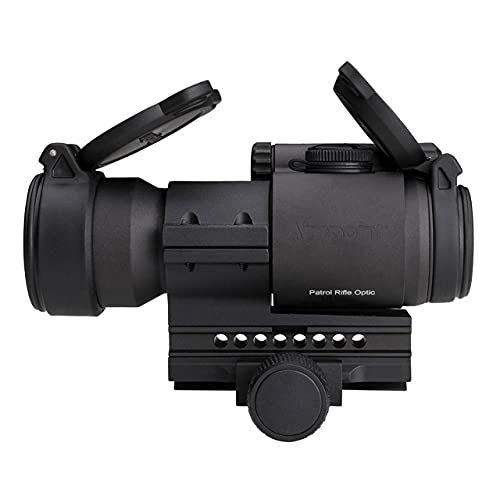 Aimpoint PRO Red Dot Reflex Sight with QRP2 Mount and Spacer, 2 MOA Aimpoint PRO Red Dot Reflex Sight with QRP2 Mount and Spacer, 2 MOA | $512.00 | 1x | 2 MOA |
 Holosun 510C Multi-Reticle 2 MOA Dot and 65 MOA Circle Open Reflex Sight Holosun 510C Multi-Reticle 2 MOA Dot and 65 MOA Circle Open Reflex Sight | $295.84 | 1x | 2 MOA |
A dash means the manufacturer does not publish that figure. We leave it blank rather than estimating it.
How we chose
We did not test these optics in person and we never claim to. Picks are researched from manufacturer specification sheets, published optical and ballistic formulas, and the recurring themes in verified owner reviews. Every pick is matched to a real objective diameter, a real tube size, a real ring height or a real exit pupil rather than to a price bracket, and it is placed in the tier where its capability actually belongs. Where a figure is shooter convention rather than a sourced number we label it, and where a manufacturer does not publish a figure we leave it out instead of estimating it.
Sources
- Trijicon published specifications for the MRO HD
- Owner-review consensus from duty and competition use
Frequently asked questions
What makes the Trijicon MRO HD different from a standard tube red dot?
Trijicon builds the MRO HD around a 25mm objective housed in a body shorter than a comparable full size tube sight, which widens the usable field of view without the sight feeling like looking down a pipe. It is still a fully enclosed tube design rather than an open reflex sight, which protects the emitter better in weather.
What is the exact window size and body length of the MRO HD?
Trijicon's published specification set for this model does not include an exact window diameter or overall body length. This review states the design goal Trijicon does publish, a wide field of view in a shortened housing, rather than inventing precise dimensions the manufacturer has not made part of the public spec sheet.
Does the MRO HD have shake awake or a motion sensor?
No. Trijicon's published listing does not include a shake awake or motion-activation feature for this model, unlike considerably cheaper sights such as the SIG Romeo5 Gen II or the Holosun 510C, both of which do publish motion sensing as a standard feature.
How long does the battery last on the Trijicon MRO HD?
Trijicon does not publish a specific battery-life figure for this model, unlike the Aimpoint PRO, which states over 30,000 hours of continuous runtime, or the Vortex SPARC Gen II, which publishes an hours range by brightness setting. That is a real gap in the published specification set rather than a number this review can estimate.
Is the MRO HD worth $689.99 over a cheaper red dot?
If duty-grade durability and Trijicon's long track record matter more than a features list, many owners say yes based on years of hard use without failure. If a published battery figure, solar backup or a switchable reticle matter more, a cheaper sight from this review's comparison table publishes features the MRO HD's own listing does not.
Will the MRO HD work for someone with astigmatism?
Not reliably. Its dot is a projected point of light like any other red dot sight, and an astigmatic eye smears a point source into a star or comma shape regardless of the housing's durability or price. A prism sight with an etched glass reticle is the standard alternative for that specific issue.
Researched, not professional advice. This page is compiled from published manufacturer specifications, published optical and ballistic formulas, and owner-review consensus, not hands-on testing. Figures described as a rule of thumb are shooter convention rather than sourced numbers, and they are labelled that way wherever they appear. Ballistic figures come from a point mass model using the ballistic coefficient the maker publishes, so treat them as a starting point and confirm them on paper at a measured distance. Confirm your firearm is unloaded with the action open before you mount, level, torque or bore sight anything. Verify a zero only on a supervised range or a safe, legal backstop, know what lies beyond your target, and follow the law where you hunt and shoot, including rules on land access and permitted cartridges.