Sight adjustment
Scope Click Adjustment Calculator
Quick answer
Clicks equal the miss distance divided by what one click moves at that range. At 100 yards a quarter MOA click moves 0.262 inches, so a 2 inch correction needs 8 clicks. At 200 yards the same click moves 0.524 inches and the same 2 inch correction needs only 4.
The rule people remember is that four clicks move one inch. That is only true for a quarter MOA turret at 100 yards, and it is wrong at every other distance, which is why groups get chased around a target.
A click is an angle, so what it moves grows with distance. The same click that moves a quarter of an inch at 100 yards moves half an inch at 200 and a full inch at 400. Correcting a group shot at 200 yards with 100 yard arithmetic overshoots by exactly double.
Enter where the group landed relative to where you aimed, at the distance you actually shot it, and the calculator gives you whole clicks you can dial plus the error left on the target afterwards.
Click adjustment calculator
Dial this
The formula
clicks = miss in inches / (click value in inches at that distance)
What makes a zeroing session worth trusting
Top matches update when you change your numbers.

Vortex Riflescope Bubble Level, 1 inch
$39.00A permanent anti-cant level clamped to the tube, visible in your peripheral vision as you settle behind the rifle. It fixes the error at the moment it matters rather than at the bench.
Best for: checking cant on every shot rather than once at mounting
Check price on Amazon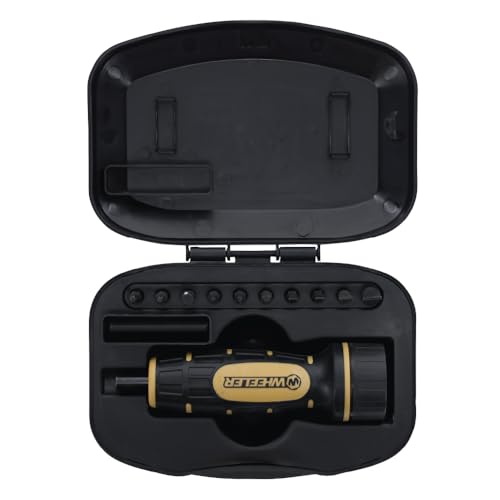
Wheeler Firearms Accurizing Torque Wrench with Bits and Case
$60.13The tool this whole category is named after. Dial the inch pound figure, tighten until it clicks, and the ring screw is at the number the ring maker published rather than at whatever felt right.
Best for: the standard torque wrench for scope mounting
Check price on Amazon
Champion Redfield Style Precision Sight-In Targets, 100 Pack
$25.99The grid is printed in one inch squares, so you can read the correction straight off the paper in inches and convert it once rather than estimating.
Best for: reading a correction directly off the target
Check price on Amazon
Splatterburst 12 x 18 inch Sight In Shooting Target
$13.99The hole shows as a bright ring, so you can see where you hit at 100 yards through the scope rather than walking down after every shot.
Best for: seeing your hits without walking downrange
Check price on Amazon
Caldwell DeadShot Filled Front and Rear Shooting Rest Bags
$37.99Front and rear bags together for the price of most single bags, which is the cheapest route to a stable zeroing position on any bench.
Best for: a stable position without a mechanical rest
Check price on Amazon
Caldwell The Rock Deluxe Adjustable Front Rest
$94.99A proper adjustable front rest, so the elevation is set by a thumbwheel rather than by your shoulder. On a zeroing session this removes most of the group size that is not the rifle.
Best for: zeroing accurately enough to trust the correction
Check price on Amazon
Wheeler Professional Laser Bore Sighter with Magnetic Connection
$97.68Attaches magnetically to the muzzle rather than being inserted into the chamber, so it works across calibers and never puts anything in the action.
Check before buying: A magnetic boresighter references the muzzle crown. If the crown is damaged or the magnet sits on a thread protector, the laser is not square to the bore and the result is worse than not using one.
Best for: bore sighting several rifles without caliber adapters
Check price on Amazon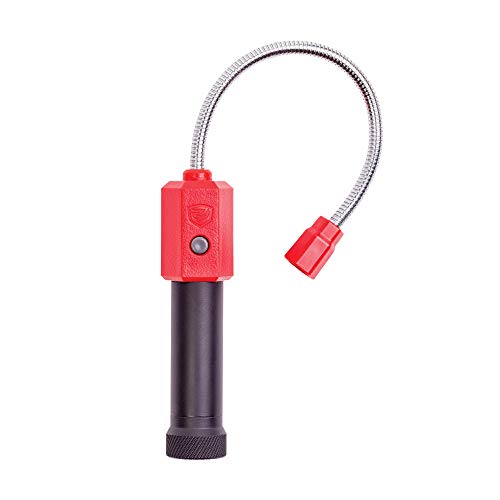
Real Avid Magnetic Bore Light with Flexible Neck
$11.99Not a boresighter: it lights the bore so you can actually see through it while you line the scope up on a distant object the traditional way, which costs nothing and has no alignment error of its own.
Best for: bore sighting a bolt action the old way, accurately
Check price on AmazonWhat one click moves at each distance
Every turret value sold, across the distances people actually zero at. This is the table to photograph and keep in the range bag.
A quarter MOA click moves 0.262 inches at 100 yards and 0.524 inches at 200, while a tenth mil click moves 0.36 inches at 100 yards.
Sourced figure
| Turret value | 50 yd | 100 yd | 200 yd | 300 yd | 500 yd |
|---|---|---|---|---|---|
| 1/8 MOA | 0.065 in | 0.131 in | 0.262 in | 0.393 in | 0.654 in |
| 1/4 MOA | 0.131 in | 0.262 in | 0.524 in | 0.785 in | 1.309 in |
| 1/2 MOA | 0.262 in | 0.524 in | 1.047 in | 1.571 in | 2.618 in |
| 1 MOA | 0.524 in | 1.047 in | 2.094 in | 3.142 in | 5.236 in |
| 0.1 mil | 0.18 in | 0.36 in | 0.72 in | 1.08 in | 1.8 in |
| 0.05 mil | 0.09 in | 0.18 in | 0.36 in | 0.54 in | 0.9 in |
| 0.2 mil | 0.36 in | 0.72 in | 1.44 in | 2.16 in | 3.6 in |
Turrets move in whole clicks, so the correction you can actually dial is the nearest whole number. The remainder is usually far smaller than the group.
Which direction do I turn the turret?
Turrets are marked with the direction the point of impact moves, not the direction the reticle moves. If your group is low and left, you dial UP and RIGHT, following the arrows.
This trips people up because the reticle appears to move the opposite way when you watch it against the target. Trust the markings on the turret, and confirm with one fouling shot before dialling a large correction.
The other common error is correcting from the wrong reference. Measure from where you aimed to the centre of the group, not from the edge of the group and not from the previous group. If the group is larger than the correction, shoot a bigger group before adjusting anything.
Why the remainder almost never matters
A turret can only stop at whole clicks, so most corrections leave a fraction on the table. At 100 yards with quarter MOA turrets the worst case remainder is an eighth of an inch, which is far inside what any rifle and shooter combination will hold.
The exception is a very coarse turret at close range. A 1 MOA turret, common on red dots, moves just over an inch at 100 yards, so the worst case remainder is half an inch. That is still acceptable for the intended use, and it is a reason not to expect a red dot to produce a precise 100 yard zero.
Sources
- Definition of a minute of angle and of a milliradian
- Manufacturer published turret click values from the product listings in our catalog
Frequently asked questions
How many clicks is 1 inch at 100 yards?
With quarter MOA turrets, 3.82 clicks, which you round to 4. With tenth mil turrets it is 2.78 clicks, so 3. The widely quoted "four clicks per inch" is correct for quarter MOA turrets at 100 yards and wrong at every other distance, because a click is an angle and covers more ground further out.
How many clicks at 200 yards?
Half as many as at 100 yards for the same correction in inches, because one click covers twice as much ground. A quarter MOA click moves 0.524 inches at 200 yards, so a 2 inch correction needs 4 clicks rather than the 8 it would need at 100. Correcting a 200 yard group with 100 yard arithmetic overshoots by double.
Which way do I turn the turret if I am shooting low?
Up. Turrets are marked with the direction the point of impact moves, so follow the arrow labelled UP. The reticle will appear to move down against the target as you do it, which is normal and is why people second-guess themselves. Trust the markings and confirm with a shot before dialling a large correction.
Should I correct from a single shot?
No. A single shot tells you almost nothing about where the rifle is shooting, because it includes all of your own error with no way to separate it. Shoot at least three, ideally five, and measure from your aiming point to the centre of the group. If the group is larger than the correction you are about to make, do not make it.
What if my scope has MOA turrets and a mil reticle?
You have to convert every reading, by multiplying mils by 3.43775 to get MOA, before you can dial. It works and it is a genuinely bad configuration to own, because the conversion happens in the field under time pressure. If you are still choosing a scope, match the reticle unit to the turret unit and never think about this again.
My clicks do not seem to move the impact the right amount. Why?
Most often the turret is not tracking, which you can confirm with a box test: dial a known amount up, right, down and left, and check that the groups land at the corners of a square. Loose ring screws and a scope creeping under recoil produce the same symptom, so check torque before blaming the optic.
Researched, not professional advice. This page is compiled from published manufacturer specifications, published optical and ballistic formulas, and owner-review consensus, not hands-on testing. Figures described as a rule of thumb are shooter convention rather than sourced numbers, and they are labelled that way wherever they appear. Ballistic figures come from a point mass model using the ballistic coefficient the maker publishes, so treat them as a starting point and confirm them on paper at a measured distance. Confirm your firearm is unloaded with the action open before you mount, level, torque or bore sight anything. Verify a zero only on a supervised range or a safe, legal backstop, know what lies beyond your target, and follow the law where you hunt and shoot, including rules on land access and permitted cartridges.