Trajectory and zero
Zero Distance Calculator
Quick answer
Choosing a zero is choosing where you want your error. A 100 yard zero is easiest to confirm and leaves a .308 about 14.7 inches low at 300. A 200 yard zero lifts the bullet a couple of inches high in the middle distances and roughly halves that holdover.
Every zero is a compromise between shooting high in the middle distances and shooting low at the far end, and there is no zero that avoids both. What you are actually choosing is which of those two errors you would rather have, given the distances you really shoot.
This calculator shows every zero distance side by side for your load, so the decision is made on numbers rather than on what somebody said at the range. The figures that matter are the maximum rise above the line of sight, which decides whether a centre hold works, and the holdover at the far end, which decides whether you need to dial.
Zero distance calculator
With your zero
| Zero | Near zero | Highest above sight line | Path at 200 | Path at 300 | Path at 400 |
|---|
The model
G1 point mass integration, standard sea level atmosphere, launch angle solved so the path crosses zero at your chosen distance
What a zeroing session actually needs
Top matches update when you change your numbers.

Champion Redfield Style Precision Sight-In Targets, 100 Pack
$25.99The grid is printed in one inch squares, so you can read the correction straight off the paper in inches and convert it once rather than estimating.
Best for: reading a correction directly off the target
Check price on Amazon
Caldwell The Rock Deluxe Adjustable Front Rest
$94.99A proper adjustable front rest, so the elevation is set by a thumbwheel rather than by your shoulder. On a zeroing session this removes most of the group size that is not the rifle.
Best for: zeroing accurately enough to trust the correction
Check price on Amazon
Caldwell DeadShot Filled Front and Rear Shooting Rest Bags
$37.99Front and rear bags together for the price of most single bags, which is the cheapest route to a stable zeroing position on any bench.
Best for: a stable position without a mechanical rest
Check price on Amazon
Splatterburst 12 x 18 inch Sight In Shooting Target
$13.99The hole shows as a bright ring, so you can see where you hit at 100 yards through the scope rather than walking down after every shot.
Best for: seeing your hits without walking downrange
Check price on Amazon
Wheeler Professional Laser Bore Sighter with Magnetic Connection
$97.68Attaches magnetically to the muzzle rather than being inserted into the chamber, so it works across calibers and never puts anything in the action.
Check before buying: A magnetic boresighter references the muzzle crown. If the crown is damaged or the magnet sits on a thread protector, the laser is not square to the bore and the result is worse than not using one.
Best for: bore sighting several rifles without caliber adapters
Check price on Amazon
Garmin Xero C1 Pro Compact Ballistics Chronograph
$499.99The instrument that made chronographs ordinary. It sits beside you on the bench rather than downrange, so there is nothing to shoot through and nothing to set up in front of the muzzle.
Best for: anyone who dials come-ups and wants real numbers
Check price on Amazon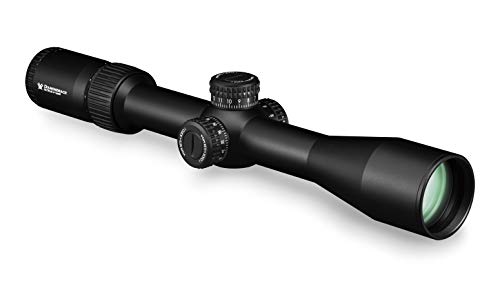
Vortex Diamondback Tactical 4-16x44 First Focal Plane Riflescope, EBR-2C MOA
$399.00 Full specificationsThe cheapest first focal plane scope worth owning, and the one that makes the case for the whole category: the reticle holds its subtension at every magnification, so a hold is a hold rather than a calculation.
Best for: a first precision rifle scope, or a hunting rifle that will be dialled
Check price on AmazonThe three zeros worth considering
A 100 yard zero is the easiest to confirm and the easiest to reason about, while a 200 yard zero trades a couple of inches of mid range rise for roughly half the holdover at 300.
Shooter convention
| Zero | Best for | The cost |
|---|---|---|
| 25 or 50 yd | Getting on paper, and rimfire or close range work | The bullet climbs well above the line of sight further out, so you need holdover data past 150 yards |
| 100 yd | Almost everybody. Easiest to confirm on any range | More holdover at the far end than a 200 yard zero |
| 200 yd | Open country where shots run past 200 | The bullet rides a couple of inches high in the middle, which matters on small targets |
| 300 yd | Flat shooting cartridges in open country only | Enough mid range rise to miss a small vital zone with a centre hold |
The widely repeated advice to be two inches high at 100 yards is a rule of thumb rather than a specification, and it produces a different zero distance for every cartridge. Work from the zero distance you want instead.
Near zero, far zero, and the gap in between
Every zero has two crossings of the line of sight, not one. The bullet starts below your line of sight by your full sight height, climbs to cross it at the near zero, rides above it through the middle, and crosses again on the way down at the far zero you set.
Almost everybody knows about the far one. Almost nobody thinks about the near one, and it is where close range misses come from. Inside the near zero the rifle shoots low, and how low depends almost entirely on how high your scope sits above the bore.
A rifle zeroed at 200 yards with a tall mount can be four inches low at 25 yards. That is geometry rather than a zeroing fault, and the fix is to know the number before you need it.
Point blank range, and the honest caveat
Maximum point blank range is the farthest distance at which you can hold dead centre and still land inside a target of a size you choose, without holdover and without dialling. For most hunting it is the single most useful concept in ballistics.
The vital radius is your choice and nothing here decides it. Four inches is the usual figure for deer sized game and it is a convention rather than a standard. Choose a smaller number and your point blank range shrinks, which is the correct trade if you are not confident of the shot.
The calculator finds the zero that maximises this for your load. Note that the optimum zero is rarely a round number, and a 100 or 200 yard zero you can genuinely confirm on a range beats a 217 yard zero you cannot.
Sources
- G1 standard drag function, the published Ingalls and Siacci reference
- Published factory load specifications for the preset cartridges
Frequently asked questions
What is the best zero distance for a hunting rifle?
For most hunting inside 300 yards, either 100 or 200 yards. A 100 yard zero is easier to confirm and easier to reason about because almost every range has a 100 yard line. A 200 yard zero flattens the far end at the cost of the bullet riding a couple of inches high in the middle distances, which only matters on small targets.
Should my rifle be two inches high at 100 yards?
That is a rule of thumb, not a specification, and it produces a different zero distance for every cartridge and every sight height. It is a reasonable approximation of a 200 yard zero for common hunting cartridges. Work from the zero distance you actually want and let the figure at 100 yards be whatever it turns out to be.
Can I zero at 25 yards instead of 100?
Use 25 yards to get on paper, which saves a lot of ammunition, then confirm at the distance you actually want. The near zero and the far zero are different distances and a 25 yard zero is not the same as a 100 yard zero. The relationship between them depends on your sight height and your load, which is what this calculator shows.
What is a near zero?
The first crossing of the line of sight, on the way up. The bullet starts below your sight line by your full sight height and climbs to meet it. With a typical hunting rifle zeroed at 200 yards the near zero falls somewhere around 25 to 50 yards, and inside that distance the rifle shoots low.
Does changing my zero change my point of impact at other distances?
It shifts the entire curve up or down, yes. Zeroing further out means the bullet leaves the muzzle at a slightly steeper angle, so it rides higher everywhere in the middle and falls less at the far end. Nothing about the bullet flight changes, only the angle you launch it at relative to your line of sight.
Why does my zero shift between the range and the field?
Check mounting first: loose ring screws and a scope creeping under recoil produce exactly this. After that, temperature and altitude change air density and therefore the far end of the trajectory, and a different position or rest changes how the rifle recoils. A zero that moves at 100 yards is almost always mechanical rather than atmospheric.
Researched, not professional advice. This page is compiled from published manufacturer specifications, published optical and ballistic formulas, and owner-review consensus, not hands-on testing. Figures described as a rule of thumb are shooter convention rather than sourced numbers, and they are labelled that way wherever they appear. Ballistic figures come from a point mass model using the ballistic coefficient the maker publishes, so treat them as a starting point and confirm them on paper at a measured distance. Confirm your firearm is unloaded with the action open before you mount, level, torque or bore sight anything. Verify a zero only on a supervised range or a safe, legal backstop, know what lies beyond your target, and follow the law where you hunt and shoot, including rules on land access and permitted cartridges.