Low power variable optics
Primary Arms SLx 1-6x24 Gen IV Review
Quick answer
The Primary Arms SLX 1-6x24 Second Focal Plane Gen IV LPVO Riflescope is a 1-6x24 second focal plane LPVO built around the ACSS Aurora reticle, priced at $349.99. Its 4 mm exit pupil at 6x stays genuinely usable in low light, and the reticle does ranging, holdover and a moving target lead calibrated to 5.56 and .308 in one etched pattern.
Most LPVO reticles give a shooter a bare centre dot at 1x and a set of holdover hashes at 6x, and leave ranging and wind entirely up to the shooter's own judgment. The SLx 1-6x24 Gen IV takes a different approach: Primary Arms designs its own ACSS Aurora reticle to fold ranging brackets, yard-based holdovers and a moving target lead into a single etched pattern, calibrated specifically for 5.56 and .308 loads out to a working distance.
That is a genuinely complete firing solution etched into glass, and it is also a design that makes one particular trade very deliberately: the reticle is busier than a plain BDC, and it is only exactly correct for the cartridges Primary Arms built it around. At $349.99 this scope competes directly with simpler illuminated LPVOs from Vortex and Sig, and the honest comparison is workflow rather than glass quality.
This review is researched from Primary Arms published specifications and owner-review consensus on major retail listings, not from a hands-on shooting session, and it marks the reticle's calibrated figures as manufacturer-published rather than independently verified.
On this page
- What does the ACSS Aurora reticle actually add over a plain BDC?
- What does the 24 mm objective give you across the zoom range?
- What ring height and mount does this scope need?
- Where the SLx 1-6x24 Gen IV costs you: reticle clutter and a calibration tied to one cartridge class
- Alternatives if the calibrated reticle is more than you need
- A budget pick and a step up if you would rather hold than dial
What does the ACSS Aurora reticle actually add over a plain BDC?
A generic BDC reticle gives a shooter a stack of holdover hashes and leaves the rest of the work, ranging a target and estimating a moving target's lead, to be done in the shooter's head. The ACSS Aurora reticle etched into this scope folds all three tasks into the glass at once: bracket-style ranging references sized to an average torso, yard-marked holdover dots calibrated to 5.56 NATO and .308 Winchester, and lead lines for a target moving across the shooter's field of view.
The trade for that capability is density. Where a duplex or a simple BDC reticle is uncluttered by design, the Aurora reticle puts real information on the glass at every magnification, and a shooter who has not learned which part of the pattern to use for which task will find the extra marks slow down a fast shot rather than speed it up. Eleven illumination settings help isolate the centre aiming point from the rest of the pattern in bright light, but the reticle itself is a genuinely different object from the one on a cheaper LPVO, not a decorated version of the same idea.
What does the 24 mm objective give you across the zoom range?
Exit pupil, computed
exit pupil (mm) = objective diameter (mm) / magnification at 1x: 24 / 1 = 24 mm (eye-limited, not scope-limited) at 2x: 24 / 2 = 12 mm at 4x: 24 / 4 = 6 mm at 6x: 24 / 6 = 4 mm
Exact arithmetic. A dark-adapted human pupil rarely exceeds 5 to 7 mm depending on age, which is a population convention rather than a published spec. Twilight factor at 6x, computed as the square root of objective times magnification (24 x 6), is 12.0, a middling figure that reflects a scope built for speed rather than for extended low light glassing.
A 24 mm objective is a deliberately modest choice on a scope meant to live at low magnification, and the numbers show why that is the right call rather than a compromise.
The SLx 1-6x24 Gen IV gives a 4 mm exit pupil at its maximum 6x, a genuinely usable low light figure, because the top-end magnification stays modest on a 24 mm objective.
Sourced figure
| Magnification | Exit pupil | What it means |
|---|---|---|
| 1x | 24 mm (eye-limited) | Far larger than the eye can use; the sight picture at 1x is limited by the shooter’s own pupil, exactly as a true 1x should behave |
| 2x | 12 mm | Still eye-limited rather than scope-limited |
| 4x | 6 mm | At the upper end of a dark-adapted pupil; comfortable well into dusk |
| 6x | 4 mm | A genuinely usable figure even in dim light, thanks to the modest top-end magnification |
Because this scope tops out at 6x rather than 8x or 10x on the same objective, the exit pupil at maximum power stays wide enough to be a real low light asset rather than a bright-day-only setting.
What ring height and mount does this scope need?
Primary Arms builds this scope on a 30 mm tube with a 24 mm objective, which needs comparatively little ring height and is one of the practical advantages of a compact LPVO over a long range scope. Check what ring height a 24 mm objective needs on a 30 mm tube before ordering rings, and consider a cantilever mount if the rifle's rail position leaves the scope too far back for proper eye relief at 1x.
The dovetail-compatible magnification ring accepts a throw lever, and on a scope built around fast transitions between 1x and 6x, using one is worth doing rather than skipping: finding a bare ring quickly with a gloved hand under time pressure is slower and less certain than finding a lever.
Where the SLx 1-6x24 Gen IV costs you: reticle clutter and a calibration tied to one cartridge class
The honest limitation of this scope is not the optics, which owner-review consensus rates well for the price. It is the reticle's own design trade. The ACSS Aurora pattern is busier on the glass than a plain duplex or BDC reticle, and a shooter who has not deliberately learned which reference points apply to ranging, which apply to holdover and which apply to a moving lead will find the extra information slows a fast shot rather than speeding it up. This is a real cost, not a minor one, on a scope whose whole purpose at 1x is speed.
The second real limitation is cartridge specificity. The yard-calibrated holdover dots and ranging brackets are built around 5.56 NATO and .308 Winchester specifically. A shooter running a materially different cartridge and load will find the reticle's shape correct but its calibrated distances wrong, which is a limitation of a calibrated reticle rather than a defect, and worth knowing before buying into the system.
Alternatives if the calibrated reticle is more than you need
Two directions, depending on whether the reticle complexity or the price is the thing you would trade away.
| Model | Price | Magnification | Objective lens | Focal plane | Illuminated reticle | Tube diameter |
|---|---|---|---|---|---|---|
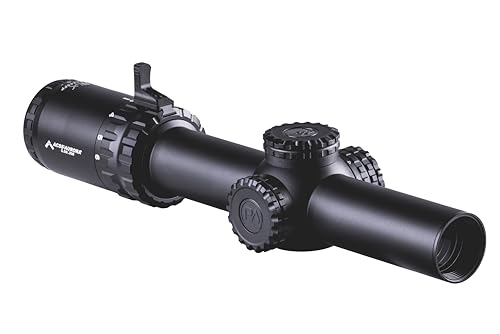 Primary Arms SLX 1-6x24 Second Focal Plane Gen IV LPVO Riflescope Primary Arms SLX 1-6x24 Second Focal Plane Gen IV LPVO Riflescope | $349.99 | 1-6x | 24 mm | Second | Yes | - |
 Vortex Strike Eagle 1-6x24 Second Focal Plane Riflescope, BDC3 MOA Vortex Strike Eagle 1-6x24 Second Focal Plane Riflescope, BDC3 MOA | $225.75 | 1-6x | 24 mm | Second | Yes | 30 mm |
 Swampfox Arrowhead 1-6x24 SFP LPVO, Green BDC, 30mm Swampfox Arrowhead 1-6x24 SFP LPVO, Green BDC, 30mm | $299.00 | 1-6x | 24 mm | Second | Yes | 30 mm |
A dash means the manufacturer does not publish that figure. We leave it blank rather than estimating it.
A budget pick and a step up if you would rather hold than dial
The Vortex Strike Eagle 1-6x24 Second Focal Plane Riflescope, BDC3 MOA is a genuinely cheaper LPVO on the same 1-6x24 layout with a simpler BDC3 reticle rather than a calibrated ranging system, the right choice for a shooter who wants a plain centre hold and occasional holdover marks without the reticle density. The Swampfox Arrowhead 1-6x24 SFP LPVO, Green BDC, 30mm undercuts both on price with a green illuminated reticle that reads well against foliage. For a shooter who has decided the ACSS approach is worth the learning curve but wants first focal plane subtension at every power rather than second, the Vortex Viper PST Gen II 1-6x24 Second Focal Plane Riflescope, VMR-2 MOA is the genuine step up, at close to double the price.
How we chose
We did not test these optics in person and we never claim to. Picks are researched from manufacturer specification sheets, published optical and ballistic formulas, and the recurring themes in verified owner reviews. Every pick is matched to a real objective diameter, a real tube size, a real ring height or a real exit pupil rather than to a price bracket, and it is placed in the tier where its capability actually belongs. Where a figure is shooter convention rather than a sourced number we label it, and where a manufacturer does not publish a figure we leave it out instead of estimating it.
Sources
- Primary Arms published specifications for the SLx 1-6x24 Second Focal Plane Gen IV LPVO Riflescope
- Owner-review consensus from verified purchaser reviews on major retail listings
Frequently asked questions
What does the ACSS Aurora reticle in the Primary Arms SLx 1-6x24 do?
It combines ranging brackets, yard-calibrated holdover dots and a moving target lead in one etched second focal plane pattern, built by Primary Arms specifically for 5.56 NATO and .308 Winchester. It lets a shooter range a target and hold a correction directly off the glass rather than computing one, though the marks are only exactly correct for those two cartridges.
What exit pupil does the SLx 1-6x24 Gen IV give at full magnification?
4 mm at 6x, computed exactly as the 24 mm objective divided by 6x magnification. That is a genuinely usable low light figure, wider than what many higher-magnification LPVOs on the same objective can offer, because this scope keeps its top end at a modest 6x rather than 8x or 10x.
Is the ACSS reticle too busy for a fast, close-range shot?
It can be, until you have learned which part of the pattern applies. At 1x the illuminated centre dot works exactly like a red dot, but the surrounding ranging and lead references remain visible and add clutter a plain duplex reticle does not have. Owner-review consensus is mixed on this specifically, more so than on any other part of the scope.
Does the ACSS reticle work with a different cartridge than 5.56 or .308?
The reticle still functions as a plain second focal plane reticle with any cartridge, but the yard-calibrated holdover dots and ranging brackets will be wrong in distance for a materially different trajectory, since Primary Arms calibrates them to those two specific loads. Treat the calibrated marks as approximate rather than exact with anything else.
What tube size and ring height does this scope need?
A 30 mm tube on a 24 mm objective, which needs comparatively little ring height. Check the specific stocked heights that clear this objective on a 30 mm tube before ordering, since the objective housing rather than the tube diameter sets the clearance requirement against the barrel or rail.
Is the Primary Arms SLx 1-6x24 Gen IV worth it over a simpler LPVO?
Only if the calibrated ranging and lead system is a workflow you will actually use, since it is the entire reason this scope costs more than a comparable Vortex or Swampfox LPVO with a plain BDC reticle. For a shooter who wants a fast centre hold and nothing more, a simpler reticle on a cheaper scope covers the job just as well.
Researched, not professional advice. This page is compiled from published manufacturer specifications, published optical and ballistic formulas, and owner-review consensus, not hands-on testing. Figures described as a rule of thumb are shooter convention rather than sourced numbers, and they are labelled that way wherever they appear. Ballistic figures come from a point mass model using the ballistic coefficient the maker publishes, so treat them as a starting point and confirm them on paper at a measured distance. Confirm your firearm is unloaded with the action open before you mount, level, torque or bore sight anything. Verify a zero only on a supervised range or a safe, legal backstop, know what lies beyond your target, and follow the law where you hunt and shoot, including rules on land access and permitted cartridges.