LPVO Riflescopes
Best 1-6x LPVOs
Quick answer
The best 1-6x LPVO for most shooters is the Primary Arms SLX 1-6x24 Second Focal Plane Gen IV LPVO Riflescope at $349.99, because it holds a genuine 1.00x at the low end with both eyes open, and a true 1x is the specification that separates a real close-range optic from one that only claims to be one.
A low power variable optic sold as "1-6x" is not automatically a 1x optic. Plenty of scopes marketed that way sit at 1.1x or 1.15x on the low end, which sounds trivial until you try shooting both eyes open at close range and find the reticle picture does not match what your off eye sees. That mismatch is the whole argument for buying carefully in this category rather than by magnification range alone.
This roundup is built from published manufacturer specifications and owner-review consensus, not our own hands-on testing, so every figure below traces back to a source you can check yourself rather than to a claim we invented.
The second real trade in a 1-6x is what happens to the eye box once you turn the ring to 6x. A wide, forgiving eye box at 1x gets noticeably tighter at the top of the range on every optic in this category, and how much tighter is the difference between a scope that stays fast under stress and one that punishes an imperfect cheek weld.
On this page
What does a "true 1x" actually mean?
A true 1x setting means the image through the scope is the same apparent size as the naked eye sees the same scene. Shoot both eyes open, and your two eyes should agree on how big the target is. When a 1-6x is actually 1.1x or 1.15x at its lowest setting, your two eyes disagree slightly, your brain resolves the conflict by suppressing one image, and the optic stops feeling like an open sight and starts feeling like a scope you have to consciously look through.
The gap sounds small on paper and is not small in practice. It shows up as a moment of hesitation on a close target, exactly the moment a 1-6x exists to remove. Manufacturers do not always publish an exact low-end magnification figure more precise than "1x" on the spec sheet, so the honest way to check is owner-review consensus and side-by-side comparisons rather than trusting the box alone.
Why does the eye box get worse at 6x?
Every variable optic trades eye box for magnification as you turn the ring up, and a 1-6x with a 6x jump on the top end feels this more than a fixed 3-9x scope does, because the low end promises a forgiving, fast picture that the high end cannot keep.
Every 1-6x in this catalog is a second focal plane design, which means the reticle holds a constant visual size while the eye box tightens as magnification climbs toward 6x.
Sourced figure
| Model | Magnification | Tube | Focal plane | Price |
|---|---|---|---|---|
| Vortex Strike Eagle 1-6x24 | 1-6x | 30mm | SFP | $225.75 |
| Primary Arms SLX 1-6x24 Gen IV | 1-6x | 30mm | SFP | $349.99 |
| SIG SAUER Tango-MSR 1-6x24 | 1-6x | 30mm | SFP | $258.00 |
| Swampfox Arrowhead 1-6x24 | 1-6x | 30mm | SFP | $299.00 |
| Vortex Viper PST Gen II 1-6x24 | 1-6x | 30mm | SFP | $599.00 |
None of these manufacturers publish an exact eye box dimension in inches at every magnification step, which is genuinely typical for this category. Where a figure is not published, owner-review consensus is the only honest source, and it consistently ranks these five in roughly the order shown by price.
Beginner: a first LPVO that will not embarrass itself
The goal at this tier is a genuine 1x and a durable second focal plane reticle at a price that leaves room in the budget for a real mount, because a 1-6x mounted in a flexing cantilever undoes most of what the glass buys you.

Vortex Strike Eagle 1-6x24 Second Focal Plane Riflescope, BDC3 MOA
$225.75 Full specificationsA true 1x low end and a transferable lifetime warranty at a price that does not force a compromise elsewhere on the build.
Best for: A first AR-pattern build or a truck gun optic that needs to be fast up close.
Check price on AmazonIntermediate: the buy-once pick
This is where the eye box at 6x, the illumination, and the glass all take a real step up together, and it is the tier most committed shooters should actually land on rather than treat as a stepping stone.
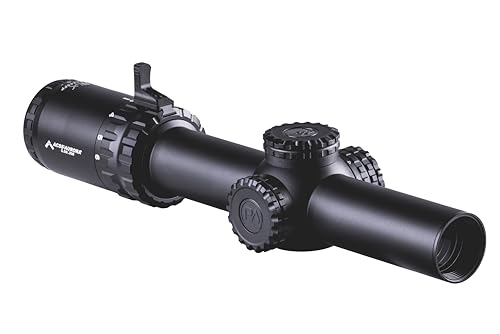
Primary Arms SLX 1-6x24 Second Focal Plane Gen IV LPVO Riflescope
$349.99 Full specificationsA genuine 1x with both eyes open, a wider eye box at 6x than the beginner tier, and an illuminated reticle bright enough to use in daylight.
Best for: A shooter who has already confirmed they want a 1-6x specifically and is done shopping after this one.
Check price on Amazon
Athlon Optics Argos BTR GEN2 1-8x24 Riflescope, ATSR5 SFP IR BDC
$239.99 Full specificationsAn 8x top end on the same 24mm objective, for a shooter who wants one optic to also cover a modest amount of precision work.
Best for: Someone who is not certain a 1-6x is enough magnification for their use.
Check price on AmazonExpert: the performance ceiling
At this tier the glass, the illumination, and the turret feel stop being the limiting factor, and what is left is the eye box at 6x and the reliability of the illumination system under years of use.
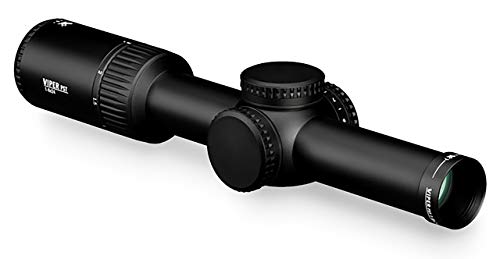
Vortex Viper PST Gen II 1-6x24 Second Focal Plane Riflescope, VMR-2 MOA
$599.00 Full specificationsThe widest usable eye box at 6x in the catalog lineup and turrets built to the same repeatable standard as Vortex full-size precision scopes.
Best for: A duty or competition rifle that lives on 1x most of the time but needs 6x to actually work when called on.
Check price on AmazonWho should not buy this tier: Not for a shooter whose 1-6x will spend nearly all of its life parked at 1x on a home-defense or close-quarters gun. The extra money here buys a better picture at 4x through 6x, and if that range is rarely used, the intermediate tier delivers nearly the same result for less.
1x versus 6x: what you are actually trading
The honest summary of the whole category, stated as a trade rather than as a spec sheet.
Turning a 1-6x from 1x to 6x trades a wide, forgiving eye box and both-eyes-open shooting for magnified detail and a narrower, less forgiving picture.
Shooter convention
| At 1x | At 6x |
|---|---|
| Both eyes open, target focused | One eye through the scope, reticle focused |
| Wide, forgiving eye box | Narrow eye box, cheek weld matters |
| Fast target acquisition inside 25 yards | Usable identification and hits past 200 yards |
| Reticle at true size against the target | Reticle subtension changes because this is SFP glass |
Every model in this catalog is second focal plane, so the reticle itself stays a constant visual size across the whole range while the target grows behind it.
How we chose
We did not test these optics in person and we never claim to. Picks are researched from manufacturer specification sheets, published optical and ballistic formulas, and the recurring themes in verified owner reviews. Every pick is matched to a real objective diameter, a real tube size, a real ring height or a real exit pupil rather than to a price bracket, and it is placed in the tier where its capability actually belongs. Where a figure is shooter convention rather than a sourced number we label it, and where a manufacturer does not publish a figure we leave it out instead of estimating it.
Sources
- Vortex published specifications
- Primary Arms published specifications
- SIG SAUER published specifications
- Owner-review consensus from optics and rifle-build forums
Frequently asked questions
What makes a 1-6x scope a "true 1x"?
A true 1x means the image through the optic is the same apparent size as the naked eye sees, so shooting both eyes open feels identical to shooting with no optic at all. Many scopes marketed as 1x actually sit at 1.1x or 1.15x, which is a small enough gap to miss on a spec sheet and a large enough gap to notice the moment you try to shoot fast with both eyes open.
Should I buy a 1-6x or a 1-8x LPVO?
Buy a 1-6x if your shooting is genuinely close range with occasional shots to 300 yards, because the shorter zoom ratio usually buys a wider eye box and a lighter optic. Buy a 1-8x if you want one optic to also cover modest precision work past 300 yards, and accept a narrower eye box at the top end as the trade for the extra reach.
Is second focal plane fine for a 1-6x LPVO?
Yes, and it is what nearly every 1-6x on the market uses. Second focal plane keeps the reticle a constant visual size at every magnification, which matters more than subtension accuracy for a close-range optic, since a BDC or ranging reticle in this category is a rough tool rather than a precision one anyway.
Do I need an illuminated reticle on a 1-6x LPVO?
Strongly recommended rather than optional. A 1-6x is meant to work at 1x like a red dot, and a black reticle center against a dark backdrop or low light defeats that purpose. An illuminated center dot restores the fast, both-eyes-open picture the whole category exists to deliver.
What ring height does a 1-6x LPVO need?
Most 1-6x scopes have a slim 24mm objective bell, which typically clears with a lower ring than a hunting scope needs, but correct eye relief on an AR-pattern platform usually calls for a cantilever mount that pushes the scope forward rather than a tall ring alone. Confirm clearance and forward reach before ordering rings.
Why does my 1-6x feel slower than a red dot up close?
Usually the eye box or the true magnification. If the low end is not a genuine 1x, both-eyes-open shooting fights your brain instead of feeling natural, and a tight eye box punishes anything short of a perfect cheek weld. Both problems are specification issues, not technique issues, and they explain most complaints in this category.
Researched, not professional advice. This page is compiled from published manufacturer specifications, published optical and ballistic formulas, and owner-review consensus, not hands-on testing. Figures described as a rule of thumb are shooter convention rather than sourced numbers, and they are labelled that way wherever they appear. Ballistic figures come from a point mass model using the ballistic coefficient the maker publishes, so treat them as a starting point and confirm them on paper at a measured distance. Confirm your firearm is unloaded with the action open before you mount, level, torque or bore sight anything. Verify a zero only on a supervised range or a safe, legal backstop, know what lies beyond your target, and follow the law where you hunt and shoot, including rules on land access and permitted cartridges.