Low power variable optics
Vortex Strike Eagle 1-6x24 Review
Quick answer
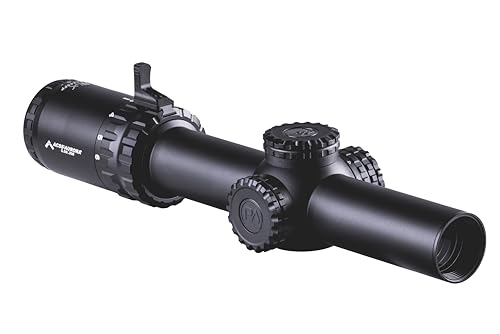
The Vortex Strike Eagle 1-6x24 Second Focal Plane Riflescope, BDC3 MOA is a 1-6x second focal plane LPVO with an illuminated BDC3 reticle, priced at $225.75. Its 4 mm exit pupil at 6x keeps a genuinely usable sight picture at full magnification, on a scope built for a fast, close-to-mid-range carbine rather than distance work.
The Strike Eagle 1-6x24 did not invent the low power variable optic, but owner-review consensus and years of sustained sales consistently credit it with making the category ordinary: a genuine 1x with both eyes open at the bottom and a usable 6x at the top, at a price that undercut what had previously been a specialist purchase. This review covers the 1-6x version specifically; a companion review covers the 1-8x24 built on the same platform, because the two scopes make a genuinely different trade and are worth comparing directly.
At $225.75 this scope is aimed at a carbine that needs to be fast up close and only occasionally needs to identify or engage a target past 200 yards, and the whole design favors the close end of that range over the far one.
This review is researched from Vortex published specifications and owner-review consensus, not from a hands-on shooting session, and states the exit pupil arithmetic as exact rather than approximate.
On this page
- What made this scope the default LPVO rather than a specialist choice?
- What does the 24 mm objective actually give you across the zoom range?
- Is a true 1x actually different from "about 1x"?
- What ring height and mount does this scope need?
- Where the Strike Eagle 1-6x24 costs you: not enough scope past 300 yards
- The 1-8x24 alternative and other LPVOs worth considering
- Instead of 6x, or a step up for ranging
What made this scope the default LPVO rather than a specialist choice?
Before scopes like this one, a true 1x variable with an illuminated reticle and a wide enough field of view for fast close-range use was a premium purchase. The Strike Eagle 1-6x24 combined those features with an updated magnification ring that includes a thread-in throw lever and repositioned magnification indicators visible without removing the scope from the rifle, at a price competitive with much simpler fixed 4x optics.
The reticle is second focal plane, meaning the illuminated centre dot stays a constant visual size regardless of magnification, which is the correct choice for a scope meant to be used at 1x with both eyes open exactly like a red dot, and the BDC3 reticle adds holdover marks for when the shot calls for more precision than a centre hold.
What does the 24 mm objective actually give you across the zoom range?
Exit pupil, computed
exit pupil (mm) = objective diameter (mm) / magnification at 6x: 24 / 6 = 4.0 mm at 1x: 24 / 1 = 24 mm
Exact arithmetic. A dark-adapted human pupil rarely exceeds 5 to 7 mm depending on age, which is a population convention rather than a published spec. At 1x the exit pupil is limited by the eye rather than the scope, which is the point of a true 1x setting.
The 24 mm objective on this scope is modest by long range standards and is exactly the right size for its job, because the whole design lives at low magnification.
The Strike Eagle 1-6x24 gives a 4.0 mm exit pupil at its maximum 6x, a genuinely usable low light figure, because a small objective is sufficient at this modest top-end magnification.
Sourced figure
| Magnification | Exit pupil | What it means |
|---|---|---|
| 1x | 24.0 mm | Far larger than the eye; sight picture is limited by the eye, not the scope, exactly as a true 1x should behave |
| 2x | 12.0 mm | Still eye-limited rather than scope-limited |
| 4x | 6.0 mm | At the upper end of a dark-adapted pupil; comfortable through dusk |
| 6x | 4.0 mm | A genuinely usable figure even in dim light, thanks to the modest top-end magnification |
Compare this against the 1-8x24 version of the same platform: an identical 24 mm objective pushed to 8x drops the exit pupil to 3.0 mm, a real loss for two extra powers of magnification.
Is a true 1x actually different from "about 1x"?
Yes, and it matters more than most spec sheets suggest. A genuine 1x setting introduces no magnification at all, so both eyes stay open and the reticle floats on the target the way a red dot does, with no image shift or apparent movement as your eye position changes slightly. A scope that markets "1x" but is actually 1.1x or 1.2x introduces a small but real image magnification that some shooters find disorienting with both eyes open at speed, particularly under time pressure.
Owner-review consensus on this scope consistently describes the low end as behaving like a red dot rather than like a low-magnification scope, which is the specific claim that separates a well-executed true 1x from a marketing approximation.
What ring height and mount does this scope need?
A 24 mm objective on a 30 mm tube needs comparatively little ring height, which is one of the practical advantages of a compact LPVO over a long range scope. Check what ring height a 24 mm objective needs on a 30 mm tube before ordering, and consider a cantilever mount if the rifle's rail position requires the scope pushed forward for proper eye relief at 1x.
A throw lever, included on this scope's magnification ring, is worth using rather than skipping: the difference between 1x and 6x needs to be a single fast motion under time pressure, and a bare magnification ring without a lever is slower to find and turn with a gloved hand.
Where the Strike Eagle 1-6x24 costs you: not enough scope past 300 yards
The honest limitation of this scope is magnification, and it is a deliberate limitation rather than a flaw. Six power is enough to identify a target and take a confident shot out to roughly the distance the BDC3 reticle's holdover marks cover, and it runs out of usefulness well before the distances a dedicated long range scope in this catalog is built for. A shooter who expects this scope to also serve as an occasional long range tool will be disappointed by 6x, which was never the design goal.
The second real limitation, shared with every second focal plane reticle, is that the BDC3 holdover marks are only correct at one specific magnification, typically the maximum. Using them at any lower power gives an incorrect holdover distance, which is a genuine drawback against a first focal plane scope and the direct cost of keeping the reticle a constant visual size at 1x.
The 1-8x24 alternative and other LPVOs worth considering
The most direct comparison is the 1-8x24 version of this exact platform, reviewed separately, plus two competitors at a similar price.
| Model | Price | Magnification | Objective lens | Focal plane | Illuminated reticle | Tube diameter | Reticle |
|---|---|---|---|---|---|---|---|
 Vortex Strike Eagle 1-6x24 Second Focal Plane Riflescope, BDC3 MOA Vortex Strike Eagle 1-6x24 Second Focal Plane Riflescope, BDC3 MOA | $225.75 | 1-6x | 24 mm | Second | Yes | 30 mm | BDC3 MOA |
 Vortex Strike Eagle 1-8x24 Second Focal Plane Riflescope, BDC3 MOA Vortex Strike Eagle 1-8x24 Second Focal Plane Riflescope, BDC3 MOA | $307.99 | 1-8x | 24 mm | Second | Yes | 30 mm | BDC3 MOA |
 Primary Arms SLX 1-6x24 Second Focal Plane Gen IV LPVO Riflescope Primary Arms SLX 1-6x24 Second Focal Plane Gen IV LPVO Riflescope | $349.99 | 1-6x | 24 mm | Second | Yes | - | - |
A dash means the manufacturer does not publish that figure. We leave it blank rather than estimating it.
Instead of 6x, or a step up for ranging
If the extra reach is worth the narrower exit pupil at the top, the Vortex Strike Eagle 1-8x24 Second Focal Plane Riflescope, BDC3 MOA uses the same 24 mm objective pushed to 8x, covered in a companion review specifically addressing what that costs in eye box and brightness. The Primary Arms SLX 1-6x24 Second Focal Plane Gen IV LPVO Riflescope matches the magnification range with an ACSS reticle that adds built-in ranging and holdover instead of Vortex's simpler BDC3, at a modest premium. The Swampfox Arrowhead 1-6x24 SFP LPVO, Green BDC, 30mm undercuts this scope on price with a green illumination option, which reads better against foliage for many eyes than the standard red dot.
How we chose
We did not test these optics in person and we never claim to. Picks are researched from manufacturer specification sheets, published optical and ballistic formulas, and the recurring themes in verified owner reviews. Every pick is matched to a real objective diameter, a real tube size, a real ring height or a real exit pupil rather than to a price bracket, and it is placed in the tier where its capability actually belongs. Where a figure is shooter convention rather than a sourced number we label it, and where a manufacturer does not publish a figure we leave it out instead of estimating it.
Sources
- Vortex Optics published specifications for the Strike Eagle 1-6x24
- Owner-review consensus from verified purchaser reviews on major retail listings
Frequently asked questions
Is the Vortex Strike Eagle 1-6x24 a true 1x?
Yes, based on published specifications and consistent owner-review consensus describing the low end as behaving like a red dot rather than a low-magnification scope. A genuine 1x introduces no image magnification at all, so both eyes stay open with no apparent image shift as your eye position changes slightly.
What exit pupil does the Strike Eagle 1-6x24 give at 6x?
4.0 mm, computed exactly as the 24 mm objective divided by 6x magnification. That is a genuinely usable figure even in dim light, since the modest top-end magnification on this scope keeps the exit pupil wide compared with a longer range scope pushed to 20x or more on the same objective.
Is the Strike Eagle 1-6x24 good past 300 yards?
It is not built for that distance. Six power is enough to identify a target and hold the BDC3 reticle's marks out to the range those holdovers cover, which is well short of what a dedicated long range scope offers. This scope is designed for a fast, close-to-mid-range carbine.
What is the difference between the Strike Eagle 1-6x24 and the 1-8x24?
Both use the same 24 mm objective; the 1-8x24 pushes magnification two powers higher, which drops its exit pupil at maximum power to 3.0 mm against 4.0 mm here. The extra reach on the 1-8x24 costs eye box and low light performance at the top of its range in exchange for more identification distance.
Do the BDC3 reticle holdover marks work at any magnification?
No, only at the magnification Vortex calibrated them for, typically the scope's maximum power, because this is a second focal plane reticle that stays a constant visual size as magnification changes. Using the holdover marks at a lower power gives an incorrect distance and is a common mistake with this reticle type.
What ring height does a 24 mm objective need on a 30 mm tube?
Comparatively little, since a 24 mm objective is small enough that most standard ring heights clear it without difficulty. Check the specific stocked heights against your rifle's rail height, and consider a cantilever mount if the scope needs to sit further forward for correct eye relief at 1x.
Researched, not professional advice. This page is compiled from published manufacturer specifications, published optical and ballistic formulas, and owner-review consensus, not hands-on testing. Figures described as a rule of thumb are shooter convention rather than sourced numbers, and they are labelled that way wherever they appear. Ballistic figures come from a point mass model using the ballistic coefficient the maker publishes, so treat them as a starting point and confirm them on paper at a measured distance. Confirm your firearm is unloaded with the action open before you mount, level, torque or bore sight anything. Verify a zero only on a supervised range or a safe, legal backstop, know what lies beyond your target, and follow the law where you hunt and shoot, including rules on land access and permitted cartridges.