Optic Types
Red Dot Against an LPVO
Quick answer
Mount the Aimpoint PRO red dot for anything decided inside 100 yards, and mount the Primary Arms SLX 1-6x24 LPVO once you need real magnification to identify a target further out. A red dot has unlimited eye relief and no eye box, while an LPVO trades that speed for magnification, weight, and a mount that must set eye relief correctly.
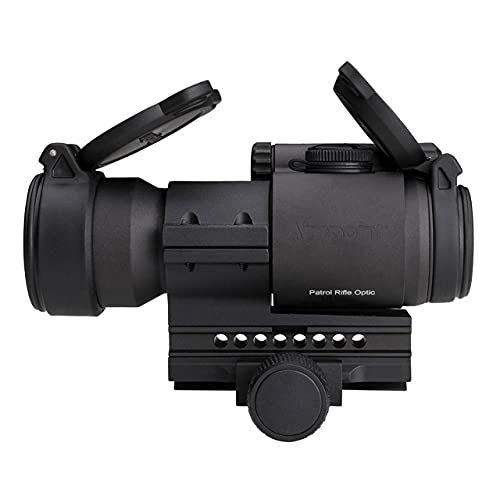
Aimpoint PRO Red Dot Reflex Sight with QRP2 Mount and Spacer, 2 MOA
$512.00Unlimited eye relief and no eye box at all, so there is no cheek weld to get right before the dot appears.
Best for: the optic you never switch off and never think about
Check price on Amazon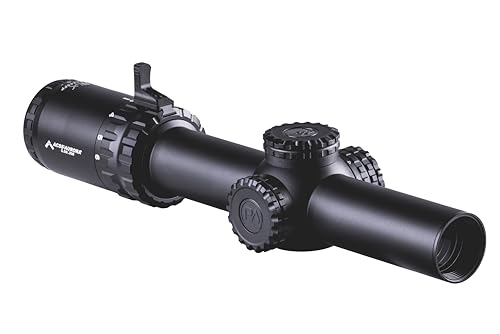
Primary Arms SLX 1-6x24 Second Focal Plane Gen IV LPVO Riflescope
$349.99 Full specificationsA genuine 1x low end with real magnification on tap to 6x, at the cost of a true eye box and a mount that has to set eye relief.
Best for: holding rather than dialling, on a 5.56 or .308 carbine
Check price on AmazonA red dot and a low power variable optic solve different problems, and the honest way to choose between them is to name the problem first rather than compare spec sheets side by side. A red dot exists to put a dot on target as fast as a set of iron sights, with no magnification and nothing shaped like an eye box to fight. An LPVO exists to do exactly that at 1x, then let you dial up real magnification the moment a target needs identifying or hitting further out.
Neither optic is a strict upgrade over the other, and a shooter who buys an LPVO expecting it to feel like a red dot at 1x is usually disappointed by the weight and the mount before they ever notice the glass. This page is built from published manufacturer specifications and owner-review consensus, not our own hands-on testing, so every figure below traces back to a source rather than to a feeling.
Why does a red dot have no eye box at all?
A red dot projects an illuminated point onto a flat or slightly curved lens rather than forming a magnified, focused image the way a telescope does. Because there is no image being relayed through a chain of lenses, there is no single distance or head position your eye has to occupy to see the dot. Move your head anywhere behind the lens within reason and the dot is still there, still appears to sit on the target, and still works. That is what "unlimited eye relief" means in practice: there is no eye box to find, because there is no optical relay that requires one.
An LPVO cannot make that same claim, even set all the way down to 1x. It is a true magnifying telescope with an erector system, and every telescope has an exit pupil your eye has to be positioned inside to see a full, unvignetted image. At 1x that exit pupil is usually wide and forgiving, which is why a good LPVO feels close to a red dot at its lowest setting. It is still not the same thing, and shooters who have run both back to back consistently describe the red dot as feeling faster from an imperfect position.
What does an LPVO cost you that a red dot never charges?
Three costs show up on an LPVO that a red dot simply does not have. The first is weight: a variable optic with a zoom erector, a larger objective, and a longer main tube is meaningfully heavier than a compact reflex sight, and that weight sits out at the end of the barrel where it matters most for handling. The second is the mount itself. An LPVO on an AR-pattern platform typically needs a cantilever mount that pushes the optic forward to set correct eye relief for the shooter's head position, and getting that measurement wrong produces a scope that is unusable at the exact moment speed matters.
The third cost is the eye box shrinking as the magnification ring turns up. Even a well-built 1-6x LPVO that feels almost red-dot-fast at 1x tightens up noticeably by 6x, punishing anything less than a consistent cheek weld. None of this makes an LPVO the wrong choice. It makes it the wrong choice for a shooter who only ever needs a dot on target inside 100 yards and never needs to identify or reach further than that.
Red dot against LPVO, by the numbers
The two optics differ in kind, not just in degree, on every specification that actually decides how each one behaves in the field.
A red dot has unlimited eye relief and stops producing an aiming point entirely if the battery dies, while an LPVO's etched reticle keeps working without power and buys real magnification at the cost of a genuine eye box.
Sourced figure
| Specification | Red dot | LPVO |
|---|---|---|
| Magnification | Fixed at 1x, no zoom | 1x to 6x or wider, variable |
| Eye relief | Unlimited, no eye box to find | Finite, an eye box exists even at 1x |
| Eye box at high magnification | Not applicable | Narrows noticeably by the top of the range |
| Reticle with a dead battery | No aiming point at all | Etched glass reticle remains fully visible |
| Typical weight | A few ounces | Noticeably heavier, plus a cantilever mount |
| Mounting requirement | Height and position for cheek weld | Height, position, and correct eye relief distance |
Exact published weights and eye relief distances vary by model within each category; the pattern in every row holds across the catalog regardless of which specific optic you compare.
What happens when each optic's battery dies?
Most modern red dots run for years on a single battery thanks to motion activation, which puts the sight to sleep after a period of stillness and wakes it the instant the rifle moves. That is a genuinely long runtime, and it is also the optic's single point of failure: a dead battery on a red dot means no aiming point exists at all, because the dot is the only thing an electronic reflex sight produces.
An LPVO with an illuminated reticle handles this failure mode differently, because the reticle itself is etched into the glass rather than generated electronically. A dead battery on an LPVO costs you the illumination and nothing else. The etched crosshair or BDC pattern is still fully visible and fully usable in daylight, which is a real, structural advantage for an optic that has to keep working after the electronics quit.
Sources
- Aimpoint published specifications
- Primary Arms published specifications
- Vortex published specifications
- Owner-review consensus from AR-pattern rifle build and defensive shooting forums
Frequently asked questions
Is an LPVO better than a red dot overall?
Neither is better in general; they answer different questions. A red dot is faster and lighter for anything decided inside 100 yards with no need for magnified identification. An LPVO gives up some of that speed and adds weight and a real eye box in exchange for genuine magnification, which matters the moment a target needs to be identified or hit further out than a red dot can resolve.
Do I need magnification for shooting inside 100 yards?
Usually not. Inside 100 yards, most targets are identifiable and hittable with the naked eye, which is exactly the scenario a red dot is built for: no magnification to focus, no eye box to find, just a dot on the target. Magnification starts earning its keep past that range, or any time positive identification before firing is genuinely in question.
How much heavier is an LPVO than a red dot?
Meaningfully heavier in every case, because an LPVO packs a zoom erector, a larger objective lens, and a longer main tube into the housing, none of which a compact reflex sight needs. The exact figure varies by model, but expect an LPVO plus its cantilever mount to add noticeably more weight at the front of the rifle than a red dot and a simple riser ever will.
Can I run an LPVO at 1x exactly like a red dot?
Close, but not identically. A well-built 1-6x LPVO set to a genuine 1x gives both-eyes-open shooting that feels similar to a red dot, but it is still a telescope with a real, if generous, eye box at that setting. A true reflex sight has no eye box at all, so an imperfect head position never costs you the picture the way it eventually can on an LPVO.
What happens if my LPVO illumination battery dies?
You lose the glow and keep the reticle, as long as the reticle is etched into the glass rather than being a wire that relies on illumination to be visible. Nearly every LPVO on the market today uses an etched reticle for this exact reason, so a dead battery is an inconvenience rather than a total loss of the aiming point.
Which is faster up close, a red dot or an LPVO at 1x?
A red dot, consistently, according to owner-review consensus across defensive and competition shooting forums. The lack of any eye box means a red dot forgives an imperfect presentation that would cost an LPVO shooter the sight picture, even with the ring turned all the way down to 1x. The gap is small with a well-built LPVO but it is not zero.
Researched, not professional advice. This page is compiled from published manufacturer specifications, published optical and ballistic formulas, and owner-review consensus, not hands-on testing. Figures described as a rule of thumb are shooter convention rather than sourced numbers, and they are labelled that way wherever they appear. Ballistic figures come from a point mass model using the ballistic coefficient the maker publishes, so treat them as a starting point and confirm them on paper at a measured distance. Confirm your firearm is unloaded with the action open before you mount, level, torque or bore sight anything. Verify a zero only on a supervised range or a safe, legal backstop, know what lies beyond your target, and follow the law where you hunt and shoot, including rules on land access and permitted cartridges.