Prism sights
Vortex Spitfire HD Gen II 3x Review
Quick answer
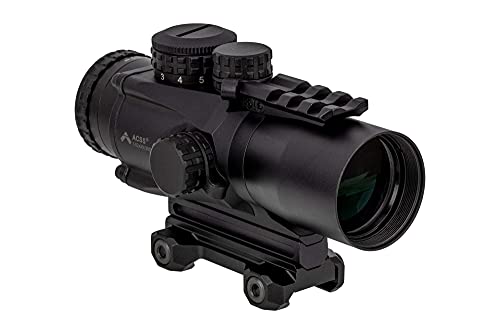
The Vortex Spitfire HD Gen II 3X Prism Scope, BDC4 Reticle is a fixed 3x prism sight with an etched BDC4 reticle, priced at $389.79. It brings Vortex's transferable lifetime warranty to the prism category, and the reticle stays fully usable with the illumination completely off, which a projected red dot cannot do.
Vortex built its reputation on hunting scopes and expanded into red dots and LPVOs, and the Spitfire HD Gen II 3x is the company's answer in a category it entered later than Primary Arms and Trijicon: the fixed-power prism sight. What it brings that a newer or smaller prism maker cannot is the same transferable, no-receipt lifetime warranty Vortex puts on its riflescopes, applied to a category where the buyer is often choosing a sight specifically to solve an astigmatism problem and wants to know it will be replaced without argument if it fails.
At $389.79 the Spitfire competes directly with the Primary Arms SLx 3x32 reviewed elsewhere on this site, and the honest comparison is reticle philosophy and warranty rather than raw optical performance, since both are etched-glass prism sights solving the same underlying problem.
This review is researched from Vortex published specifications and owner-review consensus, not from a hands-on shooting session, and states plainly where a figure such as objective lens diameter is not published for this specific configuration rather than estimating one.
On this page
- What does Vortex's warranty actually change about buying a prism sight?
- What objective lens diameter does this sight actually have?
- Does the reticle survive a dead battery, and why does that matter?
- Where the Spitfire HD Gen II costs you: fixed 3x is a narrow window
- Alternatives if a fixed 3x is the wrong amount of magnification
- Instead of fixed 3x, a variable alternative and a magnifier combination
What does Vortex's warranty actually change about buying a prism sight?
Vortex's VIP warranty repairs or replaces a damaged or defective product for as long as the owner has it, transfers to a subsequent owner with no receipt required, and has been backing the company's optics for long enough that owner-review consensus treats it as close to a known quantity rather than a marketing promise. In a category where a smaller or newer brand's warranty terms are a genuine unknown until a shooter actually needs to use one, that track record is worth real money on its own.
This matters specifically for a prism sight because the category skews toward buyers solving a real problem, astigmatism, rather than buyers shopping on price or features first. A failure that takes the sight out of service is a failure that takes the fix for that problem out of service too, and Vortex's warranty history is the reason a cautious buyer leans toward this sight over a newer prism maker at a similar price.
What objective lens diameter does this sight actually have?
Vortex's own product listing for this configuration does not publish an objective lens diameter, which means this review cannot compute an exit pupil figure the way it can for the Primary Arms SLx 3x32, whose 32 mm objective is stated plainly. That is stated here rather than guessed at, in line with this site's rule against inventing a figure a manufacturer has not published.
What Vortex does publish is a BDC4 reticle with holdover marks out to 650 yards and 12 illumination brightness settings, the lowest two rated for use with night vision equipment, which places this sight's practical low light performance in the same territory as its Primary Arms competitor even without a directly comparable exit pupil number to cite.
Does the reticle survive a dead battery, and why does that matter?
Yes, and this is the single most important functional fact about any etched prism reticle. The BDC4 reticle is a physical pattern cut into the glass, illuminated from behind for contrast in bright conditions, but visible and usable with the illumination completely off or the battery entirely dead. A red dot sight has no equivalent fallback: when its battery dies, the sight goes dark and becomes a piece of plain glass with nothing to aim through.
Vortex specifically designs this sight, described in its own marketing as usable "even without illumination," around that guarantee. For a defensive or duty use case where a dead battery at the worst moment is a real scenario worth planning for, that is a genuine and not a marginal advantage over any illuminated-only red dot in this catalog.
Where the Spitfire HD Gen II costs you: fixed 3x is a narrow window
The honest limitation of this sight has nothing to do with the glass, the reticle or the warranty, all of which are genuine strengths. It is the fixed magnification itself. Three power is meaningfully more magnification than a red dot for identifying a target and taking a precise shot at moderate distance, and it is also too much magnification for the fastest possible close-range shot, where a true 1x or a red dot's unmagnified sight picture lets both eyes track a target with zero image shift as it moves.
A fixed 3x sight asks the shooter to accept a single point on that spectrum rather than choosing where on it a given shot falls, which is exactly the flexibility an LPVO or a magnifier-and-red-dot combination provides instead. For a rifle whose job is genuinely close, inside 25 yards, or genuinely varied, this fixed magnification is the wrong tool, not because it performs poorly at 3x but because 3x is not always the right amount of scope.
Alternatives if a fixed 3x is the wrong amount of magnification
Two directions: a cheaper etched-reticle competitor, and a genuinely flexible LPVO instead of a fixed power.
| Model | Price | Magnification | Illuminated reticle | Etched glass reticle | Reticle | Objective lens |
|---|---|---|---|---|---|---|
 Vortex Spitfire HD Gen II 3X Prism Scope, BDC4 Reticle Vortex Spitfire HD Gen II 3X Prism Scope, BDC4 Reticle | $389.79 | 3x | Yes | Yes | BDC4 | - |
 Primary Arms SLX 3x32 Gen III Prism Scope Primary Arms SLX 3x32 Gen III Prism Scope | $299.99 | 3x | Yes | Yes | - | 32 mm |
 Vortex Strike Eagle 1-6x24 Second Focal Plane Riflescope, BDC3 MOA Vortex Strike Eagle 1-6x24 Second Focal Plane Riflescope, BDC3 MOA | $225.75 | 1-6x | Yes | - | BDC3 MOA | 24 mm |
A dash means the manufacturer does not publish that figure. We leave it blank rather than estimating it.
Instead of fixed 3x, a variable alternative and a magnifier combination
The Primary Arms SLX 3x32 Gen III Prism Scope is the direct prism competitor at a similar price with a published objective diameter and exit pupil this review can verify, calibrated instead to 7.62x39 and .300 Blackout. For a shooter who wants true 1x speed up close and 3x or more when a target needs a proper look, the Vortex Strike Eagle 1-6x24 Second Focal Plane Riflescope, BDC3 MOA trades the etched reticle's dead-battery guarantee for a genuinely variable magnification range. A magnifier such as the Holosun HM3X 3X Flip-to-Side Magnifier with Quick Detach Mount paired with a red dot is the other route to the same flexibility, flipping to the side in a second when the extra power is not needed.
How we chose
We did not test these optics in person and we never claim to. Picks are researched from manufacturer specification sheets, published optical and ballistic formulas, and the recurring themes in verified owner reviews. Every pick is matched to a real objective diameter, a real tube size, a real ring height or a real exit pupil rather than to a price bracket, and it is placed in the tier where its capability actually belongs. Where a figure is shooter convention rather than a sourced number we label it, and where a manufacturer does not publish a figure we leave it out instead of estimating it.
Sources
- Vortex Optics published specifications and warranty terms for the Spitfire HD Gen II 3X Prism Scope
- Owner-review consensus from verified purchaser reviews on major retail listings
Frequently asked questions
Does the Vortex Spitfire HD Gen II 3x reticle work without a battery?
Yes. The BDC4 reticle is etched into the glass rather than projected, so it stays visible and usable whether the illumination is switched off or the battery is dead. Illumination only adds brightness and contrast against a bright background; it does not create the reticle itself.
What is the exit pupil of the Spitfire HD Gen II 3x?
Vortex does not publish an objective lens diameter for this specific configuration, so this review cannot compute an exact exit pupil figure rather than estimate one. Its BDC4 reticle and 12 illumination settings, including two rated for night vision use, suggest low light performance broadly comparable to similar fixed-power prism sights in this catalog.
Is a fixed 3x prism sight a good choice for a close-range carbine?
Not the best choice if the shot is genuinely close, inside 25 yards or so, where a true 1x or a red dot's unmagnified picture tracks a moving target with both eyes open more naturally. Three power is better suited to identifying a target and taking a precise shot at a moderate distance than to the fastest possible close engagement.
How does Vortex's warranty apply to this prism sight?
The same transferable, no-receipt lifetime VIP warranty Vortex applies to its riflescopes and red dots covers this sight: damage or a defect gets repaired or replaced for as long as you own it, and it carries over to a new owner without proof of purchase. This is a meaningful advantage over a newer or smaller prism maker with less warranty history.
How does this sight compare with the Primary Arms SLx 3x32?
Both are fixed 3x etched-reticle prism sights solving the same astigmatism problem at a similar price. The Primary Arms sight publishes a 32 mm objective and a 10.3 mm exit pupil this review can verify; Vortex does not publish an equivalent figure for this configuration. The Primary Arms reticle is calibrated to 7.62x39 and .300 Blackout, this one to a generic BDC4 holdover.
Should I buy a magnifier and red dot instead of a fixed 3x prism?
Consider it if you want the flexibility to flip between an unmagnified sight picture and 3x on demand rather than living with 3x permanently. A magnifier adds a second component and a mount to fail, where a prism sight is one sealed unit, so the trade is flexibility against simplicity rather than one being objectively better.
Researched, not professional advice. This page is compiled from published manufacturer specifications, published optical and ballistic formulas, and owner-review consensus, not hands-on testing. Figures described as a rule of thumb are shooter convention rather than sourced numbers, and they are labelled that way wherever they appear. Ballistic figures come from a point mass model using the ballistic coefficient the maker publishes, so treat them as a starting point and confirm them on paper at a measured distance. Confirm your firearm is unloaded with the action open before you mount, level, torque or bore sight anything. Verify a zero only on a supervised range or a safe, legal backstop, know what lies beyond your target, and follow the law where you hunt and shoot, including rules on land access and permitted cartridges.