Glass and light
Field of View Calculator
Quick answer
Field of view scales linearly with distance and inversely with magnification. A scope showing 35 feet at 100 yards shows 70 feet at 200 and 175 feet at 500. Doubling the magnification roughly halves the field.
Manufacturers publish field of view as feet at 100 yards in North America and as degrees or metres at 1,000 metres elsewhere, which makes comparing two optics from different catalogues needlessly hard. This converts between all of them.
Two relationships do the work and both are simple. Field of view scales linearly with distance, so whatever you see at 100 yards you see twice as much of at 200. And it scales inversely with magnification, so going from 3x to 9x cuts the field to roughly a third.
That second relationship is why a wide field and high magnification are in direct tension, and why the honest answer to "what magnification do I need" usually involves turning it down.
Field of view calculator
What you see
The formula
feet at distance = feet at 100 yd x (yards / 100) degrees = 2 x arctan(feet / 2 / 300) field is inversely proportional to magnification
Optics where field of view is the point
Top matches update when you change your numbers.

Vortex Strike Eagle 1-6x24 Second Focal Plane Riflescope, BDC3 MOA
$225.75 Full specificationsThe scope that made low power variables ordinary rather than exotic. A genuine 1x with an illuminated centre that works with both eyes open, and six power when you need to look properly.
Best for: a first LPVO on a carbine
Check price on Amazon
Vortex Crossfire II 3-9x40 Riflescope, Dead-Hold BDC Reticle
$128.99 Full specificationsThe default first centrefire scope, and the reason is the warranty rather than the glass: Vortex transfers its lifetime warranty to whoever owns the scope, with no receipt and no registration, which is worth more over twenty years than a modest optical upgrade.
Best for: a first deer rifle where the scope should outlast the rifle
Check price on Amazon
Vortex Diamondback HD 8x42 Binoculars
$239.00The same binocular at eight power, which gives a 5.25 mm exit pupil, a wider field and an image that is noticeably steadier in the hand. Most people should buy this rather than the 10x.
Best for: handheld glassing at dawn and dusk
Check price on Amazon Vortex Diamondback HD 10x42 Binoculars
$240.00The default recommendation in this category for a decade, and the reason is that nothing at the price has better glass with a transferable lifetime warranty behind it.
Best for: general hunting and glassing
Check price on Amazon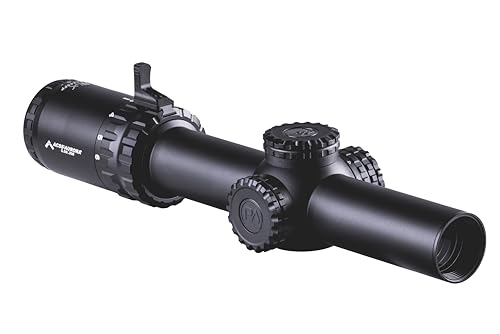
Primary Arms SLX 1-6x24 Second Focal Plane Gen IV LPVO Riflescope
$349.99 Full specificationsThe ACSS reticle does ranging, holdover and a moving target lead in one etched pattern calibrated to a cartridge class, which is a lot of capability for a shooter who will never dial a turret.
Best for: holding rather than dialling, on a 5.56 or .308 carbine
Check price on Amazon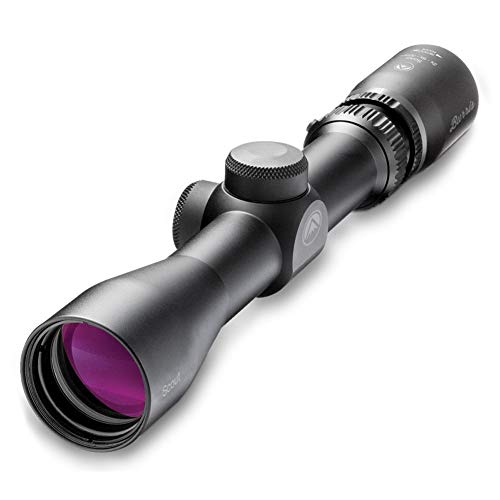
Burris Scout 2-7x32 Riflescope, Ballistic Plex Reticle
$429.00 Full specificationsLong eye relief so it mounts forward of the action, which keeps the ejection port clear and lets you shoot with both eyes open and full peripheral vision.
Best for: a forward-mounted scout rifle setup
Check price on AmazonWhat typical optics actually show you
Representative published figures for common configurations, converted into degrees and projected out to distance. These are typical values for the class rather than a specification for any particular model.
A 3-9x40 typically shows about 35 feet at 100 yards at 3x and only about 13 feet at 9x, which is the cost of magnification made concrete.
Shooter convention
| Configuration | At 100 yd | In degrees | At 200 yd | At 500 yd |
|---|---|---|---|---|
| Typical 3-9x40 at 3x | 35 ft | 6.68 degrees | 70 ft | 175 ft |
| Typical 3-9x40 at 9x | 13 ft | 2.48 degrees | 26 ft | 65 ft |
| Typical 1-6x24 at 1x | 110 ft | 20.78 degrees | 220 ft | 550 ft |
| Typical 4-16x44 at 16x | 7.5 ft | 1.43 degrees | 15 ft | 37.5 ft |
| Typical 10x42 binocular | 340 ft | 59.08 degrees | 680 ft | 1700 ft |
These are representative figures for the class, not published specifications for a particular model. Always use the figure in your own manual, which manufacturers do publish for field of view.
Why field of view matters more than people expect
Three situations where it decides the outcome.
- Finding the target at all. At 16x a scope might show seven feet at 100 yards. Locating a stationary animal through that is genuinely hard, which is why experienced shooters find the target at low magnification and then zoom in.
- Tracking something moving. A narrow field means a moving animal leaves the picture, and once it is gone you have to find it again from scratch.
- Shooting fast up close. This is the entire argument for a true 1x on a low power variable: a wide field lets you shoot with both eyes open and keep peripheral awareness.
Field of view is also a reasonable proxy for eyepiece quality within a price class. A wide field at a given magnification is optically harder to deliver, so a maker offering one is usually spending money on the eyepiece.
Field of view and eye relief pull against each other
Designing a wide field and generous eye relief into the same eyepiece is difficult, and inexpensive optics usually sacrifice one.
That matters most on a hard recoiling rifle, where eye relief is a safety consideration rather than a comfort one. Given the choice on a magnum, take the eye relief. Given the choice on a rimfire or a low power variable used up close, take the field.
Note also that on most variable scopes, eye relief changes across the magnification range. Set your eye relief at the magnification you expect to shoot at, which for a hunting scope is usually the top of the range rather than the bottom.
Sources
- Exact trigonometry for angular field of view, and manufacturer published field of view figures
Frequently asked questions
How is field of view measured on a riflescope?
In North America as the width in feet visible at 100 yards. European makers usually publish degrees, or metres at 1,000 metres. All three describe the same angle, so they convert exactly between each other. Field of view is one of the figures manufacturers do reliably publish, so use the number in your own manual.
How does magnification affect field of view?
Inversely and almost exactly. Doubling the magnification roughly halves the field of view. A scope showing 35 feet at 100 yards at 3x will show about 12 feet at 9x. This is the concrete cost of magnification and it is the main reason to leave a variable scope turned down until you need it.
What is a good field of view for hunting?
At the magnification you actually hunt at, as wide as you can get. On a 3-9x used mostly at 4x or 5x, something in the region of 25 feet at 100 yards is comfortable for finding and tracking. Very narrow fields at high magnification make locating an animal slow, which is when shots get missed.
Does a bigger objective give a wider field of view?
No. Field of view is determined by the eyepiece design and the magnification, not the objective diameter. A bigger objective gives you a larger exit pupil and therefore a brighter image at a given magnification, which is a different benefit entirely and is frequently confused with this one.
Why does my field of view seem smaller than the specification?
Usually eye position. If your eye is not at the correct eye relief distance and centred, you see a smaller circle with dark edges. Check that the scope is set for your actual shooting position, and on a variable scope remember that eye relief shifts as you change magnification.
Is a wider field of view always better?
Not always, because it competes with eye relief in the eyepiece design. On a hard recoiling rifle, take the eye relief, which is a safety matter rather than a comfort one. On a low power variable used fast and up close, take the field. On a high magnification target scope neither is usually the limiting factor.
Researched, not professional advice. This page is compiled from published manufacturer specifications, published optical and ballistic formulas, and owner-review consensus, not hands-on testing. Figures described as a rule of thumb are shooter convention rather than sourced numbers, and they are labelled that way wherever they appear. Ballistic figures come from a point mass model using the ballistic coefficient the maker publishes, so treat them as a starting point and confirm them on paper at a measured distance. Confirm your firearm is unloaded with the action open before you mount, level, torque or bore sight anything. Verify a zero only on a supervised range or a safe, legal backstop, know what lies beyond your target, and follow the law where you hunt and shoot, including rules on land access and permitted cartridges.