First focal plane riflescopes
Best First Focal Plane Scopes
Quick answer
The best first focal plane riflescope is the Vortex Venom 5-25x56 First Focal Plane Riflescope, EBR-7C MOA at $499.00, because its reticle holdovers stay accurate at every magnification setting rather than only at maximum power. First focal plane is the wrong choice for most hunting rifles; this page says plainly who should skip it.
A first focal plane reticle physically grows and shrinks with magnification, sitting in front of the erector assembly rather than behind it. The reason to want that is subtension: the amount of target a mil or an MOA mark on the reticle covers stays constant no matter what power you are on, so a holdover measured at 8x is the same holdover at 20x with no math to convert it.
A second focal plane reticle stays a constant size on the glass regardless of magnification, which means its subtensions are only correct at one specified power, usually the top of the range. That is a real limitation for dialling or holding a computed correction, and it is completely irrelevant for a duplex crosshair used to put a bullet on a deer inside 200 yards.
This is genuinely a case where the wrong choice for your rifle is a common one, and this page spends as much time on who should not buy first focal plane as on who should. Researched from published manufacturer specifications and owner-review consensus, not a hands-on shooting session.
On this page
Who should NOT buy a first focal plane scope?
This is the most important section on this page, because first focal plane is bought far more often than it is needed.
Skip first focal plane if you hunt at low magnification in fading light. The reticle shrinks along with the image at low power, and a thin FFP reticle against a dark animal at last light can be genuinely hard to see, exactly when the shot is happening. A second focal plane reticle stays a constant, visible size regardless of power.
Skip it if your rifle never leaves 200 yards. Subtension only matters when you are measuring or holding over a real distance. Inside 200 yards with a simple duplex, first focal plane buys nothing and costs the reticle visibility described above.
Skip it if you are on a strict budget. First focal plane construction adds cost, and on an inexpensive scope that cost is frequently paid for by cutting turret repeatability or glass quality instead, which matters more.
Buy first focal plane if you dial or hold over a computed correction at varying magnification, which is precision and long range shooting, competition, and any rifle where the reticle itself is used to range or hold rather than just to aim center.
How reticle subtension actually changes between first and second focal plane
The same 2 mil hold, on the same reticle, at two different magnifications. This is the entire argument for first focal plane in one table.
A first focal plane reticle covers the same 2 mil of target at 8x and at 24x, while the identical mark on a second focal plane reticle covers three times as much target at 8x as it does at 24x.
Sourced figure
| Focal plane | Magnification | What a 2 mil mark actually covers | Usable without conversion? |
|---|---|---|---|
| First focal plane | 8x | Exactly 2 mil of target | Yes |
| First focal plane | 24x | Exactly 2 mil of target | Yes |
| Second focal plane | 8x (below calibrated power) | More than 2 mil of target | No, requires a conversion factor |
| Second focal plane | 24x (the calibrated power) | Exactly 2 mil of target | Yes, at this power only |
A second focal plane reticle is only exactly correct at the single magnification it was calibrated for, almost always the top of the range. At every other power the reader must multiply by a ratio, in the field, under time pressure.
A first first focal plane scope
For a shooter moving from a fixed hunting scope to their first dialling or holdover platform, without yet knowing exactly how much magnification range they will use.

Arken Optics SH4 GEN2 4-16x50 FFP Riflescope, Illuminated VPR MIL Reticle
$299.99 Full specificationsA 34 mm tube and a locking zero stop at a price that undercuts most of the category, from a direct-to-consumer maker whose entry into first focal plane construction has held up in owner-review consensus.
Best for: a first scope built specifically around holdovers rather than a fixed reticle
Check price on Amazon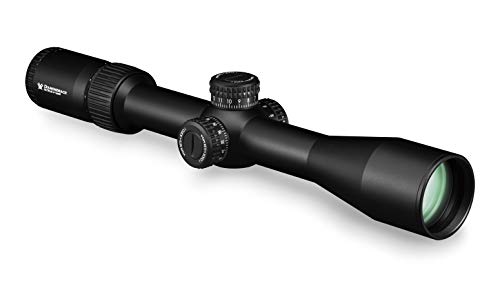
Vortex Diamondback Tactical 4-16x44 First Focal Plane Riflescope, EBR-2C MOA
$399.00 Full specificationsThe same 4-16x44 first focal plane configuration used across this site turnkey builds, chosen for turret repeatability that holds up rather than for the largest feature list.
Best for: a shooter who wants the widely proven pick over a newer entrant
Check price on AmazonThe buy-once first focal plane riflescope
Where the reticle, glass and turret quality all step up together, for a rifle whose holdovers get used regularly rather than occasionally.

Athlon Argos BTR GEN3 6-24x50 Riflescope, APRS11 FFP IR MIL Reticle
$379.99 Full specificationsAn illuminated first focal plane mil reticle with a zero stop, a combination that rarely appears together this far under the price of the expert tier on this page.
Best for: low light holdovers where an illuminated reticle stays visible against a dark background
Check price on Amazon
Primary Arms SLX 3-18x50mm FFP Gen II Riflescope
$499.99Primary Arms designs its own reticle family to combine ranging, holdover and wind holds into one first focal plane pattern sized to a specific load class rather than a generic grid.
Best for: a shooter who wants to range and hold without dialling for every shot
Check price on AmazonFirst focal plane at the performance ceiling
Two very different expert-tier answers, because first focal plane serves two different jobs at this level: a dedicated long range platform, and a low power variable built for speed up close with correct subtensions further out.

Vortex Venom 5-25x56 First Focal Plane Riflescope, EBR-7C MOA
$499.00 Full specificationsA 56 mm objective keeps the exit pupil usable at 25x well into fading light, on a 34 mm tube built for the elevation travel that a first focal plane scope at this magnification range is actually bought for.
Best for: a dedicated long range platform where holdovers are read at every power setting
Check price on Amazon
Trijicon Credo 1-8x28 LPVO First Focal Plane Riflescope, 34mm Tube
$1,509.03 Full specificationsFirst focal plane construction on a genuine 1-8x low power variable, which is unusual: the reticle is small enough at 1x to still be fast up close while staying correct for holdovers at 8x.
Best for: a rifle that needs to be fast at 1x and precise at 8x on the same reticle
Check price on AmazonWho should not buy this tier: Anyone hunting at low magnification in fading light, where a first focal plane reticle physically shrinks and can become hard to see against a dark animal exactly when the shot is happening. A second focal plane hunting scope from the flagship riflescope roundup is the correct tool for that shot, regardless of budget.
How we chose
We did not test these optics in person and we never claim to. Picks are researched from manufacturer specification sheets, published optical and ballistic formulas, and the recurring themes in verified owner reviews. Every pick is matched to a real objective diameter, a real tube size, a real ring height or a real exit pupil rather than to a price bracket, and it is placed in the tier where its capability actually belongs. Where a figure is shooter convention rather than a sourced number we label it, and where a manufacturer does not publish a figure we leave it out instead of estimating it.
Sources
- Vortex Optics and Trijicon published reticle and objective specifications
- Athlon Optics and Primary Arms published reticle designs
- Owner-review consensus on first focal plane reticle visibility aggregated across major retailers
Frequently asked questions
What is the best first focal plane riflescope?
The Vortex Venom 5-25x56 First Focal Plane Riflescope, EBR-7C MOA at $499.00. Its 56 mm objective keeps the exit pupil usable at 25x into fading light, which matters specifically for first focal plane use because holdovers are read at every magnification, not only at a fixed power.
Is first focal plane worth it for hunting?
Usually not. The reticle shrinks along with the image at low magnification, which can make it hard to see against a dark animal at last light, exactly when many hunting shots happen. A second focal plane reticle stays a constant visual size at every power, which is the better trade for most hunting rifles.
What is reticle subtension and why does it matter?
Subtension is how much of the target a mark on the reticle actually covers. On a first focal plane scope that amount stays constant at every magnification, so a 2 mil hold measured at 8x is still exactly 2 mil at 24x. On a second focal plane scope it is only correct at one specified power, usually the highest.
Can I range a target with a first focal plane reticle at any magnification?
Yes, which is the specific advantage over second focal plane. Because the reticle subtensions are correct at every power, a target measured in mils or MOA gives a correct range calculation whether you are at 6x or 24x, with no conversion factor needed.
Why does my first focal plane reticle look thin at low magnification?
Because it physically shrinks along with everything else in the image as magnification decreases, which is the mechanism that keeps subtensions correct. At the lowest end of the power range a fine reticle can become hard to see against a dark or low-contrast background, which is the main argument against first focal plane for hunting.
Does first focal plane cost more than second focal plane at the same magnification?
Generally yes, because the reticle sits ahead of the magnifying erector assembly and has to be manufactured to hold up optically at every power rather than one. That added cost is worth paying if you regularly hold over or range at varying magnification, and is not worth paying for a hunting rifle used mainly at one power with a simple duplex.
Researched, not professional advice. This page is compiled from published manufacturer specifications, published optical and ballistic formulas, and owner-review consensus, not hands-on testing. Figures described as a rule of thumb are shooter convention rather than sourced numbers, and they are labelled that way wherever they appear. Ballistic figures come from a point mass model using the ballistic coefficient the maker publishes, so treat them as a starting point and confirm them on paper at a measured distance. Confirm your firearm is unloaded with the action open before you mount, level, torque or bore sight anything. Verify a zero only on a supervised range or a safe, legal backstop, know what lies beyond your target, and follow the law where you hunt and shoot, including rules on land access and permitted cartridges.