Leveling Tools
Best Scope Levels and Anti-Cant Tools
Quick answer
The best scope leveling tool for most builds is the Wheeler Engineering Professional Reticle Leveling System at $59.99, which references the action rather than the bench. A reticle canted 2 degrees is invisible at 100 yards, yet it turns 0.35 MOA of every 10 MOA you dial into unwanted windage, which is roughly 1.8 inches at 500 yards.
Cant is whether the reticle's vertical crosshair is actually square to gravity when the rifle is shouldered. It costs nothing to check and it is one of the largest avoidable sources of missed shots at distance, precisely because it is invisible where most people zero.
The mechanism is simple trigonometry rather than a mystery: if the reticle is tilted, dialling elevation moves the impact partly sideways instead of purely upward, and the amount of sideways error grows in direct proportion to how much you dial. At 100 yards the effect is smaller than a group. At 500 or 600 yards with a real come-up on the turret, it is a clean miss that looks exactly like a wind call gone wrong.
Every figure below is either exact trigonometry, marked accordingly, or a stated convention, and this page never estimates a figure a manufacturer has not published.
On this page
Best budget anti-cant tools
A first leveling tool does not need to be elaborate. These clip or bolt onto the rail and give you a visible reference at the range for a very small amount of money, which is most of the way to solving the problem entirely.

Monstrum Low Profile Picatinny Anti-Cant Level Bubble
$16.99A low profile bubble level that clips to a Picatinny rail, giving a constant visual reference in peripheral vision while shouldering the rifle.
Best for: A first scope on a Picatinny-railed rifle
Check price on Amazon
Wheeler Engineering Level-Level-Level Mounting Tool with Magnetic Base
$19.99A magnetic-base tool built specifically for the mounting process itself, referencing the action rather than the tabletop it sits on.
Best for: Levelling the reticle correctly during the mounting job itself
Check price on AmazonBest buy-once leveling systems
At this tier the tool references the rifle's own machined surfaces rather than your eye and a tabletop, which removes the parallax error that comes from eyeballing a bubble from an angle.
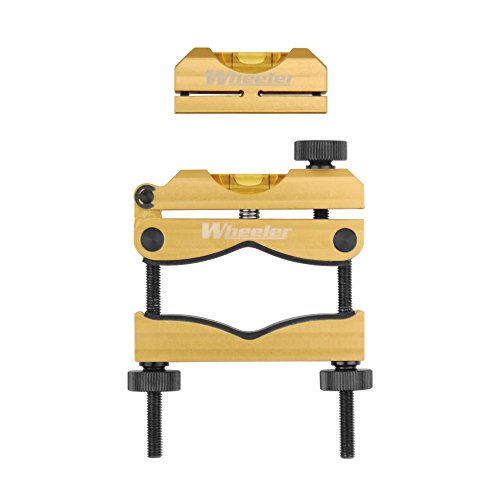
Wheeler Engineering Professional Reticle Leveling System
$59.99References the action and the scope against each other rather than against the table, which is the distinction that actually matters for accuracy.
Best for: Mounting a scope that will be dialled at distance
Check price on Amazon
Vortex Riflescope Bubble Level, 1 inch
$39.00A permanent anti-cant level that clamps to the tube itself and stays visible in peripheral vision on every shot, not only during mounting.
Best for: A rifle that gets dialled regularly at distance
Check price on AmazonBest precision leveling tools
These reference a machined flat on the turret housing or a precision mounting surface rather than the crosshair itself, which is genuinely square to the reticle by manufacture, unlike an eyeballed centre line.

Arisaka Optic Leveler Combo, Precision Mounting Tool
$34.20References the machined flat on the scope's turret housing, which is genuinely square to the reticle, rather than your eye tracking the crosshair itself.
Best for: A precision build where mounting error needs to be measured, not estimated
Check price on Amazon
Vortex Riflescope Pro Leveling Kit
$29.00A published leveling kit that pairs an action-reference level with a scope-reference level, checking both halves of the same alignment.
Best for: A full precision mounting job done in one session
Check price on AmazonWho should not buy this tier: Skip a leveling system that references a scope's machined turret housing if the scope you own has no exposed flat built for exactly this purpose. The advantage only exists on scopes designed with that reference surface, and on everything else a standard action-referenced level does the identical job for a fraction of the price.
How much does a small cant actually cost you?
The working
horizontal error (MOA) = dialled elevation (MOA) x sin(cant angle)
Exact trigonometry. The error is proportional to how much elevation you dial, which is exactly why cant is invisible at short range and punishing at distance once you start dialling real come-ups.
The relationship between cant angle and windage error is exact trigonometry, not a rule of thumb, which is why it can be tabulated precisely.
Two degrees of cant is invisible in the reticle at 100 yards, and it turns 0.35 MOA of every 10 MOA you dial into unwanted windage, which is roughly 1.8 inches at 500 yards.
Sourced figure
| Cant angle | Horizontal error per 10 MOA dialled | Error at 500 yards, dialling 10 MOA |
|---|---|---|
| 1 degree | 0.17 MOA | 0.9 in |
| 2 degrees | 0.35 MOA | 1.8 in |
| 3 degrees | 0.52 MOA | 2.7 in |
| 5 degrees | 0.87 MOA | 4.6 in |
| 10 degrees | 1.74 MOA | 9.1 in |
Figures use sin(angle) times the dialled MOA, then convert to inches at 500 yards using the exact MOA subtension at that distance. A two degree cant is genuinely difficult to spot in a reticle at 100 yards, which is exactly why it survives uncorrected.
Why cant is invisible where you zero it
At 100 yards a small cant produces an error small enough to disappear inside the size of an ordinary group. The reticle looks straight, the group looks fine, and the rifle appears zeroed correctly, because at that distance and with a small come-up the sideways component of the error is a few hundredths of an inch.
The same rifle at 500 yards, with 10 or 15 MOA dialled to reach that distance, turns the identical two degrees of cant into multiple inches of unexplained sideways drift. Shooters who experience this for the first time almost always blame wind, because the symptom, a shot that lands off to one side, looks identical to a wind call error. Checking cant with a level costs a few minutes and removes the possibility entirely.
How we chose
We did not test these optics in person and we never claim to. Picks are researched from manufacturer specification sheets, published optical and ballistic formulas, and the recurring themes in verified owner reviews. Every pick is matched to a real objective diameter, a real tube size, a real ring height or a real exit pupil rather than to a price bracket, and it is placed in the tier where its capability actually belongs. Where a figure is shooter convention rather than a sourced number we label it, and where a manufacturer does not publish a figure we leave it out instead of estimating it.
Sources
- Exact trigonometric relationship between cant angle and dialled elevation error
- Wheeler, Vortex and Arisaka published leveling tool specifications from the product listings in our catalog
Frequently asked questions
What is scope cant and why does it matter?
Cant is whether the reticle's vertical line is actually square to gravity when the rifle is shouldered, rather than tilted slightly to one side. It matters because dialling elevation on a canted reticle moves the impact partly sideways instead of purely upward, and that sideways error grows in direct proportion to how much elevation you dial.
How much cant is actually a problem?
Even 1 to 2 degrees becomes meaningful once you start dialling real come-ups at distance. Two degrees of cant turns about 0.35 MOA of every 10 MOA dialled into unwanted windage, which is roughly 1.8 inches at 500 yards. At 100 yards the same error is small enough to hide inside a normal group, which is why it goes uncorrected.
Do I need an expensive leveling system, or will a cheap bubble level work?
A cheap rail-mounted bubble level removes most of the problem for very little money, and it is a large improvement over eyeballing the reticle against a wall. A reticle-referenced system that checks the action and the scope against each other, rather than against a tabletop, is worth the extra cost mainly for a precision build that will actually be dialled at distance.
Can I level a scope by eye without any tool?
You can attempt to, using a plumb line or a squared wall, but it is far less reliable than a tool that references the action directly, and small errors from eyeballing are exactly the kind that survive uncorrected because they look fine at 100 yards. A basic level costs very little and removes the guesswork entirely.
Does cant affect windage or elevation more?
Cant converts part of your intended elevation correction into windage error; it does not meaningfully change the elevation itself. The larger the come-up you dial, the larger the sideways error becomes, which is exactly why cant is invisible on a 100 yard zero, where little elevation is dialled, and obvious once you are correcting for distance.
Should the level go on the tube or on the rail?
Both positions work, and they check slightly different things. A rail-mounted level references the base relative to gravity. A tube-mounted level checks the scope itself, which is what actually needs to be square to gravity for the reticle to be correct. A tube-mounted level is the more direct check once the base itself is confirmed square.
Researched, not professional advice. This page is compiled from published manufacturer specifications, published optical and ballistic formulas, and owner-review consensus, not hands-on testing. Figures described as a rule of thumb are shooter convention rather than sourced numbers, and they are labelled that way wherever they appear. Ballistic figures come from a point mass model using the ballistic coefficient the maker publishes, so treat them as a starting point and confirm them on paper at a measured distance. Confirm your firearm is unloaded with the action open before you mount, level, torque or bore sight anything. Verify a zero only on a supervised range or a safe, legal backstop, know what lies beyond your target, and follow the law where you hunt and shoot, including rules on land access and permitted cartridges.