Long range riflescopes
Best Long Range Riflescopes
Quick answer
The best long range riflescope is the Vortex Viper PST Gen II 5-25x50 First Focal Plane Riflescope, EBR-7C MOA at $999.00, because its turrets return to zero reliably after hundreds of revolutions, which is the specific failure mode that separates a real distance scope from one that merely has exposed turrets and a big number on the box.
Long range shopping goes wrong in a predictable place: magnification. A 6-24x scope is not automatically a longer-range scope than a 4-16x one, because magnification has nothing to do with how far a scope can actually be dialled. What decides that is internal elevation travel and whether the turret returns to the same place every time it is asked to.
A scope has a fixed amount of internal elevation travel, and roughly half of it sits above mechanical center. A rifle that is not perfectly aligned eats into that half before a single click of come-up is dialled. A 30 mm tube gives meaningfully more room for that travel than a 1 inch tube; a 34 mm tube gives more still. None of this is published as a single clean number by most makers, which is why total elevation travel is frequently unavailable rather than simply omitted from this page.
Researched from published manufacturer specifications and owner-review consensus, not a hands-on shooting session at distance. Where a maker does not publish total elevation travel, this page says so rather than estimating a figure that does not exist.
On this page
Why a 20 MOA base matters more than the next tier of scope
A canted base tilts the whole scope down at the front, so the zero sits lower in the erector range rather than in the middle. The unused down travel becomes usable up travel, and it is a fraction of the price of stepping up a whole scope tier. On a rifle shot inside 300 yards, however, the same base can make it impossible to zero at all, because the erector runs out of down adjustment before the impact reaches the line of sight.
Check your own load against real numbers before assuming a scope needs replacing: see what 1 MOA and 1 mil are worth at 500 yards and compare it to a published elevation travel figure, or run a 308 Winchester with a 200 yard zero to see the actual come-up a distance shot requires.
The elevation budget
usable elevation past zero = (total internal travel / 2) - travel already consumed by mechanical alignment a 20 MOA base converts roughly 20 MOA of unused DOWN travel into usable UP travel
The exact split above and below mechanical center varies by scope and is rarely published to the MOA. Treat the halving as the right scale of the effect, not an exact promise for any specific model.
What actually separates a long range riflescope from a hunting scope
The honest comparison, since specification sheets make it look like this is about magnification and it is not.
The largest real difference between a long range riflescope and a hunting scope is turret repeatability and tube diameter, not the top end of the magnification range.
Shooter convention
| What changes | How much it matters | Why |
|---|---|---|
| Turret repeatability under heavy dialling | The largest factor | Returns to zero after hundreds of revolutions, in the cold, with gloves on, which is exactly what a distance rifle demands and a hunting scope never tests |
| Tube diameter (30 mm or 34 mm) | Large | Leaves room the erector needs to travel further before running out, which a 1 inch tube frequently cannot provide |
| First focal plane reticle | Large for dialling and holding | Subtensions stay correct at every magnification, so a hold taken at low power matches one taken at high power |
| Zero stop | Moderate to large | Lets you return to zero by feel without counting revolutions, which removes the chance of being one full turn off |
| Top-end magnification | Small past about 20x | Mirage usually limits what can be resolved at distance before the optic itself runs out of resolving power |
This ordering is close to the reverse of how these scopes are marketed, which is exactly why the specification sheet alone is a poor guide to this category.
A first real step into dialling at distance
For a shooter who has proven they can zero and read a wind call, and now wants a scope that can actually be dialled past a hunting rifle range.
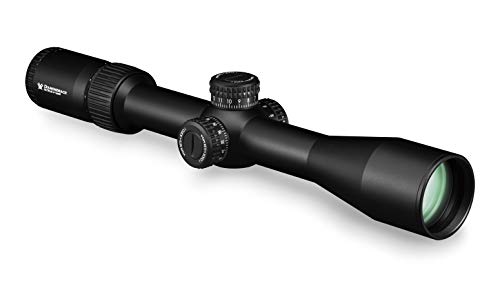
Vortex Diamondback Tactical 4-16x44 First Focal Plane Riflescope, EBR-2C MOA
$399.00 Full specificationsA first focal plane reticle on a 30 mm tube at the lowest price where turret repeatability is genuinely trustworthy rather than a marketing claim, which is the correct floor for this category.
Best for: a first scope built specifically to be dialled rather than merely capable of it
Check price on Amazon
Arken Optics SH4 GEN2 4-16x50 FFP Riflescope, Illuminated VPR MIL Reticle
$299.99 Full specificationsDirect-to-consumer pricing on a 34 mm tube with a locking zero stop, which puts genuinely useful internal elevation travel within reach of a first distance scope purchase.
Best for: a shooter who wants more elevation headroom before their reach is proven
Check price on AmazonThe buy-once long range riflescope
Where the turret feel and glass quality genuinely justify the price increase over the beginner tier, for a rifle that will be dialled regularly rather than occasionally.

Athlon Optics Midas TAC HD 6-24x50 First Focal Plane Riflescope, APRS3 FFP MIL
$569.00 Full specificationsThe step up from an entry level first focal plane scope to this one is glass and turret feel rather than added features, and turret feel is what stops a shooter losing count of clicks in the cold with gloves on.
Best for: a rifle where the turrets get used every session, not just at sight-in
Check price on Amazon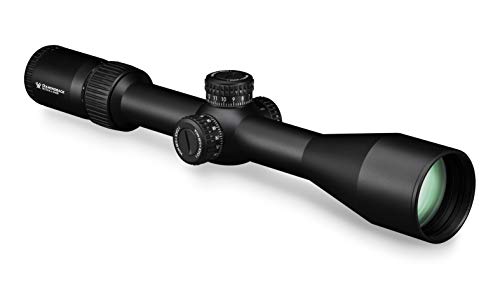
Vortex Diamondback Tactical 6-24x50 First Focal Plane Riflescope
$425.99 Full specificationsA 50 mm objective and a 6-24x range on the same construction quality as the 4-16x44 below it, for a shooter who has confirmed they actually shoot past the range where the smaller objective runs thin.
Best for: a shooter who has proven a need for more top-end magnification
Check price on AmazonThe reference long range riflescope
Where turret repeatability, mount precision and internal travel converge, at a price where none of the three is compromised to hit a lower number.

Leupold Mark 4HD 4.5-18x52 M5C3 Side Focus FFP PR2-Mil Riflescope
$1,499.99 Full specificationsA 34 mm tube and a side focus first focal plane design built for the largest possible internal elevation travel, from a maker whose turret mechanisms are built to a military and law enforcement specification.
Best for: a precision rifle where the mount and the scope are both being built to the same standard
Check price on AmazonWho should not buy this tier: Anyone whose groups are larger than roughly half a minute of angle, or who has never actually run out of elevation with a cheaper scope. This tier solves a mechanical problem, turret repeatability and internal travel, and it does nothing for a rifle or a load that is the real limiting factor. Prove the need with the intermediate tier first.
How to tell if you have actually run out of elevation
- Confirm the rifle is unloaded. Open the action, check the chamber is empty, and leave it open for the rest of this check.
- Work out your required come-up. Find the come-up your load needs at your longest realistic distance in MOA or mil, using your own chronographed velocity rather than a catalog figure.
- Halve the published total travel. Roughly half of a scope total internal elevation travel sits above mechanical center. Halve the published figure to estimate what is actually available for dialling.
- Subtract what your zero already used. A rifle that is not perfectly aligned to the base consumes some of that travel just reaching a 100 yard zero, before any come-up is dialled at all.
- Compare what is left to what you need. If the remaining travel does not comfortably clear your required come-up, add a canted base before assuming the scope itself needs replacing.
How we chose
We did not test these optics in person and we never claim to. Picks are researched from manufacturer specification sheets, published optical and ballistic formulas, and the recurring themes in verified owner reviews. Every pick is matched to a real objective diameter, a real tube size, a real ring height or a real exit pupil rather than to a price bracket, and it is placed in the tier where its capability actually belongs. Where a figure is shooter convention rather than a sourced number we label it, and where a manufacturer does not publish a figure we leave it out instead of estimating it.
Sources
- Vortex Optics published turret and elevation travel specifications
- Leupold, Athlon Optics and Arken Optics published specifications
- Owner-review consensus on turret repeatability aggregated across major retailers
Frequently asked questions
What is the best riflescope for long range shooting?
The Vortex Viper PST Gen II 5-25x50 First Focal Plane Riflescope, EBR-7C MOA at $999.00. Turret repeatability, the ability to return reliably to zero after hundreds of revolutions, is the specific capability that separates a genuine long range scope from one with exposed turrets and little else, and it is where this pick earns its price.
Does more magnification mean a scope can shoot further?
No. Magnification determines how large the target appears; it has no bearing on how much elevation the turret can dial. A 6-24x scope with limited internal travel reaches less far than a 4-16x scope built with a 34 mm tube and a well engineered erector. Judge reach by elevation travel and turret repeatability, not by the top magnification number.
Do I need a 34mm tube for long range shooting?
Only once you have confirmed your required come-up approaches half of what a 30 mm tube scope can provide. A 34 mm tube leaves more room for the erector to travel, which matters mainly past 800 yards or with a load that needs unusually large elevation corrections. It does not improve brightness or click precision.
How do I know if my scope has run out of elevation?
Work out the come-up your load needs at your longest realistic distance, halve the scope published total elevation travel to estimate what sits above mechanical center, then subtract whatever your zero already consumed. If what remains does not clearly exceed your required come-up, the fix is usually a canted base rather than a new scope.
Is a zero stop worth having on a long range riflescope?
Once you regularly dial come-ups, yes. A zero stop is a mechanical stop that prevents the turret from turning below your zero, so you can return to it by feel alone without counting revolutions or checking a fiber optic indicator. It removes the specific and common mistake of being one full turret revolution off, which produces a large and confusing miss.
What ballistic coefficient and velocity should I use for a drop table?
Your own, whenever possible. A catalog muzzle velocity comes from a test barrel that is usually longer than yours, and a difference of 100 feet per second is completely ordinary between rifles. A chronographed velocity, run through a computed drop table like the ones on this site, produces a far more trustworthy come-up past 400 yards than any published figure alone.
Researched, not professional advice. This page is compiled from published manufacturer specifications, published optical and ballistic formulas, and owner-review consensus, not hands-on testing. Figures described as a rule of thumb are shooter convention rather than sourced numbers, and they are labelled that way wherever they appear. Ballistic figures come from a point mass model using the ballistic coefficient the maker publishes, so treat them as a starting point and confirm them on paper at a measured distance. Confirm your firearm is unloaded with the action open before you mount, level, torque or bore sight anything. Verify a zero only on a supervised range or a safe, legal backstop, know what lies beyond your target, and follow the law where you hunt and shoot, including rules on land access and permitted cartridges.