Long range scope reviews
Vortex Diamondback Tactical 4-16x44 Review
Quick answer
The Vortex Diamondback Tactical 4-16x44 at $399.00 is the cheapest first focal plane scope worth owning: its EBR-2C reticle holds true subtension at every magnification, giving a 2.75mm exit pupil at 16x, a real trade for a hold you can trust without checking your zoom setting first.
First focal plane scopes exist to solve one problem: a reticle that holds a hold or a dial mark true at any magnification, not only at the top of the zoom range. Most FFP scopes charge a real premium for that. The Vortex Diamondback Tactical 4-16x44 is the point where that premium gets small enough to stop mattering.
This review is built from Vortex's own published specifications, the exact optical arithmetic those specs allow, and the consensus of verified owner reviews. We did not test this scope in person. Turret repeatability across hundreds of clicks is the one thing a spec sheet cannot show, and it is worth confirming with your own box test before trusting a scope at distance.
On this page
- What does first focal plane actually buy you that a hunting scope does not?
- What exit pupil does this scope actually deliver across its zoom range?
- What ring height does a 44mm objective on a 30mm tube need?
- What does owner-review consensus say about this scope at the range?
- The compromise that keeps this the cheapest FFP worth owning
- A step up with more magnification, and an illuminated alternative instead
What does first focal plane actually buy you that a hunting scope does not?
In a second focal plane scope, the reticle stays a constant size on your eye as you zoom, which means its holdover marks are only accurate at one specific magnification, usually the top of the range. In a first focal plane scope like this one, the reticle grows and shrinks with the image, so a 2 mil hold is exactly 2 mils of correction whether you are at 4x or 16x. That is the entire argument for the category, and it is why exposed turrets and a mil or MOA reticle almost always ship together on an FFP scope.
What exit pupil does this scope actually deliver across its zoom range?
The working
exit pupil = objective / magnification, twilight factor = sqrt(objective x magnification)
Exact arithmetic from the published 44mm objective and 4-16x magnification range.
At 16x the Diamondback Tactical 4-16x44 gives a 2.75mm exit pupil, which is why this scope is a daylight and moderate-light tool at full power rather than a dusk one.
Sourced figure
| Magnification | Exit pupil | Twilight factor |
|---|---|---|
| 4x | 11.00mm | 13.3 |
| 8x | 5.50mm | 18.8 |
| 16x | 2.75mm | 26.5 |
See the full 44mm objective at 16x low light breakdown for how this figure compares against every other 44mm scope on this site at the same magnification.
What ring height does a 44mm objective on a 30mm tube need?
This scope moves up to a 30mm tube for more internal elevation travel than a 1 inch tube provides, which changes the ring height math from the smaller hunting scopes above. See the worked figures for a 44mm objective on a 30mm tube rather than assuming the same ring height that worked on a 1 inch, 40mm hunting scope will clear this one.
What does owner-review consensus say about this scope at the range?
The recurring positive theme is exactly what the price suggests should not be possible: owners consistently describe turrets that track and return to zero reliably across a full magnification range, which is the one thing a budget FFP scope most commonly fails at. The extra-low dispersion glass Vortex publishes for this model also comes up repeatedly as a real, visible step over the glass in this site's 3-9x40 hunting tier.
The recurring caution is the reticle itself at the bottom of the zoom range: because an FFP reticle shrinks along with the image at low magnification, the EBR-2C's fine subtension marks can be genuinely hard to pick out at 4x in dim cover, which is a real trade rather than a manufacturing flaw.
The compromise that keeps this the cheapest FFP worth owning
Something has to give at this price against a $500 or $600 FFP scope, and here it is glass refinement rather than the core mechanism: the image is noticeably less crisp at the edges of the field than the pricier Athlon Midas TAC or the Vortex Viper PST Gen II, and the reticle's fine subtension lines are the hardest to read of any scope in this size class at minimum zoom. Neither issue affects whether the turrets track correctly, which is the part that actually matters for a first precision rifle.
This scope also does not publish a zero stop, unlike the pricier Arken and Athlon FFP scopes below. That means returning to a hunting zero after dialing elevation is a matter of counting clicks back rather than spinning the turret to a hard mechanical stop, which is a real, if minor, added step in the field.
A step up with more magnification, and an illuminated alternative instead
If you want more top-end reach in the same tier, the Athlon Argos BTR GEN3 6-24x50 at $379.99 steps up to 24x with an illuminated reticle and a zero stop, reviewed separately. If you want illumination and a zero stop at this exact magnification range instead, the Arken SH4 GEN2 4-16x50 at $299.99 adds both on a larger 34mm tube for a similar price.
| Model | Price | Magnification | Objective lens | Focal plane | Reticle | Tube diameter | Illuminated reticle |
|---|---|---|---|---|---|---|---|
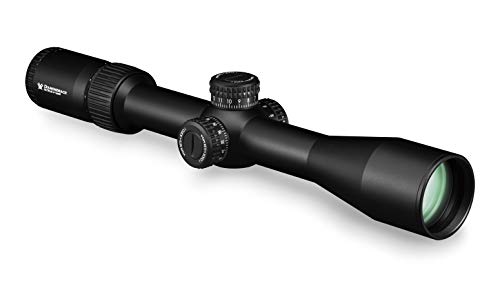 Vortex Diamondback Tactical 4-16x44 First Focal Plane Riflescope, EBR-2C MOA Vortex Diamondback Tactical 4-16x44 First Focal Plane Riflescope, EBR-2C MOA | $399.00 | 4-16x | 44 mm | First | EBR-2C MOA | 30 mm | - |
 Arken Optics SH4 GEN2 4-16x50 FFP Riflescope, Illuminated VPR MIL Reticle Arken Optics SH4 GEN2 4-16x50 FFP Riflescope, Illuminated VPR MIL Reticle | $299.99 | 4-16x | 50 mm | First | VPR MIL | - | Yes |
 Athlon Argos BTR GEN3 6-24x50 Riflescope, APRS11 FFP IR MIL Reticle Athlon Argos BTR GEN3 6-24x50 Riflescope, APRS11 FFP IR MIL Reticle | $379.99 | 6-24x | 50 mm | First | APRS11 MIL | 30 mm | Yes |
A dash means the manufacturer does not publish that figure. We leave it blank rather than estimating it.
How we chose
We did not test these optics in person and we never claim to. Picks are researched from manufacturer specification sheets, published optical and ballistic formulas, and the recurring themes in verified owner reviews. Every pick is matched to a real objective diameter, a real tube size, a real ring height or a real exit pupil rather than to a price bracket, and it is placed in the tier where its capability actually belongs. Where a figure is shooter convention rather than a sourced number we label it, and where a manufacturer does not publish a figure we leave it out instead of estimating it.
Sources
- Vortex published specifications for the Diamondback Tactical 4-16x44 FFP
- Owner-review consensus on turret tracking and reticle visibility
Frequently asked questions
What is the exit pupil of the Diamondback Tactical 4-16x44 at 16x?
2.75mm, calculated as the 44mm objective divided by 16x magnification. That is enough for daylight and overcast conditions but noticeably below what a dark-adapted eye can use, which is why 16x on this scope is a daylight setting rather than a low-light one, despite the larger objective than a hunting scope.
What ring height does the Diamondback Tactical 4-16x44 need?
Enough to clear a 44mm objective bell on a 30mm tube, which sits taller than the rings a 40mm hunting scope on a 1 inch tube needs. Check the published clearance figures for a 44mm objective on a 30mm tube against your own base height rather than assuming a hunting-scope ring height carries over.
Is first focal plane worth it on a scope this cheap?
Yes, and that is this scope's entire reason to exist. A first focal plane reticle subtends correctly at any magnification, so a mil or MOA hold read at 8x is still accurate at 16x. Most FFP scopes charge considerably more for that feature, and this is the least expensive one worth buying specifically for it.
What does the EBR-2C reticle actually offer?
A first focal plane MOA reticle with graduated holdover and windage marks that stay proportionally correct at any magnification, since it is etched into the glass rather than printed on a fixed-size plane. It suits shooters who prefer holding over a graduated reticle to dialing a turret for every shot.
Is a 30mm tube necessary on this scope?
It does not make the scope track any more finely than a 1 inch tube would, but it holds more internal elevation travel, which is exactly what a first focal plane scope built for dialing at distance needs room for. That is why nearly every FFP scope, including this one, moves to a 30mm or larger tube.
Is the Diamondback Tactical 4-16x44 good for a .308 at long range?
Yes, comfortably. A .308 zeroed at 200 yards needs roughly 9.84 MOA of come-up to reach 500 yards, and this scope's 30mm tube and first focal plane construction give real room and an accurate reticle for that distance. See how it compares against a shorter-range 3-9x40 hunting configuration on the dedicated comparison page.
Researched, not professional advice. This page is compiled from published manufacturer specifications, published optical and ballistic formulas, and owner-review consensus, not hands-on testing. Figures described as a rule of thumb are shooter convention rather than sourced numbers, and they are labelled that way wherever they appear. Ballistic figures come from a point mass model using the ballistic coefficient the maker publishes, so treat them as a starting point and confirm them on paper at a measured distance. Confirm your firearm is unloaded with the action open before you mount, level, torque or bore sight anything. Verify a zero only on a supervised range or a safe, legal backstop, know what lies beyond your target, and follow the law where you hunt and shoot, including rules on land access and permitted cartridges.