Laser rangefinders
Best Laser Rangefinders
Quick answer
The best all-round hunting rangefinder is the Vortex Diamondback HD 2000 Laser Rangefinder at $299.00, because it pairs a 2,000 yard reflective-target range with angle compensation, which matters far more for a hunting shot than the headline number alone.
Search for a rangefinder and most of what comes back is built for golf: a reflective flag at a known short distance, on a mown, well-lit surface. That is the wrong tool for a hunting shot, and this catalog deliberately excludes golf rangefinders for the same reason a golf rangefinder maker would tell you not to hunt with theirs.
A hunting rangefinder solves the opposite problem: a soft, non-reflective animal at an unknown distance against a cluttered background, often in poor light. The two things that actually separate a good one from a bad one are angle compensation and how confidently it reads a dull, non-reflective target, and neither of those shows up in the headline range figure.
These picks are researched from published manufacturer specifications and owner-review consensus rather than a side-by-side field test. Any product page that claims to have ranged forty animals across a season to compare units is describing marketing copy, not a repeatable test.
On this page
- Why the headline range is not the range you will get on an animal
- Why almost every rangefinder search result is the wrong tool
- Range and price across the hunting rangefinder lineup
- Why angle compensation matters more than the headline range
- Beginner: a real hunting rangefinder, not a golf one
- Intermediate: the buy-once hunting rangefinder
- Expert: the longest confident read
Why the headline range is not the range you will get on an animal
A published maximum, such as 2,000 or 4,000 yards, is measured against a large, flat, reflective target under good conditions. A whitetail's shoulder is none of those things: it is small, curved, dull-coated and frequently seen against clutter in fading light.
A realistic expectation on a soft, non-reflective animal is roughly a third to a half of the stated maximum range, and that is normal behaviour rather than a flaw in the unit. A rangefinder rated to 2,000 yards on a reflective target that confidently reads a deer at 700 to 900 yards in good light is performing exactly as it should.
This is also why two rangefinders with very different headline numbers can perform almost identically on the shot you will actually take. The unit that reads a dull target quickly and confidently in flat light is doing the job that matters, and the number on the box tells you almost nothing about that.
Why almost every rangefinder search result is the wrong tool
Golf rangefinders dominate search results because golf is a far larger market than hunting optics, and the two devices look identical from the outside: a monocular body with a button and a display. What is inside is tuned for a completely different job.
A golf unit is optimized to lock onto a small reflective flag at a known, short distance on a flat, mown, well-lit fairway, and many include a slope mode built around a golf ball's flight rather than a bullet's. It has no reason to include angle compensation calibrated for a rifle shot, and it is frequently slower and less confident on a dull, textured, natural surface such as fur or bark.
This catalog carries hunting-specific rangefinders only, and none of the products recommended on this page are golf units. If a rangefinder you are considering elsewhere does not explicitly say it is built for hunting, assume it is not.
Range and price across the hunting rangefinder lineup
Every unit here is built for hunting rather than golf. Read the range column as a reflective-target maximum, not a promise about what a deer will return in the field.
Published reflective-target range runs from 850 to 4,000 yards across this lineup, and every unit is built for a soft hunting target rather than a golf flag.
Sourced figure
| Rangefinder | Published range | Price |
|---|---|---|
| Vortex Triumph HD 850 Laser Rangefinder | 850 yd | $99.00 |
| Bushnell BoneCollector 1000 Hunting Rangefinder | 1,000 yd | $99.88 |
| Vortex Sonora HD 1800 Laser Rangefinder | 1,800 yd | $184.99 |
| Leupold RX-1400i TBR/W Gen 2 Rangefinder with Flightpath | 1,400 yd | $199.99 |
| SIG SAUER Kilo Canyon 6x22 Rangefinder Monocular | Monocular, 6x22 | $199.99 |
| Vortex Diamondback HD 2000 Laser Rangefinder | 2,000 yd | $299.00 |
| SIG SAUER KILO3K 6x22 Laser Rangefinder | Roughly 3,000 yd | $349.99 |
| Vortex Viper HD 3000 Laser Rangefinder | 3,000 yd | $399.00 |
| Vortex Razor HD 4000 Laser Rangefinder | 4,000 yd | $499.00 |
Published range is measured against a large reflective target. Expect roughly a third to a half of this figure on a soft, non-reflective animal in ordinary field conditions, which applies to every unit in this table equally.
Why angle compensation matters more than the headline range
Angle compensation corrects for this automatically, reporting the horizontal distance to use for your holdover or dial rather than the raw slant distance. For any hunting shot taken from elevated ground, a treestand, or across a canyon, this feature is worth more than an extra thousand yards of headline range you will rarely use.
Run your own slope angle and distance through the angle shooting calculator before a hunt in steep terrain, so you know in advance how much a given slope changes the shot rather than trusting the rangefinder's internal correction blindly.
The problem it solves
A rangefinder without angle compensation reports the slant distance, the straight line to the target. Shooting the slant distance uphill or downhill makes the shot land high, because gravity only acts on the horizontal component of that distance.
The steeper the angle, the larger the error. On a moderate hillside the effect is small; on a steep canyon wall or a treestand looking down, it is easily enough to miss.
Beginner: a real hunting rangefinder, not a golf one
The goal at this tier is simply to own a unit built for the job, at the lowest price that clears the bar. A basic hunting rangefinder still beats a golf unit or estimating by eye, which remains the single largest range error most hunters make.
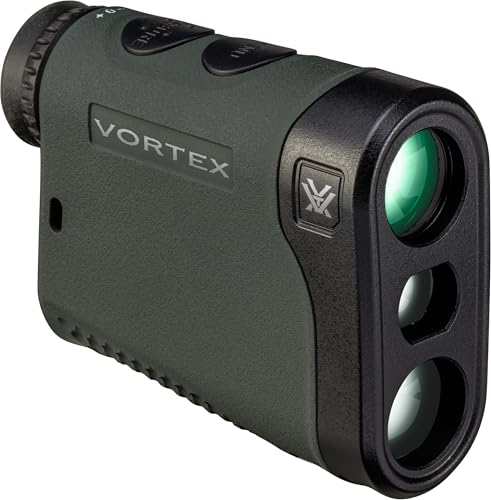
Vortex Triumph HD 850 Laser Rangefinder
$99.00An 850 yard published range covers essentially every hunting shot most rifles are used for, at the lowest price in a genuinely hunting-built lineup.
Best for: A first rangefinder for shots inside 400 yards, where the realistic range on a deer-sized target is well within its capability.
Check price on AmazonIntermediate: the buy-once hunting rangefinder
This tier optimizes for a unit that will not need replacing as your shooting distances grow, with a published range that leaves real margin on a soft target rather than one that barely covers it.
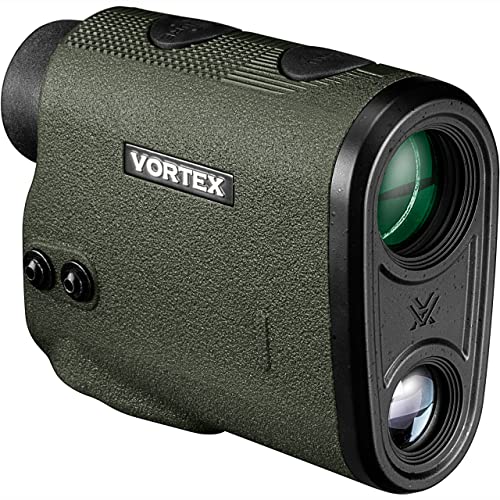
Vortex Diamondback HD 2000 Laser Rangefinder
$299.00A 2,000 yard published range gives enough margin that a realistic third-to-half reading on an animal still comfortably covers any ethical hunting shot.
Best for: Open country hunting where shots can stretch past 400 yards and a confident read at real field distances matters.
Check price on Amazon
Leupold RX-1400i TBR/W Gen 2 Rangefinder with Flightpath
$199.99The TBR/W feature printed in its own name folds a ballistic hold directly into the ranging display, which is useful for a shooter who has not built a separate drop table.
Best for: A hunter who wants a single device that both ranges and suggests a holdover, rather than cross-referencing a card.
Check price on AmazonExpert: the longest confident read
This is the performance ceiling for reading a difficult, distant, non-reflective target quickly and confidently, not simply the biggest number on the box.
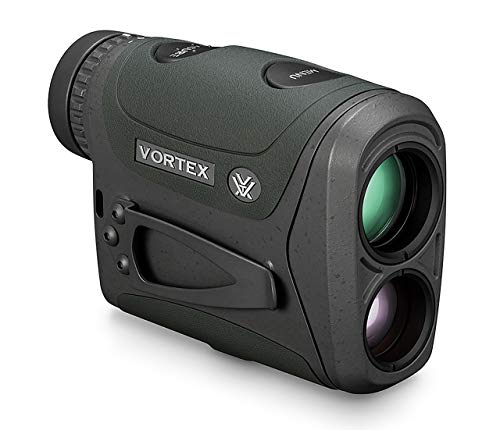
Vortex Razor HD 4000 Laser Rangefinder
$499.00The longest published range in the catalog, which translates into the most margin and the fastest, most confident reads on a small or distant target well inside that maximum.
Best for: Open country hunters and long range shooters who regularly range targets past 600 yards and want headroom rather than a unit working at its limit.
Check price on AmazonWho should not buy this tier: Not for a hunter whose shots stay inside 400 yards. A 4,000 yard published unit is solving a problem that a 2,000 yard unit already solves for that shooter, and the extra money is better spent on a tripod or a better binocular.
How we chose
We did not test these optics in person and we never claim to. Picks are researched from manufacturer specification sheets, published optical and ballistic formulas, and the recurring themes in verified owner reviews. Every pick is matched to a real objective diameter, a real tube size, a real ring height or a real exit pupil rather than to a price bracket, and it is placed in the tier where its capability actually belongs. Where a figure is shooter convention rather than a sourced number we label it, and where a manufacturer does not publish a figure we leave it out instead of estimating it.
Sources
- Vortex Optics published specifications
- Leupold published specifications
- SIG SAUER published specifications
- Bushnell published specifications
Frequently asked questions
Why does my 2,000 yard rangefinder not read that far on a deer?
The published figure is measured against a large, flat, reflective target, not an animal. A soft, dull-coated, curved target like a deer typically returns a confident read at roughly a third to a half of the stated maximum in good light, and less in poor light or against cluttered brush. That is expected performance, not a defect.
Can I use a golf rangefinder for hunting?
You can try, but it is built for a different job. Golf units are tuned to lock onto a small reflective flag on a mown surface at a known short distance, and many lack angle compensation calibrated for a rifle shot. On a dull, natural-coloured animal in the field, a hunting-specific unit is faster and more confident.
What is angle compensation and do I need it?
It corrects the straight-line distance a laser measures into the horizontal distance that actually matters for a bullet's drop, because gravity only acts on the horizontal component of an uphill or downhill shot. Without it, a steep shot from a treestand or across a canyon will read too long and the shot lands high. It matters far more than a bigger headline range.
Do I need a rangefinder if my scope has a BDC reticle?
Yes. A BDC reticle converts a known distance into a holdover, but it does nothing to measure that distance in the first place, and estimating range by eye is one of the largest sources of error most hunters make. The rangefinder and the reticle solve two different halves of the same problem.
Does a rangefinder identify what I am ranging?
No. Ranging tells you distance, not identity. Confirm the target through a binocular or spotting scope before ranging or shooting, know what lies beyond it, and follow local law on land access and legal shooting hours. A rangefinder is one tool in the decision, not the whole decision.
Are rangefinding binoculars a better option than a separate rangefinder?
If you already carry both a rangefinder and a binocular, combining them means the animal stays in the glass when you press the button rather than needing to be found again through a monocular. The tradeoff is that a failure means replacing two instruments at once, which is a real consideration on this site's rangefinding binoculars page.
Researched, not professional advice. This page is compiled from published manufacturer specifications, published optical and ballistic formulas, and owner-review consensus, not hands-on testing. Figures described as a rule of thumb are shooter convention rather than sourced numbers, and they are labelled that way wherever they appear. Ballistic figures come from a point mass model using the ballistic coefficient the maker publishes, so treat them as a starting point and confirm them on paper at a measured distance. Confirm your firearm is unloaded with the action open before you mount, level, torque or bore sight anything. Verify a zero only on a supervised range or a safe, legal backstop, know what lies beyond your target, and follow the law where you hunt and shoot, including rules on land access and permitted cartridges.