Spotting scopes
Vortex Diamondback HD 20-60x85 Spotting Scope Review
Quick answer
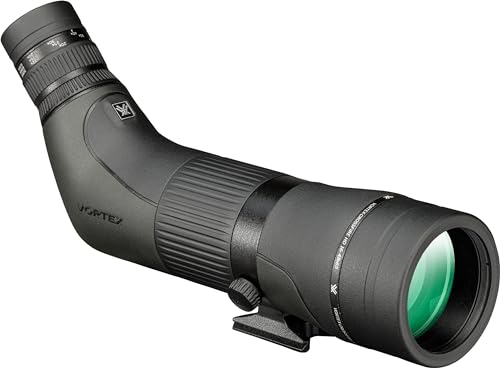
The Vortex Diamondback HD 20-60x85 Angled Spotting Scope is a 20-60x85 angled spotting scope, priced at $499.00. Its 85 mm objective is the largest in this catalog and keeps the scope usable latest into the evening, but at maximum magnification the exit pupil collapses to 1.42 mm at 60x, a bright-day figure only.
A bigger objective gathers more light, and an 85 mm objective is the largest this catalog carries, which is exactly why the Diamondback HD 20-60x85 stays a usable glassing tool later into fading light than any smaller spotter here. That advantage is real and it shows up at moderate magnification, where the extra glass keeps the image bright well past when a 65 mm spotter has gone dim.
What almost no review of a high magnification spotting scope states plainly is what happens at the top of its own zoom range. The number on the box, 60x, is real, but the exit pupil at that setting is thin enough that the top third of this scope's magnification range is a bright-day setting rather than an all-conditions one. That is not a defect specific to this scope; it is arithmetic that applies to every spotter with a headline magnification number, and it is worth stating rather than leaving buried in a spec sheet nobody reads to the bottom of.
This review is researched from Vortex published specifications and owner-review consensus on major retail listings, not from a hands-on glassing session, and computes the exit pupil figures directly from the published objective and magnification range.
On this page
- What does an 85 mm objective actually buy you over a 65 mm one?
- What does the 85 mm objective give you across the full zoom range?
- What tripod does an 85 mm spotter actually need?
- Where the Diamondback HD 20-60x85 costs you: a thin exit pupil at 60x, plus size and weight
- Alternatives if 85 mm is more scope than you want to carry
- A budget pick at the same objective size and a packable step down
What does an 85 mm objective actually buy you over a 65 mm one?
Light-gathering area scales with the square of the objective diameter, so an 85 mm objective collects roughly 71 percent more light than a 65 mm one of the same design, a genuinely large difference rather than a marginal one. At a shared moderate magnification, say 30x, that extra light shows up as a brighter, more detailed image in the last usable minutes of legal shooting light, exactly the window where judging an animal or reading a distant target actually happens.
The HD glass in this line is doing real work alongside the raw aperture: Vortex's optimized glass elements are built to cut chromatic aberration and improve edge-to-edge sharpness, which matters more as the objective grows, since a larger lens has more room to introduce colour fringing and softness toward the edges of the field if the glass is not built to control it.
What does the 85 mm objective give you across the full zoom range?
Exit pupil, computed
exit pupil (mm) = objective diameter (mm) / magnification at 20x: 85 / 20 = 4.25 mm at 60x: 85 / 60 = 1.4167 mm, rounded to 1.42 mm
Exact arithmetic. A dark-adapted human pupil rarely exceeds 5 to 7 mm depending on age, which is a population convention rather than a published spec. Twilight factor at 60x, computed as the square root of objective times magnification (85 x 60), is 71.4, the highest of any optic in this catalog, but twilight factor describes theoretical resolving power rather than image brightness, and it does not offset a thin exit pupil in dim light.
The honest way to read a 20-60x spotter's spec sheet is to see the whole range, not just the two ends printed on the box.
The Diamondback HD 20-60x85 gives a 1.42 mm exit pupil at its maximum 60x, a bright-day figure only, against 4.25 mm at its minimum 20x.
Sourced figure
| Magnification | Exit pupil | What it means |
|---|---|---|
| 20x | 4.25 mm | Comfortable through dusk for most adult eyes; this is where the 85 mm objective earns its size |
| 30x | 2.83 mm | A daylight and early dusk setting |
| 45x | 1.89 mm | Bright daylight only; the image dims noticeably as cloud cover increases |
| 60x | 1.42 mm | The narrowest setting on the scope, usable in direct sun and marginal by mid afternoon overcast |
The top third of this scope's magnification range, roughly 45x to 60x, is a bright-day tool. For last-light glassing, 20x to 30x is where the 85 mm objective's advantage over a smaller spotter actually shows up.
What tripod does an 85 mm spotter actually need?
An 85 mm objective spotting scope is a large, front-heavy instrument, and mounting it on undersized support is the single most common way its optical quality gets wasted, since any vibration or sag is magnified along with the image. The scope is Arca-Swiss compatible out of the box and also accepts standard 1/4-20 threads, so the mount itself is not the limiting factor. The tripod under it is.
Work through how to set up a spotting scope properly before assuming any tripod in a closet will do, and budget for genuine stability rather than the lightest tripod that technically has the right thread, particularly if the scope will be used at the 45x to 60x end of its range where any shake is magnified along with the target.
Where the Diamondback HD 20-60x85 costs you: a thin exit pupil at 60x, plus size and weight
The honest limitation of this scope is exactly the number almost nobody puts in the headline: at 60x the exit pupil is 1.42 mm, thinner than any riflescope reviewed on this site at its own maximum power. That is not a manufacturing shortfall, it is the unavoidable arithmetic of an 85 mm objective pushed to 60 times magnification, and it means the top of this scope's own advertised range is a bright, clear-sky setting rather than an all-conditions one. A buyer who expects 60x to work at dusk the way 20x does will be disappointed by physics rather than by the product.
The second real cost is size and weight. An 85 mm objective spotting scope is genuinely large and heavy compared with a 65 mm model, which matters directly if this scope needs to be carried any distance rather than set up once at a fixed glassing position such as a truck, a blind or a known overlook.
Alternatives if 85 mm is more scope than you want to carry
Two directions: a smaller, more packable Vortex spotter, and a similarly large competitor at a lower price.
| Model | Price | Magnification | Objective lens | Prism type |
|---|---|---|---|---|
 Vortex Diamondback HD 20-60x85 Angled Spotting Scope Vortex Diamondback HD 20-60x85 Angled Spotting Scope | $499.00 | 20-60x | 85 mm | Angled |
 Vortex Crossfire HD 16-48x65 Angled Spotting Scope Vortex Crossfire HD 16-48x65 Angled Spotting Scope | $249.00 | 16-48x | 65 mm | Angled |
 Athlon Optics Argos HD 20-60x85 Spotting Scope, 45 Degree Athlon Optics Argos HD 20-60x85 Spotting Scope, 45 Degree | $249.99 | 20-60x | 85 mm | Angled |
A dash means the manufacturer does not publish that figure. We leave it blank rather than estimating it.
A budget pick at the same objective size and a packable step down
The Athlon Optics Argos HD 20-60x85 Spotting Scope, 45 Degree matches the 85 mm objective and the 20-60x range at a noticeably lower price, trading Vortex's warranty and glass refinement for genuine aperture at a smaller cost. For a spotter that is actually easy to carry, the Vortex Crossfire HD 16-48x65 Angled Spotting Scope gives up top-end magnification and low light reach in exchange for a body that goes into a daypack without complaint. Between the two, the Vortex Viper HD 15-45x65 Angled Spotting Scope deliberately caps its own top magnification lower to keep a wider exit pupil throughout its range, on the theory that a sharp 45x beats a dim, thin 60x.
How we chose
We did not test these optics in person and we never claim to. Picks are researched from manufacturer specification sheets, published optical and ballistic formulas, and the recurring themes in verified owner reviews. Every pick is matched to a real objective diameter, a real tube size, a real ring height or a real exit pupil rather than to a price bracket, and it is placed in the tier where its capability actually belongs. Where a figure is shooter convention rather than a sourced number we label it, and where a manufacturer does not publish a figure we leave it out instead of estimating it.
Sources
- Vortex Optics published specifications for the Diamondback HD 20-60x85 Angled Spotting Scope
- Owner-review consensus from verified purchaser reviews on major retail listings
Frequently asked questions
Is the 60x setting on the Diamondback HD 20-60x85 actually usable?
Only in bright, direct light. At 60x the exit pupil computes to 1.42 mm, thinner than any riflescope on this site at its own maximum power. On an overcast day or into dusk, backing off to 30x or 20x gives a noticeably brighter, clearer image with little practical loss of resolving power at typical spotting distances.
What exit pupil does an 85 mm objective give at 20x?
4.25 mm, computed exactly as the 85 mm objective divided by 20x magnification. That is comfortable well into dusk for most adult eyes, and it is the setting where this scope's large objective actually delivers its brightness advantage over a smaller 65 mm spotter.
Is an 85 mm objective spotting scope too big to carry?
For a backcountry pack, likely yes compared with a 65 mm model. An 85 mm objective spotter is built for glassing from a fixed position, a truck, a blind or a known overlook, rather than for being carried a long distance on foot. A 16-48x65 or similar compact spotter is the better choice for that use.
Does this spotting scope need a specific tripod?
It needs a genuinely stable one. The scope is Arca-Swiss compatible and also accepts standard 1/4-20 threads, so mounting hardware is not the limiting factor, but a lightweight or undersized tripod will transmit vibration that is magnified along with the image, especially at the 45x to 60x end of the range.
How does the Diamondback HD compare with the Crossfire HD spotting scope?
The Diamondback HD uses better glass and a larger 85 mm objective for meaningfully more low light reach, at a higher price and in a larger, heavier body. The Crossfire HD is smaller, lighter and genuinely packable, with a 65 mm objective that runs out of usable brightness sooner as the light fades.
Why does a bigger objective matter more at low magnification than high?
Because exit pupil, the figure that actually governs brightness to the eye, is the objective divided by the magnification. At a shared low power the larger objective produces a meaningfully wider exit pupil, but as magnification climbs, the exit pupil shrinks for any objective size, and the advantage of the larger lens narrows toward the top of the zoom range.
Researched, not professional advice. This page is compiled from published manufacturer specifications, published optical and ballistic formulas, and owner-review consensus, not hands-on testing. Figures described as a rule of thumb are shooter convention rather than sourced numbers, and they are labelled that way wherever they appear. Ballistic figures come from a point mass model using the ballistic coefficient the maker publishes, so treat them as a starting point and confirm them on paper at a measured distance. Confirm your firearm is unloaded with the action open before you mount, level, torque or bore sight anything. Verify a zero only on a supervised range or a safe, legal backstop, know what lies beyond your target, and follow the law where you hunt and shoot, including rules on land access and permitted cartridges.