Spotting scopes
Vortex Crossfire HD 16-48x65 Spotting Scope Review
Quick answer
The Vortex Crossfire HD 16-48x65 Angled Spotting Scope is a 16-48x65 angled spotting scope, priced at $249.00. It is the entry point into a spotting scope worth owning, small enough to genuinely carry, with a 1.35 mm exit pupil at 48x that marks the bright-day limit of its own zoom range.
Most first spotting scope purchases go wrong in one of two directions: an unbranded scope with no glass quality behind the magnification number, or a scope so large the buyer stops bringing it anywhere. The Crossfire HD 16-48x65 avoids both by being genuinely packable, small and light enough to actually end up in a truck or a daypack rather than left at home, while carrying HD glass and Vortex's warranty behind the price.
At $249.00 this is the practical entry point among the spotting scopes in this catalog, and the honest way to evaluate it is against what it gives up to be small: a 65 mm objective is meaningfully smaller than the 85 mm objective on the Diamondback HD reviewed elsewhere on this site, and that difference shows up specifically as the light fades.
This review is researched from Vortex published specifications and owner-review consensus on major retail listings, not from a hands-on glassing session, and computes the exit pupil figures directly from the published objective and magnification range.
On this page
- What makes a spotting scope actually "packable" rather than just smaller?
- What does the 65 mm objective give you across the full zoom range?
- What tripod does a 65 mm spotter actually need?
- Where the Crossfire HD 16-48x65 costs you: a 65 mm objective limits last light
- Alternatives if you need more reach at last light
- A glass upgrade at the same size, and a step up in aperture
What makes a spotting scope actually "packable" rather than just smaller?
A 65 mm objective spotting scope with an angled body is meaningfully lighter and shorter than an 80 mm or 85 mm model, and that difference matters less on a spec sheet than it does on a trail. The scope that gets left in the truck because it is heavy and awkward provides zero optical value, regardless of how good its glass is, and owner-review consensus on the Crossfire HD consistently cites the size and weight as the reason it actually gets used rather than the reason it was bought.
The angled body design, rather than straight-through, is also part of the packability case: an angled eyepiece is easier to use from a low tripod position or while seated, which is most of what a spotter does whether at a known distance range checking bullet holes or glassing from a hillside.
What does the 65 mm objective give you across the full zoom range?
Exit pupil, computed
exit pupil (mm) = objective diameter (mm) / magnification at 16x: 65 / 16 = 4.0625 mm, rounded to 4.06 mm at 48x: 65 / 48 = 1.3542 mm, rounded to 1.35 mm
Exact arithmetic. A dark-adapted human pupil rarely exceeds 5 to 7 mm depending on age, which is a population convention rather than a published spec. Twilight factor at 48x, computed as the square root of objective times magnification (65 x 48), is 55.9, lower than the Diamondback HD 20-60x85's 71.4 at its own maximum, reflecting the smaller objective.
A 16x to 48x range on a 65 mm objective keeps a materially wider exit pupil throughout its zoom than an 85 mm scope pushed to 60x, even though the raw objective size is smaller.
The Crossfire HD 16-48x65 gives a 1.35 mm exit pupil at its maximum 48x, a bright-day figure, against 4.06 mm at its minimum 16x.
Sourced figure
| Magnification | Exit pupil | What it means |
|---|---|---|
| 16x | 4.06 mm | Comfortable through dusk for most adult eyes; the low end of this scope’s range is where the 65 mm objective is fully usable |
| 24x | 2.71 mm | A daylight and early dusk setting |
| 36x | 1.81 mm | Bright daylight only; dims noticeably as cloud cover increases |
| 48x | 1.35 mm | The narrowest setting on the scope, usable in direct sun and marginal by mid afternoon overcast |
The practical low light range on this scope runs 16x to about 24x. Past that, brightness drops quickly enough that a clear day matters more than the extra magnification does.
What tripod does a 65 mm spotter actually need?
A smaller, lighter spotting scope is more forgiving of tripod choice than an 85 mm model, but it is not immune to shake, particularly at the 36x to 48x end of its range where any vibration is magnified along with the target. The scope's Arca-Swiss compatible foot means it mounts directly to most modern tripod heads without an additional plate.
Because this scope is genuinely meant to travel, a compact travel tripod is a reasonable pairing rather than the heavier support an 85 mm scope demands. Work through how to set up a spotting scope before assuming any lightweight tripod will hold steady at the top of the zoom range.
Where the Crossfire HD 16-48x65 costs you: a 65 mm objective limits last light
The honest limitation of this scope is not the glass quality, which owner-review consensus rates well for the price and which carries the same HD optical system branding as Vortex's larger spotters. It is the objective size itself, chosen specifically to keep the scope small and light. A 65 mm objective gathers meaningfully less light than the 85 mm objective on the Diamondback HD reviewed elsewhere on this site, roughly 42 percent less light-gathering area by the geometry of the two lenses, and that difference shows up specifically in the last half hour of usable light, exactly when a hunter is most often trying to make a final judgment on an animal.
This is the direct and unavoidable cost of packability. A buyer who plans to glass seriously into last light on a regular basis will find the 85 mm scope earns its extra size and weight; a buyer who mostly glasses in good light and wants a scope light enough to actually bring along will find this trade goes the other way.
Alternatives if you need more reach at last light
Two directions: the same size objective with better glass, and a genuine step up in aperture.
| Model | Price | Magnification | Objective lens | Prism type |
|---|---|---|---|---|
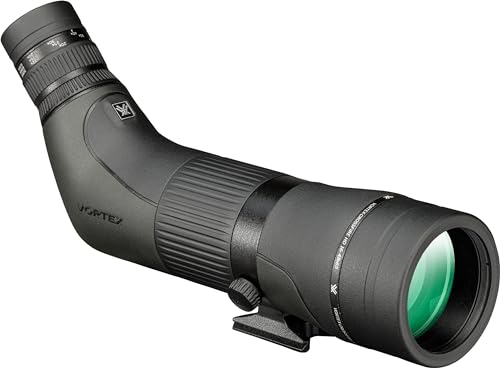 Vortex Crossfire HD 16-48x65 Angled Spotting Scope Vortex Crossfire HD 16-48x65 Angled Spotting Scope | $249.00 | 16-48x | 65 mm | Angled |
 Vortex Diamondback HD 16-48x65 Angled Spotting Scope Vortex Diamondback HD 16-48x65 Angled Spotting Scope | $399.00 | 16-48x | 65 mm | Angled |
 Vortex Diamondback HD 20-60x85 Angled Spotting Scope Vortex Diamondback HD 20-60x85 Angled Spotting Scope | $499.00 | 20-60x | 85 mm | Angled |
A dash means the manufacturer does not publish that figure. We leave it blank rather than estimating it.
A glass upgrade at the same size, and a step up in aperture
The Vortex Diamondback HD 16-48x65 Angled Spotting Scope keeps the exact same 65 mm objective and packable body while stepping up to Diamondback-grade HD glass, a genuine upgrade in image quality without any change in size or weight. For a shooter who has decided last-light performance is worth carrying more scope, the Vortex Diamondback HD 20-60x85 Angled Spotting Scope reviewed elsewhere on this site trades packability for real low light reach. The Celestron Ultima 20-60x80 Angled Spotting Scope is a similarly priced competitor from a maker with an astronomy pedigree rather than a hunting one, worth considering specifically for that different optical design lineage.
How we chose
We did not test these optics in person and we never claim to. Picks are researched from manufacturer specification sheets, published optical and ballistic formulas, and the recurring themes in verified owner reviews. Every pick is matched to a real objective diameter, a real tube size, a real ring height or a real exit pupil rather than to a price bracket, and it is placed in the tier where its capability actually belongs. Where a figure is shooter convention rather than a sourced number we label it, and where a manufacturer does not publish a figure we leave it out instead of estimating it.
Sources
- Vortex Optics published specifications for the Crossfire HD 16-48x65 Angled Spotting Scope
- Owner-review consensus from verified purchaser reviews on major retail listings
Frequently asked questions
Is the Vortex Crossfire HD 16-48x65 a good first spotting scope?
Yes, based on published specifications and owner-review consensus, specifically because it is small and light enough to actually get carried rather than left at home. It carries genuine HD glass and Vortex's warranty at the entry point of this catalog's spotting scope lineup, which is the right combination for a first purchase.
What exit pupil does the Crossfire HD 16-48x65 give at full magnification?
1.35 mm at 48x, computed exactly as the 65 mm objective divided by 48x magnification. That is a bright-day figure only. Backing off to 24x opens the exit pupil to 2.71 mm with little practical loss of resolution at typical spotting distances, which is worth doing as the light fades.
How much light does a 65 mm objective lose against an 85 mm one?
Roughly 42 percent less light-gathering area, since light-gathering scales with the square of the objective diameter. That difference is most noticeable in the last half hour of usable daylight, where the 85 mm objective stays visibly brighter. In good daylight the difference is far less noticeable.
What tripod does this spotting scope need?
A lighter, more compact tripod than an 85 mm spotter requires, since the scope itself is smaller and lighter. It still benefits from genuine stability at the 36x to 48x end of its range, where vibration is magnified along with the target, so a true travel tripod rather than a flimsy tabletop model is worth the small extra weight.
Should I buy the Crossfire HD or the Diamondback HD 16-48x65?
Both share the identical 65 mm objective and packable body. The Diamondback HD steps up to better glass at the same size and weight, for a real image quality improvement with no change in portability. The Crossfire HD is the lower-cost entry point into that same physical package.
Is 48x too much magnification for a 65 mm objective?
Not too much to use, but too much to expect brightness from in anything but good light. At 48x the exit pupil is 1.35 mm, which works in direct sun and becomes marginal by mid-afternoon overcast. The scope's more generally useful magnification range runs from 16x to about 24x, where the exit pupil stays comfortably wider.
Researched, not professional advice. This page is compiled from published manufacturer specifications, published optical and ballistic formulas, and owner-review consensus, not hands-on testing. Figures described as a rule of thumb are shooter convention rather than sourced numbers, and they are labelled that way wherever they appear. Ballistic figures come from a point mass model using the ballistic coefficient the maker publishes, so treat them as a starting point and confirm them on paper at a measured distance. Confirm your firearm is unloaded with the action open before you mount, level, torque or bore sight anything. Verify a zero only on a supervised range or a safe, legal backstop, know what lies beyond your target, and follow the law where you hunt and shoot, including rules on land access and permitted cartridges.