Sight height, .22 LR
What does a 1.6 inch sight height do to a .22 LR?
Quick answer
A .22 LR with a 1.6 inch sight height and a 100 yard zero strikes 1.4 inches above the line of sight at 25 yards, and first crosses the line of sight at about 12 yards. Sight height affects close range far more than it affects anything past 200 yards.
Sight height over bore is the vertical distance from the centre of the bore to the optical centre of the scope. The bullet leaves the muzzle 1.6 inches below your line of sight and has to climb to meet it, which is why every rifle shoots low up close no matter how it is zeroed.
This is the one number in the whole subject that is easiest to MEASURE and hardest to look up, because it depends on the receiver, the base, the rings and the tube together and no manufacturer publishes the stack. Measure from the centre of the muzzle to the centre of the objective bell, or take half of each outside diameter off the gap between them.
Subsonic for much of its flight and dropping steeply from the muzzle, which is why rimfire scopes are parallax set at 36 or 50 yards rather than 100.
On this page
Close range point of impact with a 1.6 inch sight height
Why this happens
bullet starts 1.6 in below the line of sight, climbs to meet it, crosses once on the way up and once on the way down
The two crossings are the near zero and the far zero. Almost everyone knows about the far one and almost nobody thinks about the near one, which is where close range misses come from.
Both columns are with the same rifle and the same load, zeroed at two different distances. Read this before taking a close shot with a rifle zeroed for distance.
At 25 yards this rifle strikes 1.4 inches high with a 100 yard zero, purely because the scope sits 1.6 inches above the bore.
Sourced figure
| Distance | Path, 100 yd zero | Path, 50 yd zero |
|---|---|---|
| 10 yd | -0.2 in | -0.8 in |
| 15 yd | 0.4 in | -0.5 in |
| 20 yd | 0.9 in | -0.2 in |
| 25 yd | 1.4 in | -0 in |
| 35 yd | 2.2 in | 0.2 in |
| 50 yd | 2.8 in | -0 in |
| 75 yd | 2.4 in | -1.8 in |
| 100 yd | -0 in | -5.6 in |
A negative figure means the bullet is below your line of sight. Close in, that is sight height and nothing else: the bullet has not had distance to climb yet.
How other sight heights compare
The same cartridge and the same 100 yard zero at every realistic sight height, showing the close range figures that sight height actually controls.
Going from the lowest to the highest mount changes the 25 yard point of impact by roughly 1.4 inches.
Sourced figure
| Sight height | Path at 25 yd | Path at 50 yd | |
|---|---|---|---|
| 1.2 in | 1.7 in | 3 in | |
| 1.4 in | 1.6 in | 2.9 in | |
| 1.5 in | 1.5 in | 2.9 in | |
| 1.6 in | 1.4 in | 2.8 in | This page |
| 1.8 in | 1.3 in | 2.7 in | |
| 2 in | 1.1 in | 2.6 in | |
| 2.2 in | 1 in | 2.5 in | |
| 2.4 in | 0.8 in | 2.4 in | |
| 2.6 in | 0.7 in | 2.3 in | |
| 2.8 in | 0.5 in | 2.2 in | |
| 3 in | 0.4 in | 2.1 in |
Past about 200 yards the differences between these rows collapse to almost nothing. Sight height is a close range problem, not a long range one.
What this means at point blank range
With an eight inch vital zone, the best zero for this combination is 110 yards, giving a maximum point blank range of 130 yards and a maximum rise of 3.7 inches above the line of sight.
A higher mount very slightly lengthens point blank range, because it lets the bullet cross the line of sight later and therefore spend longer inside the vital zone. The effect is real, it is worth a handful of yards, and it is not a reason to mount a scope higher than your cheek weld wants.
The much larger effect of sight height is at the other end. At 25 yards this setup is 1.4 inches off, and that is the shot people actually miss.
How to measure your own sight height in two minutes
- Clear the rifle. Open the action and confirm the chamber is empty before anything else. Leave the action open.
- Measure the barrel. Take the outside diameter of the barrel directly under the objective bell with a caliper, and halve it. That gives you the height of the bore centre above the barrel underside.
- Measure the tube. Take the outside diameter of the scope tube and halve it. A 1 inch tube is 0.5 inches to centre, a 30 mm tube 0.59 inches, a 34 mm tube 0.669.
- Measure the gap. Measure the vertical gap between the top of the barrel and the bottom of the scope tube. A set of feeler gauges or a drill bit shank works if a caliper will not reach.
- Add the three together. Half the barrel, plus the gap, plus half the tube. That is your sight height, accurate to a few hundredths, which is far closer than any published estimate for your rifle.
Rings and mounting tools for a 1.6 inch sight height
Chosen against the numbers on this page rather than from a general list, so the recommendation cannot contradict the arithmetic above.

Vortex Pro Series Riflescope Rings, 1 inch, Medium 0.95 inch
$79.00Machined to a much tighter tolerance than the Sport rings, which is what stops a ring putting a stress mark on a scope tube.
Best for: an expensive scope you do not want marked
Check price on Amazon
Vortex Pro Series Riflescope Rings, 34mm, Low 0.95 inch
$79.00The lowest practical height for a 34 mm tube, which is already 4 mm larger in radius than a 30 mm and therefore needs more height for the same objective.
Best for: a 34 mm tube with a smaller objective
Check price on Amazon
Vortex Precision Matched Rings, 34mm, 0.92 inch Height
$131.71Matched, lapped and published to a hundredth of an inch. On a scope worth more than the rifle this is not an extravagance.
Best for: a competition rifle where mounting tolerance is measured
Check price on Amazon
Arken Optics Halo Ti Titanium Scope Rings, 34mm, 0.92 inch
$89.99Titanium, so meaningfully lighter than steel at the same strength, and priced well below where titanium hardware usually starts.
Best for: saving weight on a heavy precision rig
Check price on Amazon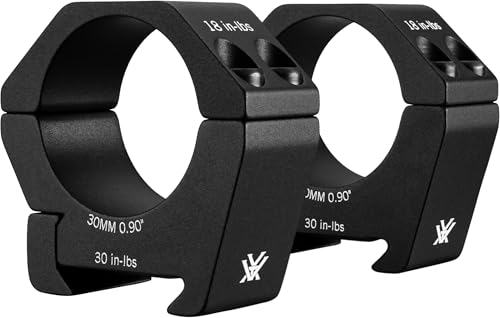
Vortex Sport Riflescope Rings, 30mm, Medium 0.90 inch
$39.00The height that fits the most common combination on this site: a 30 mm tube with a 44 mm objective.
Best for: a 30 mm tube with a 40 to 44 mm objective
Check price on AmazonHow we chose
We did not test these optics in person and we never claim to. Picks are researched from manufacturer specification sheets, published optical and ballistic formulas, and the recurring themes in verified owner reviews. Every pick is matched to a real objective diameter, a real tube size, a real ring height or a real exit pupil rather than to a price bracket, and it is placed in the tier where its capability actually belongs. Where a figure is shooter convention rather than a sourced number we label it, and where a manufacturer does not publish a figure we leave it out instead of estimating it.
Sources
- Published factory load specification: 40 grain round nose at a catalogue 1,255 feet per second
- G1 standard drag function, the published Ingalls and Siacci reference
Frequently asked questions
What is sight height over bore?
The vertical distance from the centre of the bore to the optical centre of the scope, measured at the muzzle end. It is typically 1.2 to 3 inches depending on the rifle and the mount. It decides how far below your line of sight the bullet starts, and therefore how much it has to climb before the two meet.
Does a 1.6 inch sight height matter at long range?
Barely. Past about 200 yards the trajectory is dominated by velocity and ballistic coefficient, and the differences between mount heights collapse to a fraction of an inch. Sight height is a close range consideration, which is exactly the opposite of what most shooters assume.
Should I mount my scope as low as possible?
Mount it as low as your objective bell and your cheek weld allow, in that order. Low is good because it keeps your head on the stock and your head position repeatable. It is not worth forcing: a scope so low that the bell touches the barrel, or so low you have to crush your face onto the comb, costs more accuracy than the sight height saves.
Why is my rifle shooting low at 25 yards?
Because the bullet starts 1.6 inches below your line of sight and has not climbed to meet it yet. This is normal and is not a zeroing fault. With a 100 yard zero this load is 1.4 inches high at 25 yards, and the fix is to know the number rather than to re-zero.
Can I zero at 25 yards instead of 100?
You can use 25 yards to get on paper, which saves a lot of ammunition, but the near zero and the far zero are different distances and a 25 yard zero is not the same as a 100 yard zero. Get on paper at 25, then confirm at the distance you actually want, because the relationship between the two depends on sight height and on your load.
How do I measure sight height without a caliper?
Half the barrel diameter plus the gap plus half the tube diameter. The tube half is known exactly from the tube size, so you only need to estimate two of the three. A drill bit of known diameter slid into the gap gives you the middle number accurately enough, and a ruler on the barrel gets you within a few hundredths.
Researched, not professional advice. This page is compiled from published manufacturer specifications, published optical and ballistic formulas, and owner-review consensus, not hands-on testing. Figures described as a rule of thumb are shooter convention rather than sourced numbers, and they are labelled that way wherever they appear. Ballistic figures come from a point mass model using the ballistic coefficient the maker publishes, so treat them as a starting point and confirm them on paper at a measured distance. Confirm your firearm is unloaded with the action open before you mount, level, torque or bore sight anything. Verify a zero only on a supervised range or a safe, legal backstop, know what lies beyond your target, and follow the law where you hunt and shoot, including rules on land access and permitted cartridges.