Mounting Tools
Best Torque Wrenches for Scope Mounting
Quick answer
The best torque wrench for scope mounting is the Wheeler Firearms Accurizing Torque Wrench with Bits and Case at $60.13, adjustable across the range ring and base screws actually use. Ring screws are commonly published at 15 to 25 inch pounds, far less than it feels like by hand: under-torquing lets the scope creep under recoil, and over-torquing pinches the tube and stresses the erector.
Two failure modes produce the identical symptom, a scope that will not hold zero, and they are opposite mistakes. Ring screws tightened past their published figure pinch the tube and stress the spring-held erector assembly inside the scope. Ring screws left under that figure let the scope creep forward under recoil a few thousandths of an inch at a time, which shows up as a zero that wanders over a season.
Both are invisible at the moment of mounting and both are prevented by the same cheap tool: something that reads or limits torque to the figure published for that specific fastener, rather than a screwdriver and a guess at how tight feels right.
Figures below are drawn from published manufacturer specifications where they exist, and this page says plainly where a figure is a commonly cited convention rather than a single universal standard, because torque specs genuinely vary between rifles and rings.
On this page
Best budget torque tool for a first mounting job
A first mounting job needs exactly one thing from a torque tool: land on the published figure with nothing to dial wrong. A fixed limiter does that job completely and costs less than a box of premium ammunition.

Fix It Sticks Small Torque Limiter
$46.50Torques to one published figure and stops, removing any chance of setting a dial to the wrong number during a first mounting job.
Best for: A first scope mount where simplicity beats flexibility
Check price on AmazonBest buy-once adjustable torque wrenches
An adjustable wrench covers ring screws and action screws with one tool rather than a drawer of fixed limiters, which pays for itself the moment you own more than one rifle.
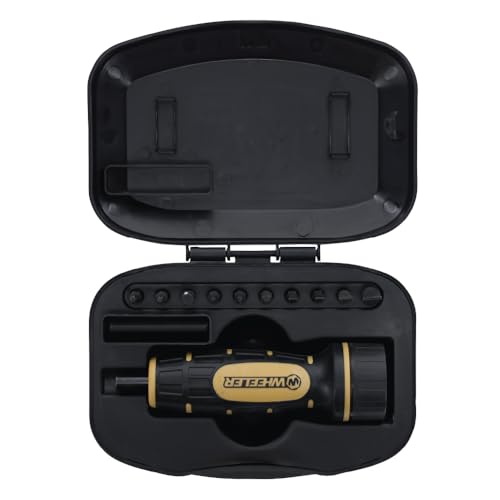
Wheeler Firearms Accurizing Torque Wrench with Bits and Case
$60.13Adjustable across the whole range scope mounting actually uses, with interchangeable bits for both ring screws and action screws.
Best for: Anyone mounting more than one scope over time
Check price on Amazon
Real Avid Gunsmithing Torque Wrench Kit with Screwdriver Bit Set
$77.99A published gunsmithing torque wrench kit with an interchangeable screwdriver bit set, covering the same range of jobs.
Best for: A general mounting kit that also handles other gunsmithing tasks
Check price on AmazonBest precision torque tools
At this tier the tool either reads torque live on a digital display or covers a wide adjustable range with a published figure for accuracy, removing the last bit of guesswork from a precision build.

Wheeler Digital FAT Wrench with Interchangeable Bits and LCD Display
$67.99Reads applied torque live on an LCD display, which is what you want working up to a figure on an action screw rather than trusting a click.
Best for: A precision build where you want to see the number, not just feel a click
Check price on Amazon
Fix It Sticks All-In-One Torque Driver Kit, 15 to 65 inch-lbs, with T-Way Wrench
$139.95Published at 15 to 65 inch pounds, wide enough to cover ring screws through action screws on the same tool without swapping limiters.
Best for: A shooter mounting scopes on several rifles with different screw specs
Check price on Amazon
Real Avid Smart-Torq and X3 Driver Kit, Adjustable 15 to 65 in-lbs
$111.46A published 15 to 65 inch pound adjustable range paired with an interchangeable driver set, covering the same span as the tool above.
Best for: A precision mounting kit that also handles a wider set of driver bits
Check price on AmazonWho should not buy this tier: Skip a digital, wide-range adjustable torque driver if you own one rifle and mount a scope once every few years. A single fixed limiter set to your ring maker's published figure does the identical job with nothing to dial, nothing to calibrate and no battery to replace.
What torque do scope mounting screws actually need?
There is no single universal figure, because it depends on the specific fastener, the material underneath it and what the manufacturer publishes for that part. What follows are the ranges commonly cited across ordinary bolt-action hardware, offered as a starting convention rather than a substitute for the number printed on your own parts.
Ring cap screws are usually torqued to 15 to 25 inch pounds, far less than it feels like by hand, while base and action screws commonly run 20 to 65 inch pounds depending on the rifle, which is why one fixed figure rarely covers every fastener on the same build.
Shooter convention
| Fastener | Typical published range | Tool needed |
|---|---|---|
| Ring cap screws | 15 to 25 in-lb on most rings; always confirm against that ring's own instructions | A tool that reads accurately well under 30 in-lb |
| Base-to-receiver screws | Commonly 20 to 45 in-lb, varying by base material and receiver | An adjustable wrench covering that band |
| Action and bedding screws | Commonly 45 to 65 in-lb on typical bolt actions; check the stock and receiver maker | The upper end of an adjustable wrench |
| One-piece mount rail clamp bolts | Often higher still, set by that specific mount's own instructions | An adjustable wrench with headroom above 65 in-lb |
These are the ranges commonly published across ordinary bolt-action hunting rifles and typical ring and base hardware. Always use the figure printed on your own parts over any general range, including this one.
Which of our torque tools actually publishes its own range?
Rather than assume every tool in this category covers the same span, here is what is actually published for the products above.
Two kits in this comparison publish an explicit 15 to 65 inch pound adjustable range, which is wide enough to cover both ring screws and most action screws with one tool.
Sourced figure
| Tool | Published range | Adjustable or fixed |
|---|---|---|
| Fix It Sticks All-In-One Torque Driver Kit, T-Way | 15 to 65 in-lb | Adjustable, interchangeable limiters |
| Real Avid Smart-Torq and X3 Driver Kit | 15 to 65 in-lb | Adjustable |
| Wheeler Digital FAT Wrench | Not stated in the published listing; reads live on an LCD display instead | Adjustable, digital readout |
| Fix It Sticks Small Torque Limiter | Fixed at one published figure per limiter purchased | Fixed |
Where a published range does not exist in the manufacturer's listing, this table says so rather than estimating one.
Why torque by feel almost always ends up wrong
Fifteen to twenty five inch pounds is a smaller amount of force than most people expect, and hand tools with no reference make it easy to overshoot without noticing. A screwdriver held with a firm, confident grip routinely applies well past 30 inch pounds before it feels "tight," which is already past where many ring makers stop.
The two failure modes that result look identical from the outside: a scope that will not hold zero. Under-torqued screws let the scope move under recoil, a little at a time, which shows up as a zero that drifts across a season and is almost always blamed on the scope itself. Over-torqued screws pinch the tube, which can distort the housing enough to bind the internal erector, producing tracking errors that also look like a scope defect.
How we chose
We did not test these optics in person and we never claim to. Picks are researched from manufacturer specification sheets, published optical and ballistic formulas, and the recurring themes in verified owner reviews. Every pick is matched to a real objective diameter, a real tube size, a real ring height or a real exit pupil rather than to a price bracket, and it is placed in the tier where its capability actually belongs. Where a figure is shooter convention rather than a sourced number we label it, and where a manufacturer does not publish a figure we leave it out instead of estimating it.
Sources
- Wheeler, Fix It Sticks and Real Avid published torque tool specifications from the product listings in our catalog
- Commonly published ring and base torque conventions across bolt-action mounting hardware
Frequently asked questions
Why does torque matter so much for scope rings?
Because the two failure modes it prevents are both invisible at the moment of mounting and both look identical later: a scope that will not hold zero. Under-torqued screws let the scope creep under recoil over time. Over-torqued screws pinch the tube and stress the internal erector. A published torque figure, correctly applied, prevents both at once.
What torque should I use for scope ring screws?
Whatever figure the specific ring's manufacturer publishes, since it varies by ring design and material rather than following one universal number. Fifteen to twenty five inch pounds is the range commonly cited across most rings, but always check the instructions that came with your own rings before assuming that range applies.
Do I need an adjustable torque wrench or is a fixed limiter enough?
A fixed limiter is enough if you own one rifle and mount a scope rarely: it removes the guesswork completely for that one figure. An adjustable wrench earns its price once you own several rifles with different published torque specs, or once you need to torque both ring screws and action screws with the same tool.
Is a digital torque wrench worth the extra cost?
Mainly for a precision build where you want to see the exact applied number rather than feel a click or a stop. For ordinary hunting rifle mounting, a well-made click-style or fixed-limiter tool applies the same accuracy for less money. The digital display is a convenience and a confirmation, not a different level of precision.
Can I use a household torque wrench for scope mounting?
Most household and automotive torque wrenches are not accurate at the low end scope screws need, since they are built and calibrated for a much higher range. A tool built specifically for firearms and optics, reading accurately down near 10 to 15 inch pounds, is worth the modest extra cost over repurposing a general shop tool.
Do base screws and ring screws need different torque?
Usually yes. Base-to-receiver screws commonly run higher than ring cap screws, and action or bedding screws higher still, because they are anchoring into different materials under different loads. An adjustable wrench that covers the full span, or a set of several fixed limiters, handles this correctly where a single figure applied to every screw would not.
Researched, not professional advice. This page is compiled from published manufacturer specifications, published optical and ballistic formulas, and owner-review consensus, not hands-on testing. Figures described as a rule of thumb are shooter convention rather than sourced numbers, and they are labelled that way wherever they appear. Ballistic figures come from a point mass model using the ballistic coefficient the maker publishes, so treat them as a starting point and confirm them on paper at a measured distance. Confirm your firearm is unloaded with the action open before you mount, level, torque or bore sight anything. Verify a zero only on a supervised range or a safe, legal backstop, know what lies beyond your target, and follow the law where you hunt and shoot, including rules on land access and permitted cartridges.