Scout riflescopes
Best Scout Riflescopes
Quick answer
The best scout riflescope is the Burris Scout 2-7x32 Riflescope, Ballistic Plex Reticle at $429.00, because 9 to 12 inches of eye relief and forward mounting keep both eyes open and full peripheral vision, which is the entire reason to choose a scout setup over a conventionally mounted riflescope.
A scout riflescope is not a smaller or cheaper version of a conventional hunting riflescope. It is built around one deliberate trade: mount it well forward of the action, give it far more eye relief than an ordinary riflescope needs, and the shooter can keep both eyes open and their full peripheral vision throughout the shot, the way a red dot works but with the option of some magnification.
That trade is not free. A scout riflescope gives up top-end magnification and works with a tighter eye box than a conventionally mounted riflescope of similar quality. Knowing what you give up before buying one is most of this decision. These picks are researched from published specifications and owner-review consensus rather than from firing every option ourselves.
On this page
What makes a riflescope a scout riflescope?
Three things together, not any one of them alone. A scout riflescope mounts well forward of the action, often on an extended rail ahead of the receiver, rather than directly over it. It carries dramatically longer eye relief than a conventional riflescope, commonly 9 to 12 inches against 3 to 4 inches on ordinary hunting glass, because your eye sits that much further from the ocular lens. And its magnification stays low, typically fixed or a low variable range topping out well under 10x.
Put together, those three choices let the shooter keep both eyes open through the shot, retain full peripheral vision, and see the target with the same situational awareness a red dot gives, while still having some magnification available for a longer or more deliberate shot.
A scout riflescope's 9 to 12 inches of eye relief and forward mounting position are what let a shooter keep both eyes open, against 3 to 4 inches and a conventional mounting position on ordinary hunting glass.
Shooter convention
| Riflescope style | Typical eye relief | Mounting position | Peripheral vision |
|---|---|---|---|
| Conventional hunting riflescope | 3 to 4 in | Over the receiver, close to the eye | Poor, one eye effectively tunnels |
| Scout riflescope | 9 to 12 in | Forward of the action, ahead of the ejection port | Full, both eyes stay open |
| Red dot sight | Unlimited | Over the receiver | Full |
Eye relief figures are typical ranges by riflescope class rather than a single published constant, since exact eye relief varies between individual models and is frequently unpublished to the precise inch.
What do you give up with a scout mount?
Two things, and both are real. First, magnification: a scout riflescope's long eye relief and forward position are optically easier to achieve at low power, which is why almost every scout riflescope on the market tops out somewhere between 2.75x and 7x rather than reaching the 10x, 16x or 24x common on conventionally mounted hunting and long-range glass.
Second, and less obviously, the eye box. Long eye relief designs compress the usable head position window compared to a conventionally mounted riflescope of similar quality, so moving your head forward, back or off center blacks out the edge of the sight picture sooner. Exact eye box width is rarely published by any manufacturer, so the honest guidance is to mount and shoulder the platform before committing, rather than trust a spec sheet that will not tell you the number.
None of this makes a scout riflescope a compromise choice, it makes it a specialised one. A hunter who takes running shots at close range in dense cover, or who wants to track movement at the edge of a field with both eyes open before deciding to shoot, is trading exactly the right things away. A hunter who mostly sits still and glasses open country at distance is trading away the wrong things for their situation, and a conventionally mounted riflescope serves them better.
Weight is the other honest reason people choose a scout build. A forward-mounted, low-power riflescope keeps mass closer to the receiver and off the muzzle end compared to a large-objective hunting riflescope in tall rings, which is a real and measurable difference on a rifle carried all day rather than shot from a fixed rest.
Beginner: a lighter, lower-priced scout riflescope
A smaller objective and a simpler reticle keep the weight down on a lightweight platform, which matters more on a scout build than on a conventionally mounted rifle.

Burris Scout 2.75x20 Riflescope with Heavy Plex Reticle
$299.99 Full specificationsA smaller 20 mm objective keeps weight and bulk down on a lightweight rifle, with a Heavy Plex reticle and genuine scout eye relief at a lower price.
Best for: A lightweight lever gun or bolt action scout build where weight forward matters
Check price on AmazonIntermediate: more magnification range and a larger objective
The step up here is a wider zoom range and more light for the same forward-mounted, long eye relief design.
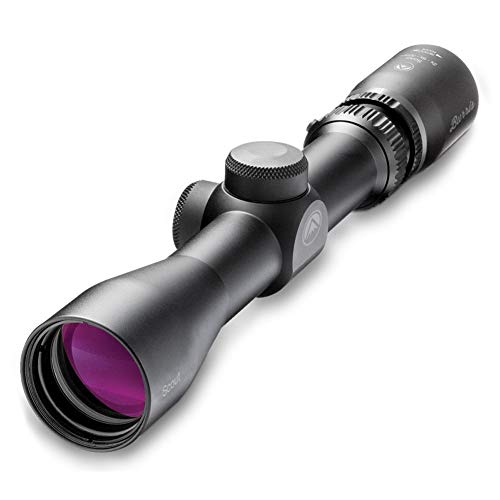
Burris Scout 2-7x32 Riflescope, Ballistic Plex Reticle
$429.00 Full specificationsA 2 to 7 power range and a 32 mm objective for more reach and more light than the fixed low-power entry option, on the same long eye relief design.
Best for: A general-purpose scout rifle build used for hunting as well as close range work
Check price on AmazonExpert: illumination for a dawn or dusk scout setup
Our catalog does not carry a premium illuminated scout-specific riflescope beyond the intermediate pick, so a scoped search is the honest option rather than a recommendation that does not exist.
Burris Scout 2-7x32 Riflescope, Ballistic Plex Reticle
$429.00 Full specificationsThe forward mounting and eye relief above already deliver the core scout advantage. For low light hunts, look at {{s:illuminated long eye relief scout riflescope|an illuminated scout riflescope}} rather than a conventionally mounted illuminated riflescope, which cannot be forward mounted the same way.
Best for: A dawn or dusk hunt where illumination helps against a dark background
Check price on AmazonWho should not buy this tier: Anyone who already knows they want more than 7x magnification or a first focal plane reticle. A scout mount is optically built for low power and forward placement, and no amount of money buys back the magnification range a conventionally mounted riflescope offers.
How we chose
We did not test these optics in person and we never claim to. Picks are researched from manufacturer specification sheets, published optical and ballistic formulas, and the recurring themes in verified owner reviews. Every pick is matched to a real objective diameter, a real tube size, a real ring height or a real exit pupil rather than to a price bracket, and it is placed in the tier where its capability actually belongs. Where a figure is shooter convention rather than a sourced number we label it, and where a manufacturer does not publish a figure we leave it out instead of estimating it.
Sources
- Manufacturer published eye relief and mounting position specifications for scout riflescopes
- Manufacturer published magnification ranges for scout riflescopes in our catalog
Frequently asked questions
What is a scout riflescope?
A riflescope built to mount well forward of the action rather than directly over it, with long eye relief, commonly 9 to 12 inches, and low magnification. That combination lets the shooter keep both eyes open and their full peripheral vision through the shot, closer to how a red dot works than a conventional riflescope.
How much eye relief does a scout riflescope need?
Roughly 9 to 12 inches, well beyond the 3 to 4 inches of a conventionally mounted hunting riflescope. That distance is what lets the optic sit forward of the action while the shooter's eye stays a comfortable distance behind it, and it is the single spec that separates a true scout riflescope from a conventional one moved forward.
What magnification is right for a scout riflescope?
Two to seven power covers most scout rifle use, from close defensive or utility shooting up to a deliberate hunting shot at moderate range. Scout riflescopes rarely exceed 7x because the long eye relief and forward mounting that define the category are optically easiest to achieve at low power.
Why does a scout riflescope have a smaller eye box?
Long eye relief designs compress the usable head position window compared to a conventionally mounted riflescope, so small movements off center black out the sight picture sooner. Exact eye box width is rarely published, which is why mounting and shoulder-testing before committing to a scout build matters more than reading a spec sheet.
Can I mount a scout riflescope like a conventional one?
You can, but it defeats the purpose. Mounting a scout riflescope in the conventional position, close over the action, forces your eye too close to the long eye relief eyepiece and produces a poor, tunneled sight picture. The forward mounting position is not optional, it is what the long eye relief design assumes.
Is a scout setup worth it for hunting?
For dangerous game, dense brush or any situation where peripheral awareness matters as much as the shot itself, yes. For open country hunting at longer range, a conventionally mounted riflescope with more magnification and a wider eye box is usually the better tool, since a scout mount trades away exactly the capability that shot needs.
Researched, not professional advice. This page is compiled from published manufacturer specifications, published optical and ballistic formulas, and owner-review consensus, not hands-on testing. Figures described as a rule of thumb are shooter convention rather than sourced numbers, and they are labelled that way wherever they appear. Ballistic figures come from a point mass model using the ballistic coefficient the maker publishes, so treat them as a starting point and confirm them on paper at a measured distance. Confirm your firearm is unloaded with the action open before you mount, level, torque or bore sight anything. Verify a zero only on a supervised range or a safe, legal backstop, know what lies beyond your target, and follow the law where you hunt and shoot, including rules on land access and permitted cartridges.