Scope Rings
Best Scope Rings
Quick answer
The best all-around scope ring for most rifles is the Vortex Pro Series Riflescope Rings, 30mm, Medium 1.00 inch at $75.99, machined to a published 1.00 inch centre height rather than sold under a marketing name. Buy every ring by that number: low, medium and high mean a different height in every maker's catalogue.
A scope ring has exactly one job: hold the tube dead straight against the receiver, without marking it, at a height that clears the objective bell. Everything else on the box, including the finish and the logo, is decoration.
The subject is more confusing than it needs to be, because ring height names are marketing, not measurements. Two makers can publish a ring called "Low" that differs by nearly a fifth of an inch. Buy by the published number in inches, never by the word printed on the box next to it.
Every roundup on this site is compiled from published manufacturer specifications and owner-review consensus rather than from testing performed in person, and we say so plainly here because this is a subject where a confidently wrong number is worse than no number at all.
On this page
Best scope rings for a first mounting job
At this stage the job is simple: clear the objective, hold the published torque figure, and cost little enough that the mount is not the expensive part of a first build. A stamped or forged ring in the $30 to $40 range does this completely once it is torqued correctly, which matters far more than which ring you buy.

Vortex Sport Riflescope Rings, 30mm, High 1.1 inch
$39.00Published at 1.1 inches to tube centre, which clears a 40 to 44 mm objective on most bolt actions with real margin, at a price that leaves budget for a level and a torque limiter.
Best for: A first 30mm scope in the 3-9x40 to 4-16x44 range
Check price on Amazon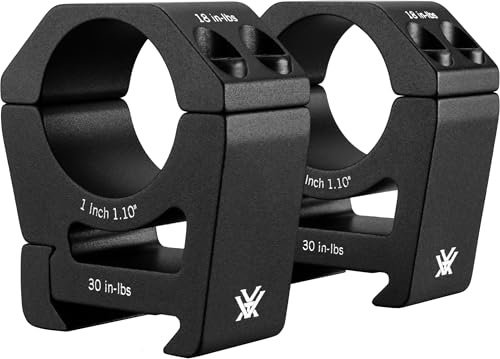
Vortex Sport Riflescope Rings, 1 inch, High 1.1 inch
$39.00The same Sport line built for a 1 inch bore, published at 1.1 inches to centre, for the many rimfire and budget hunting scopes still built on the older tube diameter.
Best for: A rimfire scope or a budget 1 inch hunting optic
Check price on Amazon
Leupold Rifleman Gen 2 1 inch Medium Rings
$30.99A published height from a maker whose fixed rings have held zero on hunting rifles for decades, at the lowest price in this comparison.
Best for: A tight budget where the name behind the torque spec still matters
Check price on AmazonBest buy-once scope rings
This is where matched pairs start to earn their price. A ring sold as a matched set is bored as a pair rather than individually, which removes most of the alignment error a bargain stamped ring introduces before a scope ever touches it.

Vortex Pro Series Riflescope Rings, 30mm, Medium 1.00 inch
$75.99Published to a 1.00 inch centre height and sold as a matched pair, which is the honest middle ground of this entire category.
Best for: A scope in the $300 to $700 range that deserves a mount that is not the weak link
Check price on Amazon
Warne Maxima 1 inch Fixed Medium Height Matte Rings
$49.79Steel construction with a published height, from a maker whose fixed rings have been a benchrest standard for a long time.
Best for: A 1 inch tube on a rifle that gets carried hard
Check price on Amazon
Burris Signature Zee 30mm High Rings, Matte
$49.77The Zee polymer insert centres the tube against a soft liner rather than metal on metal, which forgives a small mismatch between a base and a ring from different makers.
Best for: A rifle where the base and ring are not from the same manufacturer
Check price on AmazonBest precision scope rings
At this tier the ring ships factory lapped: the two bores are machined and then hand fit to run true to a published tolerance before it ever reaches you. That solves the alignment problem before you touch a lapping bar yourself.

Vortex Precision Matched Rings, 30mm, 0.87 inch Height, Picatinny
$157.41Height published to a hundredth of an inch rather than a word, on a Picatinny footprint, factory lapped as a matched pair.
Best for: A precision build where erector preload from ring misalignment is not an acceptable variable
Check price on Amazon
Vortex Precision Matched Rings, 1 inch, 0.76 inch Height, Weaver
$159.00The same factory-lapped standard in a 1 inch bore, for a precision rimfire or an older optic that will not be replaced with something larger.
Best for: A precision rimfire build kept on a 1 inch tube
Check price on Amazon
Warne Maxima Quick Detach Rings, 30mm Medium
$103.99Return-to-zero quick detach levers machined to the same standard as Warne's fixed rings, so removing the scope does not cost you the zero.
Best for: A rifle that alternates between a scope and iron sights, or travels disassembled
Check price on AmazonWho should not buy this tier: Skip factory-lapped, matched rings if the rifle underneath them will never see past 200 yards, or if the scope on top cost less than the rings do. A stamped $39 ring, torqued to the published figure, holds zero exactly as well on a woods rifle, and the tolerance you are paying for here is wasted on a rifle that cannot resolve it.
Why does the same word mean a different height in every catalogue?
Ring height names describe roughly where a maker positions a product inside its own lineup, not a measurement anyone has agreed on across the industry. The only way to know what a "Low" ring actually clears is to read the number in inches, published on the listing, and compare it against your own objective.
A ring called "Low" on the Vortex Sport line is 0.80 inches to tube centre, and a ring called "Low" on the Vortex Pro line in the same catalogue is 0.90 inches: an entire height class apart under the identical word.
Sourced figure
| Name on the box | Ring line | Height to tube centre |
|---|---|---|
| Low | Vortex Sport 30mm | 0.80 in |
| Low | Vortex Pro 30mm | 0.90 in |
| Medium | Vortex Sport 30mm | 0.90 in |
| Medium | Vortex Pro 30mm | 1.00 in |
| High | Vortex Sport 30mm | 1.10 in |
| High | Vortex Pro 30mm | 1.26 in |
| Extra high | Vortex Sport 30mm | 1.50 in |
These are two lines from one manufacturer's own catalogue, published to the same internal convention. Compare across two different makers and the spread only gets wider.
How much ring height do I actually need?
Ring height needed is roughly the objective bell's outside radius plus about an eighth of an inch of clearance. The trouble is that almost no maker publishes the bell's outside diameter, only the lens diameter behind it, and a housing wall typically adds another 4 to 8 millimetres across the full width. The honest answer is a range, not a single figure, and this site publishes that range for common objective and tube combinations: see what a 44 mm objective on a 30mm tube needs, what a 50 mm objective on a 30mm tube needs, and what a 56 mm objective on a 34mm tube needs.
One convention worth repeating because it causes real returns: most American ring makers publish height to the centre of the ring, not the bottom, and there is no industry standard that forces either. A ring published to the bottom of the bore reads roughly half a tube diameter shorter than the identical physical part published to the centre. Check which convention a maker states before comparing two rings from different brands on the number alone.
Do rings need to be lapped?
Sometimes, and it depends on the ring rather than on preference. Rings, base and receiver are each machined to their own manufacturing tolerance, so two ring bores rarely point at exactly the same place once bolted down together. A tube forced into misaligned rings is bent, slightly but permanently, which preloads the spring-held erector assembly inside the scope and can make it track differently dialling up than dialling down, which looks exactly like a scope defect.
Factory-lapped matched pairs, like the Expert picks above, solve this before the ring ever reaches you. Unmatched stamped rings benefit from a lapping kit, covered on the best scope mounting kits page, and a one-piece mount sidesteps the whole problem because both ring tops are machined into a single block. See one-piece mounts against two-piece rings for that comparison in full.
How we chose
We did not test these optics in person and we never claim to. Picks are researched from manufacturer specification sheets, published optical and ballistic formulas, and the recurring themes in verified owner reviews. Every pick is matched to a real objective diameter, a real tube size, a real ring height or a real exit pupil rather than to a price bracket, and it is placed in the tier where its capability actually belongs. Where a figure is shooter convention rather than a sourced number we label it, and where a manufacturer does not publish a figure we leave it out instead of estimating it.
Sources
- Vortex, Warne, Burris and Leupold published ring height specifications from the product listings in our catalog
- Owner-review consensus on ring alignment and torque-related zero shift
Frequently asked questions
What does "Low", "Medium" and "High" actually mean on scope rings?
Nothing standard across the industry. Every maker sets its own names for its own lineup, and the numbers behind them vary widely: a Vortex Sport "Low" is 0.80 inches to tube centre while a Vortex Pro "Low" from the same company is 0.90 inches. Ignore the word entirely and buy by the published height in inches instead.
Is ring height measured to the centre or the bottom of the tube?
There is no single standard. Most American ring makers publish height to the centre of the ring, which is the convention used throughout this site, but some publish to the bottom of the ring instead. The same physical part can show up with two different numbers depending on which convention the listing uses, so always check which one a maker means before comparing brands directly.
How do I know what ring height I need?
Ring height needed is roughly the objective bell's outside radius plus an eighth of an inch of clearance. Since the bell's outside diameter is rarely published, treat the figure as a range rather than a single number, check the ring height chart for your objective and tube size, and confirm clearance by sliding a folded note under the bell before you fully torque anything.
Do I need matched or lapped rings?
Only if you are chasing precision at distance or mounting an expensive scope. Rings, base and receiver each carry their own manufacturing tolerance, so two unmatched ring bores rarely point at exactly the same place. A budget scope on a rifle shot inside 300 yards holds zero fine in a properly torqued stamped ring; a precision build genuinely benefits from a factory-lapped matched pair.
Can I put a 1 inch scope in 30mm rings?
No, not without a shim adapter, and a shim is a compromise rather than a fix. The ring bore has to match the tube diameter exactly to clamp evenly around its full circumference. A shim concentrates pressure at a few contact points instead of spreading it evenly, which is closer to pinching the tube than holding it properly.
Are steel rings better than aluminium rings?
Steel is stiffer and holds torque slightly better under repeated mounting, which matters on a rifle remounted often. Aluminium is lighter and, at the torque figures scope rings actually use, plenty stiff enough for the vast majority of rifles. Aluminium is the sensible default, and steel is worth the extra weight only for a rifle carried hard or mounted and dismounted frequently.
Researched, not professional advice. This page is compiled from published manufacturer specifications, published optical and ballistic formulas, and owner-review consensus, not hands-on testing. Figures described as a rule of thumb are shooter convention rather than sourced numbers, and they are labelled that way wherever they appear. Ballistic figures come from a point mass model using the ballistic coefficient the maker publishes, so treat them as a starting point and confirm them on paper at a measured distance. Confirm your firearm is unloaded with the action open before you mount, level, torque or bore sight anything. Verify a zero only on a supervised range or a safe, legal backstop, know what lies beyond your target, and follow the law where you hunt and shoot, including rules on land access and permitted cartridges.