Scope Bases
Best Picatinny Scope Bases
Quick answer
The best general-purpose Picatinny base is the Nightforce Standard Duty Aluminium Mounting Scope Base at $59.00, machined flat for rifles shot inside about 300 yards. A 20 MOA canted base converts unused down travel into usable up travel for distance shooting, and on a short-range rifle it can run the erector out of down adjustment entirely, making the rifle impossible to zero.
A Picatinny base is a slotted rail bolted to the receiver that everything else, rings, one-piece mounts and accessories, clamps onto. The base itself is simple. The decision that actually matters is how much cant it builds in, and that decision is exactly backwards from what most first-time buyers assume.
More cant is not simply better. A canted base tilts the whole scope down at the front, which moves the erector's resting position lower in its own range of travel. That converts unused down adjustment into usable up adjustment, which is how a scope reaches distance at all. On a rifle that will never be dialled past 300 yards, the same trade works against you: the erector can run out of down travel before the bullet's impact ever reaches the line of sight, and the rifle cannot be zeroed regardless of how good the scope is.
Every figure here comes from published manufacturer specifications, and where a figure is not published, such as total elevation travel for a specific scope, this page says so rather than estimating one.
On this page
Best budget Picatinny bases
A first base does one job: sit flat and square on the receiver so the rings above it are not fighting an already-tilted foundation. These do that job at a low price for the great majority of hunting rifles that will never be dialled past a few hundred yards.

Weaver Base Pair for Remington 700, Matte
$18.00A matte, flat two-piece base pair correct for a rifle shot inside about 400 yards, where a canted base would waste travel it does not need.
Best for: A Remington 700 pattern hunting rifle
Check price on Amazon
Leupold Quick Release Weaver-Style Two-Piece Scope Base, Remington 700
$26.99A quick release two-piece base for a rifle that occasionally needs the mount off, at a price close to a fixed base.
Best for: A rifle that alternates between a scope and iron sights
Check price on Amazon
Weaver #63B One Piece Base for Lever Action Rifles
$16.00A one-piece base built for a lever action receiver, at the lowest price in this comparison.
Best for: A lever action rifle carrying a compact scope
Check price on AmazonBest buy-once flat Picatinny bases
At this tier the base is a single machined piece rather than a stamped two-piece pair, removing one more alignment tolerance for a rifle that is being used seriously but not yet dialled at distance.

Nightforce Standard Duty Aluminium Mounting Scope Base
$59.00A one-piece design machined to a published tolerance, correct for a rifle inside the range where a flat base is the right choice.
Best for: A serious hunting rifle shot inside about 300 yards
Check price on Amazon
Burris Xtreme Tactical Two-Piece Steel Mounting Base
$24.69Steel construction at a moderate price, published for a two-piece Picatinny footprint on a common receiver.
Best for: A budget-conscious build that still wants steel over aluminium
Check price on Amazon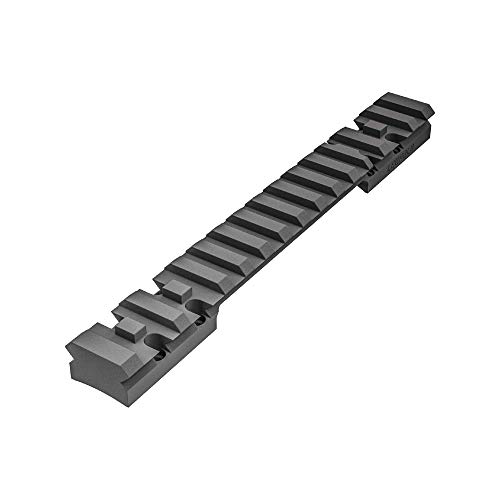
Leupold BackCountry Cross-Slot 1-Piece Base, Browning X-Bolt Long Action
$39.99A one-piece design fit specifically to one receiver pattern, removing any base-to-receiver fit question.
Best for: A Browning X-Bolt long action
Check price on AmazonBest canted Picatinny bases for distance
A 20 MOA base is the cheapest way to buy back elevation travel on a scope being dialled at real distance. It is also the tier most likely to be bought by someone who does not need it, which is why the caution below matters.

Weaver Extended Multi-Slot Base, Remington 700 Short Action, 20 MOA
$53.79Twenty MOA of built-in cant on a Remington 700 short action footprint, converting unused down travel into usable up travel for a distance build.
Best for: A short action precision rifle being dialled past 500 yards
Check price on Amazon
Outerimpact Howa 1500 and Weatherby Vanguard Long Action Picatinny Base, 20 MOA
$49.95A published 20 MOA Picatinny base fit to the Howa 1500 and Weatherby Vanguard long action pattern.
Best for: A Howa or Vanguard long action distance build
Check price on Amazon
EGW Ruger 10/22 Picatinny Rail Scope Mount, 20 MOA
$35.99A 20 MOA rail for the Ruger 10/22 pattern, for precision rimfire shooters holding over at distances where every degree of usable elevation matters.
Best for: A precision rimfire build shot well past 100 yards
Check price on AmazonWho should not buy this tier: Skip a 20 MOA canted base if the rifle underneath it will never be dialled past roughly 300 yards. The cant converts unused down travel into up travel you do not need, and on a rifle zeroed short it can run the erector out of down adjustment before the impact reaches the line of sight at all, making the rifle impossible to zero.
Do I need a 20 MOA base, or will it work against me?
This is the single most consequential decision in this whole category, and it depends entirely on how far the rifle is actually going to be shot, not on what sounds like the more capable choice.
A 20 MOA base converts unused down travel into usable up travel for distance shooting, and on a rifle that will never see past 300 yards it can make the rifle impossible to zero at all.
Shooter convention
| Base cant | Best suited to | The real risk |
|---|---|---|
| 0 MOA, flat | A rifle shot inside about 300 yards | None: the full up and down range of the erector stays available for zeroing and holdover |
| 20 MOA canted | Dialling come-ups past roughly 500 to 600 yards | Can run out of down adjustment on a rifle zeroed short, making it impossible to zero at all |
| 40 MOA and beyond | Extreme long range disciplines built around one specific scope and load | The same risk, amplified; the wrong choice on anything but a dedicated distance rifle |
A scope's total elevation travel is set by its own erector design and is usually not published by the manufacturer, which is why this is a directional decision rather than an exact one: know roughly how far you will actually shoot before choosing a cant.
Why the base is worth getting right before the rings
Everything mounted above the base inherits whatever the base itself is doing. A base that is not flat and square to the bore tilts the rings, which tilts the reticle, which is a cant problem baked into the hardware rather than something a level can fully correct at the mounting stage.
A base that is canted in the wrong direction for the rifle's actual use wastes money twice: once on the base itself, and again on the taller rings or the extra scope elevation adjustment that ends up being needed to compensate. Decide the intended shooting distance before buying the base, not after.
Picatinny and Weaver bases look similar and are not fully interchangeable in both directions: see Picatinny against Weaver bases for exactly where the compatibility breaks down.
How we chose
We did not test these optics in person and we never claim to. Picks are researched from manufacturer specification sheets, published optical and ballistic formulas, and the recurring themes in verified owner reviews. Every pick is matched to a real objective diameter, a real tube size, a real ring height or a real exit pupil rather than to a price bracket, and it is placed in the tier where its capability actually belongs. Where a figure is shooter convention rather than a sourced number we label it, and where a manufacturer does not publish a figure we leave it out instead of estimating it.
Sources
- Nightforce, Weaver, Leupold, EGW and Outerimpact published base specifications from the product listings in our catalog
- Published erector geometry: a canted base shifts resting position within existing elevation travel rather than adding travel
Frequently asked questions
What does MOA mean on a scope base?
It describes how many minutes of angle the base tilts the scope downward at the front, relative to the bore. A 20 MOA base is not adding elevation adjustment directly; it is shifting where the scope's own erector sits within its existing range, converting unused down travel into usable up travel for shooting at distance.
Do I need a 20 MOA base?
Only if you intend to dial come-ups past roughly 500 to 600 yards. A canted base converts unused down travel into up travel, which is how a scope reaches distance. On a rifle shot inside 300 yards it does the opposite of helping, and can make the rifle impossible to zero because the erector runs out of down adjustment first.
Are Picatinny and Weaver bases the same thing?
Close, but not identical. A Weaver-pattern ring generally fits a Picatinny rail because Picatinny slots are more consistently spaced and slightly wider, but a Picatinny-pattern ring does not reliably fit a Weaver base, where slot spacing can vary between makers. Check the specific ring and base combination rather than assuming either direction works.
Should I buy a one-piece or two-piece base?
A one-piece base removes one alignment question, since there is no chance of the front and rear halves being torqued a fraction out of line with each other. A two-piece base is usually cheaper and has wider compatibility. On a bolt action shot inside a few hundred yards, either works fine once properly torqued and squared.
What torque should base screws be tightened to?
Whatever figure the base manufacturer publishes for your specific receiver, since it varies by base material and screw size rather than following one universal number. Base screws commonly run higher than ring screws, and an adjustable torque wrench covering both ranges is worth owning rather than guessing by feel.
Can I combine a canted base with lapped rings?
Yes, and it is a common combination on precision builds. The base sets the overall cant relative to the bore, and lapped rings then remove any remaining bore misalignment between the two ring positions on top of that base. The two solve different problems and are frequently used together on the same rifle.
Researched, not professional advice. This page is compiled from published manufacturer specifications, published optical and ballistic formulas, and owner-review consensus, not hands-on testing. Figures described as a rule of thumb are shooter convention rather than sourced numbers, and they are labelled that way wherever they appear. Ballistic figures come from a point mass model using the ballistic coefficient the maker publishes, so treat them as a starting point and confirm them on paper at a measured distance. Confirm your firearm is unloaded with the action open before you mount, level, torque or bore sight anything. Verify a zero only on a supervised range or a safe, legal backstop, know what lies beyond your target, and follow the law where you hunt and shoot, including rules on land access and permitted cartridges.