Subtension at 50 yards
How much is 1 MOA and 1 mil at 50 yards?
Quick answer
At 50 yards, 1 MOA is 0.52 inches and 1 mil is 1.8 inches. One quarter MOA click moves the point of impact 0.131 inches and one tenth mil click moves it 0.18 inches. The common shorthand of 1 inch per MOA is 0.02 inches short at this distance.
Two different angular units are in daily use and they are not interchangeable. A minute of angle is one sixtieth of a degree, which works out to 1.05 inches at 100 yards by plain trigonometry. A milliradian is one thousandth of a radian, which is exactly 3.6 inches at 100 yards by definition, with no trigonometry involved at all.
Both scale linearly with distance, so at 50 yards a minute of angle covers 0.52 inches and a mil covers 1.8 inches. One mil is 3.44 MOA at every distance, because both are angles and the ratio between them never changes.
The shorthand that treats 1 MOA as exactly 1 inch at 100 yards is 0.02 inches out at this distance, which is inside the size of a group and nobody will ever notice.
On this page
What does each unit subtend at 50 yards?
The working
MOA inches = amount x 1.047197 x (50 / 100) mil inches = amount x 3.6 x (50 / 100)
Both are exact. The MOA constant comes from 2 x 3600 x tan(1/120 degree) and the mil constant from the definition of a milliradian.
Read across for the amount you are holding or dialling. The third column is the shooter shorthand, included so you can see exactly where it parts company with the real figure.
At 50 yards, 1 MOA subtends 0.52 inches, 1 mil subtends 1.8 inches, and the 1 inch per hundred yards convention gives 0.5 inches.
Sourced figure
| Amount | True MOA | Mil | Shooter MOA (1 in per 100 yd) |
|---|---|---|---|
| 0.1 | 0.05 in | 0.18 in | 0.05 in |
| 0.25 | 0.13 in | 0.45 in | 0.13 in |
| 0.5 | 0.26 in | 0.9 in | 0.25 in |
| 1 | 0.52 in | 1.8 in | 0.5 in |
| 2 | 1.05 in | 3.6 in | 1 in |
| 3 | 1.57 in | 5.4 in | 1.5 in |
| 5 | 2.62 in | 9 in | 2.5 in |
| 10 | 5.24 in | 18 in | 5 in |
The gap between true MOA and the 1 inch convention is 0.02 inches per minute at this distance, and it grows in direct proportion to how much you dial.
What does one turret click move at 50 yards?
Every turret value sold, and what one click of each actually moves the point of impact at this distance. The third column is how many clicks it takes to move the impact one inch, which is the number you use at the bench.
A quarter MOA click moves the point of impact 0.131 inches at 50 yards, and a tenth mil click moves it 0.18 inches.
Sourced figure
| Turret value | Moves per click | Clicks per inch | Where you find it |
|---|---|---|---|
| 1/8 MOA | 0.065 in | 15.3 | Target and benchrest turrets. Fine, and slow to dial. |
| 1/4 MOA | 0.131 in | 7.6 | The most common hunting and general purpose turret in North America. |
| 1/2 MOA | 0.262 in | 3.8 | Found on some low power and rimfire scopes, and on many red dots. |
| 1 MOA | 0.524 in | 1.9 | Red dots and simple optics. Coarse, and quick to count. |
| 0.1 mil | 0.18 in | 5.6 | The standard mil turret, and the one that pairs with a mil reticle. |
| 0.05 mil | 0.09 in | 11.1 | Fine mil turrets, usually on competition scopes. |
| 0.2 mil | 0.36 in | 2.8 | Coarse mil turrets, mostly on low power variable optics. |
Turrets only move in whole clicks, so the correction you can actually dial is the nearest whole number rather than the exact figure the arithmetic gives.
Ranging a known target size at 50 yards
If you know how big something is, the mils or MOA it covers in your reticle tell you how far away it is. Run backwards, here is what a target of each size looks like at this distance.
An 18 inch deer vital zone subtends 10 mil or 34.38 MOA at 50 yards.
Sourced figure
| Target | Size | Subtends in mils | Subtends in MOA |
|---|---|---|---|
| a 10 inch plate | 10 in | 5.56 mil | 19.1 MOA |
| a 12 inch plate | 12 in | 6.67 mil | 22.92 MOA |
| an 18 inch deer vital zone | 18 in | 10 mil | 34.38 MOA |
| a 20 inch torso | 20 in | 11.11 mil | 38.2 MOA |
| a 36 inch silhouette | 36 in | 20 mil | 68.75 MOA |
The ranging formula is range in yards equals target inches times 27.8 divided by mils, or times 95.5 divided by MOA. Both follow directly from the definitions above.
Why the 1 inch shorthand survives, and when to stop using it
Treating a minute of angle as exactly one inch at a hundred yards is wrong by 4.5 percent. That is a defensible simplification at short range and an expensive one at distance, and the crossover is not a matter of opinion: it is wherever 4.5 percent of your come-up becomes larger than the target.
At 50 yards you would need to dial more than 254.3 MOA before the error reached six inches, which is not a correction anyone makes at this distance. Use the shorthand and stop worrying about it.
The cleanest fix is not to be more careful with MOA. It is to work in mils, where the constant is exactly 3.6 inches per hundred yards and there is no approximation to get wrong, or to use a scope whose reticle and turrets are in the same unit so a hold and a dial are the same number.
Optics for shooting at 50 yards
Chosen against the numbers on this page rather than from a general list, so the recommendation cannot contradict the arithmetic above.

Vortex SPARC Red Dot Sight Gen II, 2 MOA Dot
$99.99A 2 MOA dot, a transferable lifetime warranty, and a mount that gives you both an absolute and a lower third height from the same box.
Best for: a first red dot that will not need replacing
Check price on Amazon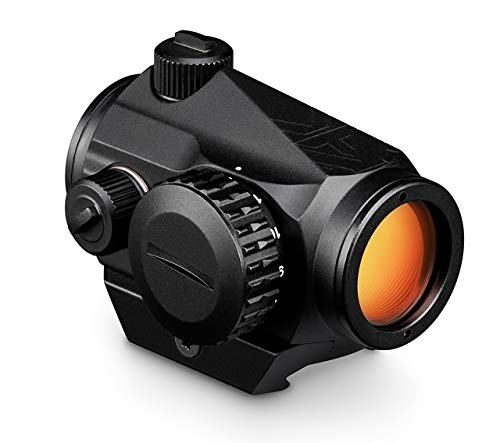
Vortex Crossfire Red Dot Sight Gen II, 2 MOA Red Dot
$119.99A tube style sight rather than an open reflex, which keeps rain and snow off the emitter. That is a real advantage in weather and a real disadvantage in weight.
Best for: a red dot used in genuinely bad weather
Check price on Amazon
SIG SAUER ROMEO5 GEN II 1x20 Red Dot Sight
$128.98 Full specificationsMotion activation is the feature that matters: the sight switches itself off when the rifle sits still and wakes instantly when it moves, so the battery lasts years left on.
Best for: a rifle that is stored ready and grabbed without warning
Check price on Amazon
Holosun ARO-CORE Red Dot Sight with Shake Awake, 22mm Window
$119.99Holosun built its reputation on battery life and shake awake, and the larger 22 mm window makes finding the dot much faster than a small tube sight.
Best for: fast target acquisition with a wide field of view
Check price on Amazon
Holosun 510C Multi-Reticle 2 MOA Dot and 65 MOA Circle Open Reflex Sight
$295.84The 65 MOA circle finds your eye far faster than a bare dot, and the 2 MOA dot inside it is precise enough for a deliberate shot. A solar cell backs up the battery.
Best for: a sight used both fast up close and deliberately at distance
Check price on Amazon
Holosun HS507C-X2 Red 2 MOA Dot and 32 MOA Circle Open Reflex Sight
$232.99 Full specificationsA compact open reflex on the common 507C footprint, which is the pattern most modern mounting plates are cut for and therefore the easiest to find a mount for.
Best for: a compact optic on a widely supported footprint
Check price on AmazonHow we chose
We did not test these optics in person and we never claim to. Picks are researched from manufacturer specification sheets, published optical and ballistic formulas, and the recurring themes in verified owner reviews. Every pick is matched to a real objective diameter, a real tube size, a real ring height or a real exit pupil rather than to a price bracket, and it is placed in the tier where its capability actually belongs. Where a figure is shooter convention rather than a sourced number we label it, and where a manufacturer does not publish a figure we leave it out instead of estimating it.
Sources
- Definition of a minute of angle, one sixtieth of one degree
- Definition of a milliradian, one thousandth of a radian
Frequently asked questions
How many inches is 1 MOA at 50 yards?
0.52 inches. A minute of angle is one sixtieth of a degree, which subtends 1.05 inches at 100 yards, and the figure scales in direct proportion to distance. Many shooters round this to 0.5 inches at this distance, which is 0.02 inches optimistic and is called shooter MOA or inches per hundred yards.
How many inches is 1 mil at 50 yards?
1.8 inches. A milliradian is one thousandth of a radian, so it subtends one thousandth of the distance to the target. At 50 yards that is 1800 inches divided by 1000, which is 1.8 inches exactly. There is no approximation and no trigonometry in that figure.
How many clicks do I need to move one inch at 50 yards?
With quarter MOA turrets, 7.6 clicks move the point of impact one inch at 50 yards. With tenth mil turrets it is 5.6 clicks. Turrets move in whole clicks only, so round to the nearest whole number and accept the small remainder rather than trying to split a click.
Is MOA or mil better for shooting?
Neither is more accurate. They are two units for the same angle, and one mil is 3.44 MOA at every distance. What matters is that your reticle and your turrets use the same one, so a correction you read off the glass is a correction you can dial without arithmetic. Mils are slightly simpler to compute in your head because the constant is a round 3.6.
What does a 1 MOA group measure at 50 yards?
0.52 inches between the two widest shot centres. Group size in MOA is a way of describing precision independently of distance, so the same rifle shooting one minute of angle prints 1.05 inches at 100 yards and 0.52 inches here. Measure centre to centre rather than edge to edge, or you add one bullet diameter to every group.
Does a bigger scope tube give finer adjustment?
No. A 30 mm or 34 mm tube does not change what a click is worth, because the click value is a property of the erector mechanism and is printed on the turret. What a larger tube gives you is room for the erector to travel further, which means more total elevation available before the scope runs out, not a finer increment per click.
Researched, not professional advice. This page is compiled from published manufacturer specifications, published optical and ballistic formulas, and owner-review consensus, not hands-on testing. Figures described as a rule of thumb are shooter convention rather than sourced numbers, and they are labelled that way wherever they appear. Ballistic figures come from a point mass model using the ballistic coefficient the maker publishes, so treat them as a starting point and confirm them on paper at a measured distance. Confirm your firearm is unloaded with the action open before you mount, level, torque or bore sight anything. Verify a zero only on a supervised range or a safe, legal backstop, know what lies beyond your target, and follow the law where you hunt and shoot, including rules on land access and permitted cartridges.