Parallax adjustment location
Side Focus or Adjustable Objective: Which Should You Buy?
Quick answer
Side focus is worth paying for because it puts the parallax adjustment where you can reach it without lifting your head or breaking your shooting position. An adjustable objective (AO) does the identical optical job at a lower price, but sits on the objective bell where reaching it means coming off the rifle entirely.

Leupold Mark 4HD 4.5-18x52 M5C3 Side Focus FFP PR2-Mil Riflescope
$1,499.99 Full specificationsAn M5C3 side focus turret mounted beside the elevation and windage dials, adjustable with the same hand already on the rifle without breaking cheek weld.
Best for: a rifle where a failed scope is not an option
Check price on Amazon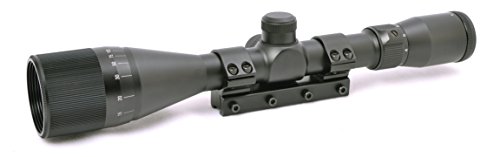
Hammers 3-9x40AO Air Rifle Scope with Mount
$89.90A ring around the objective bell that removes parallax at a lower price point, at the cost of reaching forward past the scope tube to turn it.
Check before buying: A springer recoils forward as well as backward. A scope not rated for spring piston use can fail on an air rifle even though it would last a lifetime on a centrefire.
Best for: a spring piston air rifle, where an ordinary scope will not survive
Check price on AmazonSide focus and adjustable objective solve the exact same problem: removing parallax error by moving an internal lens group until the target image lands precisely on the same plane as the reticle. Neither one is optically superior to the other. A correctly adjusted side focus turret and a correctly adjusted AO ring produce an identical result, a target with zero parallax error at the range you dialled.
What actually differs is entirely about reach. Side focus puts a dial on the side of the turret housing, within reach of the hand already on the rifle. An adjustable objective puts a ring around the front bell, which usually means removing your firing hand or your cheek from the stock to turn it.
These conclusions are researched from published mechanism placement and standard riflescope design, not from timing an adjustment on these two specific scopes.
What parallax error actually is, in one sentence
Parallax error happens when the target image is not focused onto the exact same optical plane as the reticle, so moving your eye off the centre axis of the scope makes the reticle appear to shift against the target even though neither one has actually moved. Both side focus and adjustable objective fix this by moving an internal lens until the target image lands on the reticle's plane at whatever distance you have dialled.
Why side focus wins on reach alone
A side focus turret sits in the same cluster as the elevation and windage turrets, typically on the left side of the saddle, directly under the hand that would otherwise be resting near the bolt or gripping the rifle. Ranging a target and dialling out its parallax becomes one continuous motion without moving your eye off the reticle or your cheek off the stock.
An adjustable objective ring sits at the front of the scope, past the objective bell, which on most rifles is out of reach of either hand without physically leaning forward or removing your firing grip. That is a real interruption to a shooting position that has already been built and confirmed, and it is the entire case for paying more for side focus.
Where an AO earns its lower price
Side focus and AO remove parallax identically, and the real difference is that side focus is reachable without breaking position while AO usually is not.
Shooter convention
| Feature | Side focus | Adjustable objective (AO) |
|---|---|---|
| Location | Turret saddle, beside elevation and windage | Ring around the objective bell, at the front of the scope |
| Reach while shooting | Reachable without breaking position | Usually requires coming off the rifle to turn |
| Typical price impact | Adds cost over a fixed parallax model | Lower cost than side focus in the same product line |
| Common on | Long range and precision scopes | Rimfire, airgun and budget variable scopes |
AO remains extremely common on rimfire and air rifle scopes, where shots are typically fired from a supported, unhurried position and the reach penalty matters far less than it does on a rifle used from field positions.
Why AO is not a lesser feature, just a differently placed one
An adjustable objective scope like a rimfire or air rifle optic is usually shot from a bench, a rest, or a supported position where reaching forward to the objective bell costs a few seconds and nothing else. That is a completely reasonable tradeoff for a lower price, and it is exactly why AO remains the standard parallax control on rimfire and airgun scopes rather than a design manufacturers are trying to phase out.
Side focus earns its added cost specifically on rifles shot from field positions, prone, sitting, or off a tripod, where breaking position to reach the objective bell is a real cost every single time the range changes.
Sources
- Leupold published specifications
- Hammers published specifications
- Parallax adjustment mechanism placement, standard published riflescope design
Frequently asked questions
Is side focus better than adjustable objective?
Optically they are identical, both remove parallax by moving an internal lens until the target image lands on the reticle plane. Side focus is the better choice when you need to adjust it without breaking your shooting position, since the dial sits within reach of the hand already on the rifle. Adjustable objective is a perfectly capable, lower cost alternative for bench or rest shooting.
What is adjustable objective, or AO, on a riflescope?
A ring around the objective bell at the front of the scope that removes parallax error by moving an internal lens, the same job side focus does from the turret saddle. It usually costs less than side focus and is common on rimfire and air rifle scopes, where shots are typically fired from a supported position that makes reaching the front ring less of a penalty.
Why is side focus more expensive than AO?
Side focus requires routing the parallax adjustment mechanism back to the turret saddle rather than leaving it at the objective bell where the lens actually sits, which adds mechanical complexity. That added cost buys a real, practical benefit: adjusting parallax without lifting your head, moving your firing hand, or breaking a shooting position you have already confirmed.
Do I need side focus for hunting?
It depends on how you hunt. A hunter who ranges and shoots from field positions, prone, off sticks, or from a tripod, benefits from side focus because reaching an AO ring means breaking that position. A hunter shooting mostly from a fixed blind or a bench loses little by using a lower cost AO or fixed parallax scope instead.
Does AO remove parallax as effectively as side focus?
Yes. Both mechanisms move the same type of internal lens to the same effect, and a correctly adjusted AO ring produces zero parallax error exactly like a correctly adjusted side focus turret. The difference between them is entirely about where the control sits and how easily you can reach it while shooting, not about how well either one corrects the image.
Can I convert an AO scope to side focus?
No. The parallax mechanism's location is built into the scope at manufacture and is not a swappable or upgradeable part. If reach has become a real problem with an AO scope, the practical answer is buying a scope built with side focus rather than modifying the one you have.
Researched, not professional advice. This page is compiled from published manufacturer specifications, published optical and ballistic formulas, and owner-review consensus, not hands-on testing. Figures described as a rule of thumb are shooter convention rather than sourced numbers, and they are labelled that way wherever they appear. Ballistic figures come from a point mass model using the ballistic coefficient the maker publishes, so treat them as a starting point and confirm them on paper at a measured distance. Confirm your firearm is unloaded with the action open before you mount, level, torque or bore sight anything. Verify a zero only on a supervised range or a safe, legal backstop, know what lies beyond your target, and follow the law where you hunt and shoot, including rules on land access and permitted cartridges.