Turret click values
MRAD or MOA Turrets: Which Is Finer?
Quick answer
In their most common factory form, 0.25 MOA moves the point of impact 0.262 inches at 100 yards, marginally finer than a 0.1 mil click at 0.36 inches. Mils win on mental arithmetic, since the constant is a round 3.6, and mils dominate competition. Buy based on your ecosystem, not a search for the finer click alone.
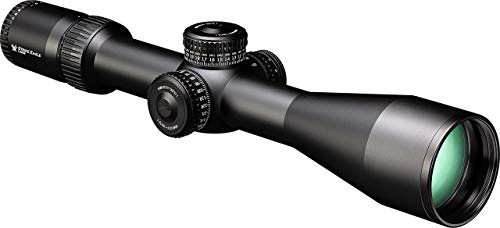
Vortex Strike Eagle 5-25x56 First Focal Plane Riflescope, EBR-7C MOA
$799.00 Full specificationsAn EBR-7C MOA reticle with quarter MOA turret clicks, the most common combination on hunting and general purpose long range scopes in the catalog.
Best for: practical and PRS style competition
Check price on Amazon
Riton Optics 3 Conquer 6-24x50 MRAD FFP Precision Riflescope
$499.00An MRAD reticle with tenth mil turret clicks, the standard adjustment on scopes built for competition and military-pattern shooting.
Best for: a mil-based precision scope with strong after-sales support
Check price on AmazonTurret fineness is one of the few places MOA and mil produce a genuinely different practical number, rather than just two ways of describing the same thing. The most common factory click values are a quarter MOA and a tenth of a mil, and they are not identical increments.
The gap is small enough that it rarely decides a purchase by itself, and the ecosystem around each unit, meaning your ballistic app, your drop chart, and who you shoot with, usually matters more than the half a hundredth of an inch of difference at the bench.
These figures are exact arithmetic from the two click values as published by scope manufacturers, not a claim about either turret's mechanical reliability.
What does one click actually move at 100 yards?
The working
0.25 MOA = 0.25 x 1.047 = 0.262 inches at 100 yards. 0.1 mil = 0.1 x 3.6 = 0.36 inches at 100 yards.
Both are exact from the two unit definitions. In their most common factory increments, a quarter MOA click is the finer of the two.
Scopes are not limited to one click value per unit. Here is how the common options compare at two distances.
A quarter MOA click moves the point of impact 0.262 inches at 100 yards, against 0.36 inches for a tenth mil click, making quarter MOA the finer of the two common factory values.
Sourced figure
| Click value | Moves at 100 yd | Moves at 500 yd |
|---|---|---|
| 1/4 MOA | 0.262 in | 1.31 in |
| 1/8 MOA | 0.131 in | 0.65 in |
| 0.1 mil | 0.36 in | 1.80 in |
| 0.2 mil | 0.72 in | 3.60 in |
An eighth MOA click, available on some higher end MOA turrets, is finer than either common mil value. Mil turrets rarely offer anything below a tenth of a mil, since the round constant is the whole appeal.
Why mils dominate competition and the round-number advantage
The case for mil has nothing to do with fineness and everything to do with arithmetic under time pressure. A tenth of a mil is 0.36 inches at 100 yards, 0.72 at 200, 1.8 at 500, always a clean multiple of 3.6. Doubling, halving and scaling those numbers in your head during a stage or a cold-bore shot is simpler than working with 1.047 and its quarter and eighth fractions. That is the actual reason mil turrets are close to universal in competition and among most professional and military shooters, not a claim that mil turrets are mechanically finer.
Why MOA still makes sense for a lot of hunters
A quarter MOA click is already finer than most hunting shots require, and MOA remains the default reticle and turret unit on a large share of American hunting scopes, which means familiarity, parts availability and reference material all lean MOA for that buyer. If your existing drop chart, rangefinder display or shooting partners already work in MOA, switching to mil for a marginal round-number convenience is rarely worth the relearning.
Sources
- Vortex Optics published specifications
- Riton Optics published specifications
- MOA and mil click values, standard published optical formulas
Frequently asked questions
Is a mil or MOA click finer?
In their most common factory form, a quarter MOA click is marginally finer, moving the point of impact 0.262 inches at 100 yards against 0.36 inches for a tenth mil click. Some MOA turrets offer an eighth MOA option finer still. The difference is small enough that it rarely decides a purchase by itself.
Why do competition shooters use mil turrets instead of MOA?
Mostly for the round constant. A milliradian is exactly one thousandth of the range, so mental math during a stage uses clean multiples of 3.6 rather than 1.047. That practical convenience, not superior fineness or accuracy, is why mil turrets are close to universal in competition and among most professional shooters.
Should hunters use MOA or mil turrets?
Either works well within typical hunting distances, where a quarter MOA or tenth mil click is far finer than the shot actually requires. MOA remains the more familiar default on American hunting scopes, and matching your turret to your existing rangefinder, ballistic app or drop chart matters more than the unit itself.
What is the smallest turret click available?
An eighth MOA click, at 0.131 inches at 100 yards, is the finest common factory adjustment, found on some higher end MOA turrets. Mil turrets typically stop at a tenth of a mil, 0.36 inches at 100 yards, since finer mil clicks are uncommon and the round constant is the design's main appeal rather than raw fineness.
Does a bigger scope tube give a finer click?
No. Click value is a property of the internal erector mechanism and is printed on the turret regardless of tube diameter. A 30mm or 34mm tube gives more total elevation travel by leaving the erector more room to move, not a finer increment per click.
Can I mix a mil reticle with MOA turrets?
Some scopes are built that way, and it works, but every hold you read off the reticle then needs multiplying by 3.43775 before you can dial it. That conversion step under time pressure is where mistakes come from, so matching the reticle unit to the turret unit is worth more than either unit's individual merits.
Researched, not professional advice. This page is compiled from published manufacturer specifications, published optical and ballistic formulas, and owner-review consensus, not hands-on testing. Figures described as a rule of thumb are shooter convention rather than sourced numbers, and they are labelled that way wherever they appear. Ballistic figures come from a point mass model using the ballistic coefficient the maker publishes, so treat them as a starting point and confirm them on paper at a measured distance. Confirm your firearm is unloaded with the action open before you mount, level, torque or bore sight anything. Verify a zero only on a supervised range or a safe, legal backstop, know what lies beyond your target, and follow the law where you hunt and shoot, including rules on land access and permitted cartridges.