Home gunsmithing
Threading a Barrel for a Suppressor: DIY vs Gunsmith
Quick answer
Threading a barrel means cutting a muzzle thread, usually 1/2x28 or 5/8x24, exactly concentric with the bore. Most owners should pay a gunsmith. Doing it yourself only makes sense with a through-bore gunsmith lathe, a spider, an indicator and a rifle you can afford to practice around.
A threaded muzzle is a small job with a large penalty for a small mistake. The thread has to sit on the same axis as the bore, the shoulder behind it has to be square to that axis, and the whole thing has to be cut without scarring the crown or the rifling at the muzzle. Everything a hunter or precision shooter cares about afterwards, from a muzzle device that bolts on straight to a suppressor that never touches a bullet, depends on how well those three conditions were met.
This guide is for the person who mounts and zeroes optics, has started to look at the barrel end of the rifle, and wants to know honestly whether the job is a weekend project or a drop-off. It covers the thread sizes you will see, the concept of concentricity, what a gunsmith job actually looks like, and the home gunsmith path if you decide to do it yourself: the lathe tiers, the spider chuck back plate, and the bench and vise side of the work. It is researched from published specifications and owner reviews, not from hands-on testing, and it is not a substitute for the instructions of your suppressor maker or a qualified gunsmith.
On this page
- What threading a barrel actually involves
- Common muzzle thread sizes
- Why concentricity decides whether the job is good
- Why a through-bore lathe and a spider matter
- The thread protector is part of the job
- What a gunsmith job looks like
- When doing it yourself makes sense
- The home gunsmith lathe path
- The bench side: vises and holding the barrel
- A realistic order of purchases
What threading a barrel actually involves
Threading is a short sequence of machining operations on the muzzle end of a barrel. The barrel is supported so that its bore, not its outside surface, defines the axis. The muzzle is faced and the crown is cut or recut. A section of the outside diameter is turned down to the thread's major diameter, a relief groove is cut at the base so the thread has somewhere to end, and the thread itself is cut with a threading tool at the correct pitch. A square shoulder is left behind the thread so a muzzle device or suppressor mount seats flat against it.
None of those steps is exotic on its own. The difficulty is the order they are done in and the setup that holds the barrel. The thread is only as good as the alignment of the barrel in the lathe, and the alignment is only as good as the way the barrel is supported at both ends. That is why the conversation about threading is really a conversation about setup, indicators and a spider, and only secondarily about the cutting tool.
Common muzzle thread sizes
Two sizes cover most centerfire hunting and precision rifles. The pairing between thread and caliber is a convention that suppressor and muzzle device makers follow, not a law, and the right answer for your rifle is whatever your suppressor's mount actually specifies. Confirm the pitch and diameter against the instructions for the device you intend to use before a tool touches the barrel.
Half inch by 28 threads per inch is the small thread seen on rimfire and smaller centerfire barrels, and five eighths by 24 is the larger thread common on .30 class and similar rifle barrels; confirm against the device you will mount.
Shooter convention
| Thread | Usually found on | What to check |
|---|---|---|
| 1/2x28 (half inch, 28 threads per inch) | Rimfire rifles and smaller centerfire cartridges, and many 9mm carbines | Barrel muzzle diameter must be large enough to leave wall behind the thread; some 9mm devices use 1/2x36 instead |
| 5/8x24 (five eighths, 24 threads per inch) | Larger centerfire rifles in the .30 class and many 6.5 and 7mm hunting and precision barrels | Muzzle contour must be large enough to cut it; a thin sporter profile may need to be left alone or turned |
| Other pitches (metric and 1/2x36) | Imported rifles, some pistol calibers and specific brands | Do not assume; read the mount specification for your device |
Pairings are shooting convention. The thread your suppressor or muzzle device is cut for is the only one that matters.
Why concentricity decides whether the job is good
Concentricity means the thread's axis and the bore's axis are the same line. If the thread is cut off axis, the device screws on tilted. A muzzle brake or compensator then redirects gas unevenly, which affects how the rifle behaves, and a suppressor's baffles line up with a bore that is not on their axis. A bullet that passes close to a baffle edge, or touches it, is a safety problem and not just an accuracy one.
Two other conditions travel with concentricity. The shoulder at the base of the thread must be square to the bore axis, because that face is what the device seats against. And the muzzle must still have an intact crown after the work, since the crown is the last thing the bullet touches. A job that holds the thread to the bore, the shoulder square and the crown clean is a good job. A job that misses any of the three is not, even if the suppressor screws on.
The way machinists check this is with a dial test indicator, a gauge that reads very small movement. The barrel is set up in the lathe, the indicator is brought against a reference that represents the bore, and the barrel is adjusted until the indicator barely moves as the spindle turns. The tolerance your suppressor maker publishes is the target. Published tolerances vary between makers, so read yours rather than relying on a number from this page.
Why a through-bore lathe and a spider matter
A barrel is long, heavy and awkward. To turn the muzzle end, the barrel normally passes through the hollow spindle of the lathe, the headstock bore, with the muzzle sticking out the working end. The portion outside the lathe is supported by the chuck, and the end poking out the back of the headstock is supported by a spider, an adjustable fixture with set screws that centers the barrel in the spindle. With the barrel supported at both ends, it is the bore at the muzzle that gets indicated true, and the spider holds it there. A lathe whose spindle bore is too small for the barrel's breech-end diameter cannot be set up this way at all.
That is the real distinction between a small hobby lathe and a gunsmith lathe. The cutting capacity and the horsepower matter much less than a large spindle bore, a spindle nose that accepts a back plate for a spider, and a bed long enough to hold the barrel and carriage together. Check the spindle bore in the manufacturer's specification against the largest diameter of the barrel you plan to put through it, and then add margin for the chuck's reach.
Without a spider and a through-bore, a barrel can be held in a four-jaw chuck and a steady rest, with the muzzle indicated through a bore plug. Experienced machinists do it, but it is a harder setup with less margin, and it is the wrong way for a first project.
The thread protector is part of the job
A threaded muzzle is a delicate surface once the work is done. Cutting the thread leaves bare, sharp-edged threads and a shoulder that should never be dinged. A thread protector is a simple cap that screws on whenever no device is mounted. It shields the threads, keeps dirt out of the muzzle and, depending on the style, can be a flush cap that looks like part of the barrel. If a gunsmith quotes the job, ask whether the protector is included. If you do the work yourself, buy it with the thread, because a rifle left with an unprotected thread will pick up nicks the first time it goes into a case.
What a gunsmith job looks like
For most owners the right answer is a gunsmith, and it is worth knowing what the transaction usually looks like so you can judge a quote. Shops generally want the barreled action or the whole rifle, sometimes only the barrel if it is off the rifle, along with the thread specification of your suppressor or muzzle device. The shop sets up, threads, cuts the shoulder, checks concentricity, and usually returns the rifle with a thread protector fitted.
Cost band, in words. A standard muzzle threading job is typically a modest flat fee, well under what most owners spend on the suppressor or muzzle brake it is for, and it rises when the barrel needs extra work such as a recrown, a profile turn-down, a custom thread pitch or fitting a specific mount. Quotes vary by region and shop, so ask for a number in writing and ask what is included.
Turnaround, in words. Turnaround ranges from days at a shop with a light queue to several weeks at a busy one, and it can stretch when the shop is waiting on a part. Ask for the current wait before you drop the rifle off, and plan around it if you hunt on a fixed date.
Three questions are worth asking any shop. What concentricity tolerance do they work to, and do they indicate off the bore? Do they cut a relief groove and a square shoulder? And what do they do about the crown? A shop that answers all three without hesitation is a shop to use.
When doing it yourself makes sense
DIY is reasonable in a narrower set of circumstances than the forums suggest. The honest test is whether the project is a repeating activity or a one-off, and whether you already own or are ready to learn the machine.
A single barrel threaded once is almost always cheaper and safer through a gunsmith, while several barrels, existing machining skill and a plan to chamber or fit barrels make a home lathe worthwhile.
Shooter convention
| Your situation | Better route | Why |
|---|---|---|
| One rifle, one suppressor, no machining background | Gunsmith | The lathe, spider and tooling cost far more than the fee, and the learning curve is on your own barrel |
| Several rifles to thread over time | Consider a home lathe | The equipment cost is spread across jobs, and your own turnaround is immediate |
| You already machine and own a small lathe | Check the spindle bore first | A lathe without a through-bore large enough for a barrel is the wrong machine for this job |
| You want to fit barrels, true actions or chamber | Home gunsmith lathe path | Threading is the easy entry point to a set of related jobs that also need a lathe |
| A rifle you cannot afford to damage | Gunsmith | Practice on a scrap barrel first, and do not practice on the one you hunt with |
The cost comparison is in words on purpose. Prices change weekly and vary by region.
The home gunsmith lathe path
If you decide to do it yourself, the path below is the order a home shop is usually built in. Grizzly Industrial is the usual starting point for a hobbyist gunsmith lathe, and each Grizzly item is paired here with an Amazon alternative or accessory so you can see both routes. The Amazon item is not always the same machine, and the card says which is which. We have not used these machines. This is research from published specifications and owner reviews.
Entry lathe: the gunsmith lathe
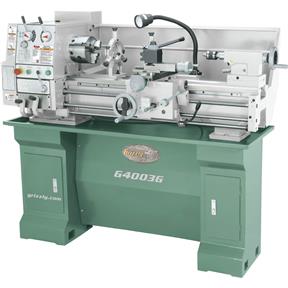

- Grizzly:
- 12 x 36 Gunsmithing Metal Lathe with Stand (G4003G)
- Amazon benchtop alternative:
- VEVOR 8.3 x 29.5 inch Benchtop Metal Lathe
The Grizzly G4003G is a 12 x 36 lathe with a stand, built as a gunsmithing machine and owner-rated 4.8 on grizzly.com across 29 reviews. The Amazon pick is a smaller benchtop lathe, offered honestly as the alternative for a shop that has no room or budget for a floor machine.
Do I need this? Only if you plan to thread, fit or chamber more than one barrel. Before buying any lathe, read its spindle bore on the specification sheet and compare it to the breech end of the barrel. The benchtop machine's bore was not stated in the Amazon listing we read.
Pick Grizzly when the work is barrels and you want a lathe built for that job. Pick Amazon when you want a smaller machine for general turning and will send barrels out.
Step up: the gearhead gunsmith lathe
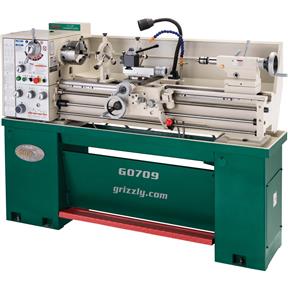

- Grizzly:
- 14 x 40 Gunsmith Gearhead Metal Lathe (G0709)
- Amazon lathe tooling:
- Accusize 1/2 in Shank Indexable Carbide Turning Tool Set
The Grizzly G0709 is a 14 x 40 gearhead gunsmith lathe, owner-rated 4.7 across 15 reviews. A lathe does nothing without tools, and the Amazon pick is a set of indexable carbide holders that includes a threading holder.
Do I need this? When the 12 x 36 is limiting you, or you plan regular barrel work. Check that the tool shank size on any holder set matches your lathe's tool post before you order.
Pick Grizzly when you want the larger machine. Pick Amazon when you already have a lathe and need the cutting tools.
Spider chuck back plate
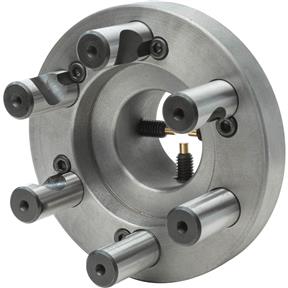

- Grizzly:
- Gunsmith D1-5 Back Plate without Guard (T26623)
- Amazon indicator:
- Neoteck Dial Test Indicator with Magnetic Base
The Grizzly T26623 is a gunsmith D1-5 back plate, owner-rated 4.5 across 15 reviews, which is the mounting plate a spider chuck bolts to. The Amazon pick is the test indicator and magnetic base that tells you whether the barrel really is true.
Do I need this? Needed for the through-bore setup. Check that the plate's D1-5 mount matches your lathe's spindle nose on the specification sheet before ordering.
Pick Grizzly when your lathe takes a D1-5 mount. Pick Amazon when you need an indicator, which every setup does.
Chambering truing fixture
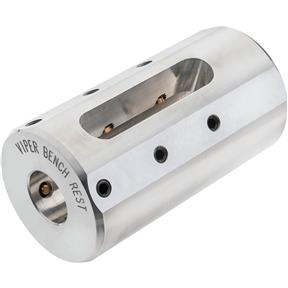

- Grizzly:
- Viper Chambering Truing Fixture (T10892)
- Amazon reamer, 308 Winchester only:
- Z.P.V. 308 Winchester Finish Chamber Reamer with Live Pilot
The Grizzly T10892 Viper chambering truing fixture exists for a different job than threading: chambering. Listed here so the full path is visible. The Amazon pick is one cartridge-specific finish reamer, which is why reamers are the last thing to buy.
Do I need this? Not for a threading project. Skip it until you are fitting barrels. Reamers are cartridge-specific, and this one only suits 308 Winchester.
Pick Grizzly when you are moving into chambering. Pick Amazon when you need that cartridge specifically.
The bench side: vises and holding the barrel
The lathe is half the project. The other half is the bench work around it: holding the barrel to remove it from the action, holding the action to mount optics, and holding small parts while you fit them. Two Grizzly vises cover the metal-vise end of that, and each pairs with an Amazon item that fills the gap the vise leaves. The same bench is where you will use the Fix It Sticks All-In-One Torque Driver Kit, 15 to 65 inch-lbs, with T-Way Wrench for ring and base screws and the Wheeler Engineering Level-Level-Level Mounting Tool with Magnetic Base to square a reticle, so a good vise pays back on optics mounting as well as barrel work.
Swivel-base bench vise
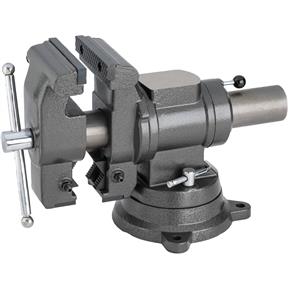

- Grizzly:
- 5 in Industrial 360-degree Swivel Base Drop-Forged Workbench Vise (T33818)
- Amazon counterpart:
- PONY 5-Inch Heavy-Duty Bench Vise with Swivel Base and Anvil
The Grizzly T33818 is a 5 inch industrial drop-forged vise with a 360-degree swivel base. The Amazon pick is the same size class in cast iron, with an anvil.
Do I need this? Yes for any metal work on the bench. A barrel should not go in bare steel jaws, so pair either vise with protective inserts.
Pick Grizzly when you want a forged vise. Pick Amazon when you want a general bench vise in the same size.
Multi-jaw rotating vise and barrel vise
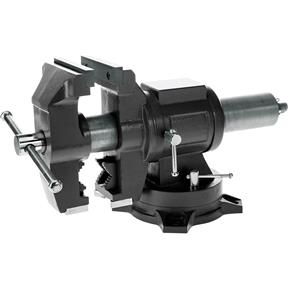

- Grizzly:
- 5 in Multi-Jaw Rotating Bench Vise (T27893)
- Amazon barrel vise:
- Mechforce Professional Barrel Vise
The Grizzly T27893 is a 5 inch multi-jaw rotating bench vise. The Amazon pick is a leather-lined barrel vise made for barrel diameters from 0.67 to 1.375 inches, which is the insert-style clamp a barrel needs.
Do I need this? Yes if you will pull a barrel. The Amazon barrel vise is the piece that actually grips the barrel without marring it.
Pick Grizzly when you want rotating jaws for odd shapes. Pick Amazon when you need to hold a barrel.
A realistic order of purchases
The mistake most people make is buying the lathe first. The order that wastes the least money is bench and vises first, because they pay back on every optics job you do. Tooling and an indicator second. The lathe and back plate only after you have decided the work is regular enough to justify them. A full walk through that order, with a do-I-need-this note for every item, is on the Grizzly gunsmithing tools buying order, and the bench itself is covered in the home gunsmithing bench setup.
How we chose
We did not test these optics in person and we never claim to. Picks are researched from manufacturer specification sheets, published optical and ballistic formulas, and the recurring themes in verified owner reviews. Every pick is matched to a real objective diameter, a real tube size, a real ring height or a real exit pupil rather than to a price bracket, and it is placed in the tier where its capability actually belongs. Where a figure is shooter convention rather than a sourced number we label it, and where a manufacturer does not publish a figure we leave it out instead of estimating it.
Sources
- Grizzly Industrial product listings for the G4003G, G0709, T26623, T10892, T33818 and T27893, including owner ratings, as published on grizzly.com
- Amazon listings for the vises, indicator, tooling and reamer shown, read through the Amazon Creators API
- Muzzle thread sizes are shooting convention; your suppressor or muzzle device maker's specification governs
Frequently asked questions
What thread size does my barrel need?
Whatever your suppressor or muzzle device is cut for. In convention, 1/2x28 is common on rimfire and smaller centerfire barrels, and 5/8x24 on larger centerfire rifles. Read the specification for the device you intend to mount before anyone cuts a thread.
Why does concentricity matter so much?
Because a thread cut off the bore axis makes the device sit tilted. For a suppressor, that can put a baffle close to the bullet's path, which is both a safety problem and an accuracy problem. The thread must be on the bore axis, the shoulder square to it, and the crown intact.
How much does a gunsmith charge to thread a barrel?
Typically a modest flat fee, usually well below the cost of the device itself, rising if the barrel also needs a recrown, a profile turn-down or a custom thread. Prices vary by shop and region, so ask for a written quote that says what is included.
Can I thread a barrel on a small benchtop lathe?
Only if the lathe's spindle bore is large enough to pass the barrel's breech end and it can mount a spider. Many small benchtop lathes cannot. Read the spindle bore on the specification sheet and compare it to your barrel before buying anything.
Do I need a spider chuck?
For the through-bore setup, yes. The spider centers the barrel at the back of the headstock so the bore, not the outside of the barrel, defines the axis. Holding a barrel without one is harder and leaves less margin for error, so it is not a good first setup.
Is threading a barrel legal?
Threading a barrel is legal in most places, and owning a suppressor is legal in most states, but buying or making one requires federal approval and some states prohibit them. Check your state and federal law before you start. This page is not legal advice.
As a Grizzly Industrial affiliate, we earn from qualifying purchases. See the affiliate disclosure.
Researched, not professional advice. This page is compiled from published manufacturer specifications, published optical and ballistic formulas, and owner-review consensus, not hands-on testing. Figures described as a rule of thumb are shooter convention rather than sourced numbers, and they are labelled that way wherever they appear. Ballistic figures come from a point mass model using the ballistic coefficient the maker publishes, so treat them as a starting point and confirm them on paper at a measured distance. Confirm your firearm is unloaded with the action open before you mount, level, torque or bore sight anything. Verify a zero only on a supervised range or a safe, legal backstop, know what lies beyond your target, and follow the law where you hunt and shoot, including rules on land access and permitted cartridges.